NFPA 25C Chapter 8: Complete Fire Pump Inspection Testing and Maintenance Guide
Quick Answer: NFPA 25C Chapter 8 sets the inspection, testing, and maintenance expectations for fire pumps to keep them reliable when demand occurs. It focuses on documented checks, functional testing, condition-based maintenance, and strict readiness controls for commercial and industrial systems.
What Chapter 8 covers and why it matters for commercial readiness
NFPA 25C Chapter 8 fire pump inspection testing maintenance requirements protect life safety and property by ensuring pump systems deliver the required flow and pressure within specified times. In practice, facilities face a recurring compliance challenge: pumps that look “fine” during visual checks can still fail under load, suffer from deteriorated starters or controls, or lose performance due to cavitation risk and worn internal components.
For commercial, industrial, and retail buildings, Chapter 8 expectations usually become a governance tool. It helps facility teams standardize periodic testing intervals, document results, manage deficiencies, and reduce nuisance disruptions. Kord Fire Protection supports this operational reality by aligning fire pump maintenance planning with water based system performance and the facility’s documented compliance program.
Facilities that want a broader compliance partner can also explore Kord Fire Protection’s full fire protection services, which naturally fits alongside fire pump readiness planning for commercial properties.
How inspections in Chapter 8 confirm readiness before testing
Chapter 8 inspection activities typically focus on observable conditions and functional setup that influence later testing outcomes. The goal is to detect degrading conditions early, before functional testing exposes them as failures or unsafe conditions.
Typical inspection checkpoints facility teams should expect
Controller and power condition: Visual inspection of the pump controller components, alarm and status indications, and wiring integrity. Many readiness failures originate in the control system, not the pump itself.
Automatic start inputs: Verification that the pump receives the correct start signals from the fire system. Common causes include mislabeled devices, compromised initiating circuits, and loose terminations.
Fuel and engine support (where applicable): For diesel or other alternate power sources, inspection focuses on availability, correct fluid levels, and storage integrity.
Valve and line security: Confirming valves in the required positions, accessible hand wheels, and no tampering that could cause loss of suction pressure or blocked discharge flow.
Exhaust, ventilation, and housekeeping: Engine environment conditions that affect operation and safe starting, particularly in pump rooms.
Even when inspection passes, Chapter 8 expects a testing strategy to verify actual performance. Inspections reduce risk, but performance tests confirm hydraulic and mechanical capability.
Testing steps that validate performance under demand
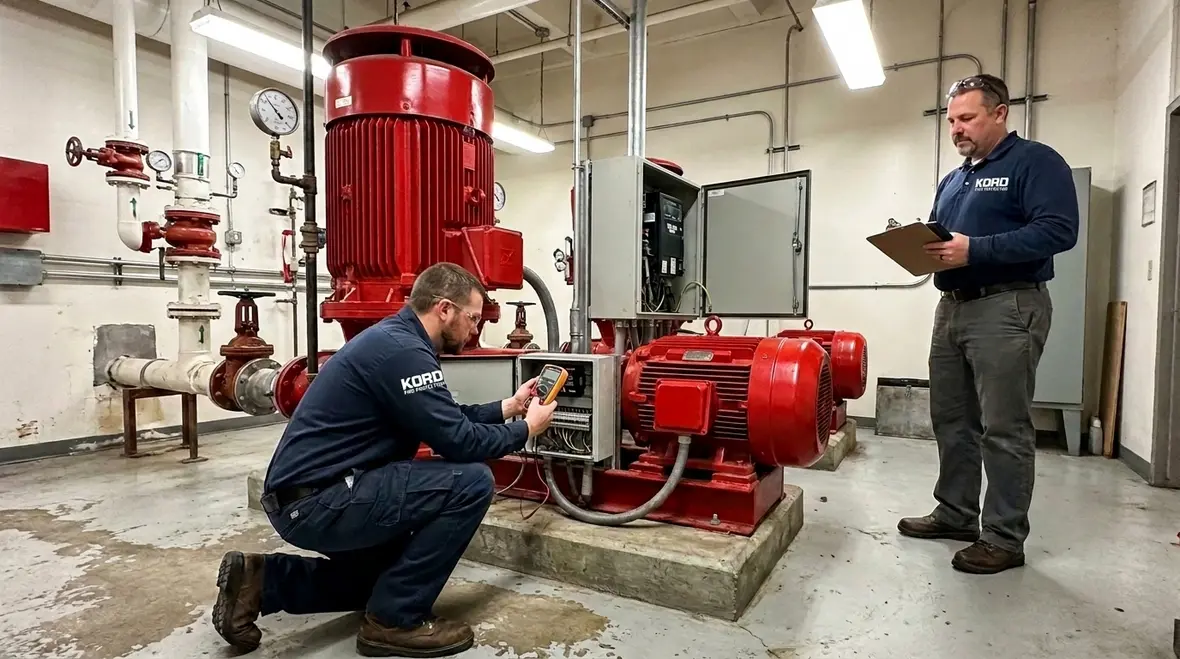
Functional testing in NFPA 25C Chapter 8 fire pump inspection testing maintenance is where reliability is proven. Operational failures often show up during supervised demand simulations, especially when suction conditions, control logic, and pump operating curves interact.
Hydraulic and flow performance testing
Testing commonly includes ensuring the pump can meet required flow and pressure parameters. Technicians evaluate pump operation under controlled conditions and verify that discharge pressure stabilizes as expected. This process also helps identify cavitation conditions and abnormal flow restrictions that can compromise the pump during real fires.
Operational tip for commercial facilities: testing must preserve system safety and prevent unintended water hammer or pressure transients that could affect sprinkler zones. A coordinated approach protects both compliance goals and tenant operations.
Starter, transfer, and sequence validation
For electric pumps and controllers, Chapter 8 testing verifies the startup sequence and motor starter performance, including correct start initiation and proper timing. For engine driven pumps, it validates the engine start sequence, run stability, and transfer logic from normal to emergency conditions.
Failure points frequently include:
Start failure from degraded controls: Relay coil wear, terminal oxidation, or deteriorated control components can prevent the pump from starting at demand.
Incorrect overload behavior: Motor overload settings or starter contact wear can cause nuisance trips or incomplete acceleration.
Engine stability issues: Fuel system contamination, battery aging, or governor problems can cause unstable operation.
Documentation and deficiency management
Chapter 8 emphasizes traceability. Test results need to be recorded and reviewed so that recurring issues can be corrected systematically. For maintenance teams, the real compliance win comes from closing the loop: identify the root cause, repair it, retest where required, and document outcomes in a way that aligns with facility inspection readiness expectations.
Maintenance in practice: preventing common pump and controller failures
Maintenance under NFPA 25C Chapter 8 fire pump inspection testing maintenance should address wear mechanisms and degradation trends rather than waiting for a failure. The pump room environment, water quality, and operating history determine how quickly components reach their end of service life.
Pump mechanical wear and hydraulic degradation
Impeller and wear ring deterioration: Wear can reduce efficiency and shift performance away from required duty points, especially after prolonged throttled operation.
Bearing wear: Bearings affect both vibration and reliability. Elevated vibration may indicate alignment issues, imbalance, or lubrication problems.
Seal and packing condition: Seal failure can introduce persistent leaks that worsen maintenance cost and can create unsafe conditions.
Suction conditions: Improper strainer condition, blocked suction piping, or air ingestion can cause cavitation and performance loss.
Controller, sensors, and alarm system upkeep
Fire pump controllers drive readiness. Maintenance should cover battery health (where applicable), terminal inspection, contact cleanliness, correct setpoints, and status indication accuracy. A frequent operational risk is “correct appearance” that hides intermittent control faults. Controlled testing schedules prevent this by validating performance and logic under supervised conditions.
System integration and water-based coordination
Fire pump readiness does not exist in isolation. Facility teams should treat Chapter 8 as one pillar of a broader water based system program. If the sprinkler system installation and maintenance approach is not aligned, pump performance can be harder to sustain during demand.
For more context on how water based systems connect to ongoing compliance, see:
NFPA 13 overview and how automatic sprinkler system installation impacts ongoing system performance
NFPA 25 overview: complete water based fire protection systems maintenance breakdown
commercial fire pump maintenance warning signs facilities should not ignore
Planning a compliant test and maintenance schedule for real facilities
Commercial sites often face scheduling constraints: tenant operations, critical business windows, and access to pump rooms. Compliance success depends on building a predictable program that minimizes downtime, ensures safe access, and supports documentation requirements.
Common compliance challenges in commercial and industrial environments
Contractor continuity and documentation gaps: Facilities can lose historical data when service transitions occur. Maintaining a living record supports audit readiness.
Water quality and suction variability: Seasonal changes can influence suction and performance. Without trending, repairs may be reactive.
Controller setpoint drift: Human error during unrelated maintenance can alter control behavior. Testing catches the deviation, but prevention is better.
Access and safety planning: Testing requires safe lockout and operational safeguards, especially in multi tenant and high traffic buildings.
How Kord Fire Protection supports ongoing NFPA 25C Chapter 8 programs
Kord Fire Protection positions fire pump maintenance as a compliance and reliability service, not a checkbox exercise. The team plans testing to validate performance, coordinates maintenance to reduce repeat failures, and maintains documentation that supports facility managers during inspections and internal audits. This alignment becomes stronger when facilities also follow a structured approach to sprinkler system compliance.
For additional regional and administrative context related to water based systems, consider:
External technical reference on fire pump services and standards support can also be useful for planning and benchmarking: firepumps.org.
Frequently Asked Questions
Call to action
Facility teams that want dependable fire pump performance should schedule an NFPA 25C Chapter 8 fire pump inspection testing maintenance review now. Kord Fire Protection can help assess readiness, plan testing to validate performance, and execute maintenance that reduces repeat failures and strengthens documentation for inspections. Contact Kord Fire Protection to build or refresh a compliant fire pump maintenance program tailored to your building type and operational constraints.

Join Our Newsletter!
Get the latest fire safety tips delivered straight to your inbox From our Newsletter.