
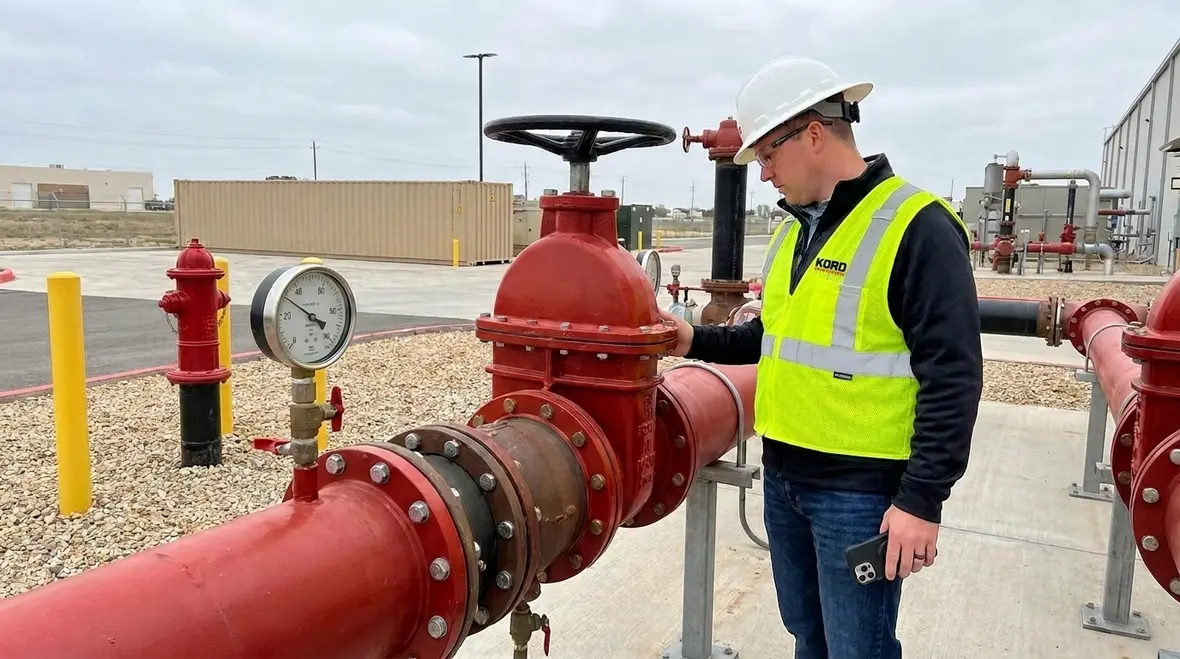
NFPA 25C Chapter 7: Private Fire Service Main Inspection and Testing Guide
Quick Answer
NFPA 25C Chapter 7 sets the inspection and testing expectations for private fire service mains, including water supplies and yard piping. The process verifies operability, identifies degradation, and confirms flow capacity, leakage control, and system readiness for emergency fire conditions.
A smart next step before you get too cozy with yard piping
If your private fire service main feeds a pump, it makes sense to pair this chapter with Kord Fire’s fire pump testing requirements guide. It fits naturally into the bigger water delivery picture and helps facility teams connect underground supply readiness with pump performance before test day gets interesting.
Why NFPA 25C Chapter 7 Matters for Commercial Facilities
Commercial and industrial properties depend on consistent water delivery from the private fire service main to the fire pump and connected fire protection systems. NFPA 25C Chapter 7 private fire service main inspection testing helps facilities maintain reliable hydrant and supply performance by focusing on physical condition, water tightness, valve alignment, and functional performance indicators. Many compliance gaps occur not in the sprinkler heads or alarms, but in below grade or yard piping that degrades quietly under traffic loads, soil movement, corrosion, and intermittent water hammer events.
Facilities typically face added complexity from operational uptime expectations, shared utility corridors, and seasonal temperature swings. Kord Fire Protection supports ongoing compliance with procedures that align inspection scope to the building’s installed configuration, available access points, and the facility’s risk profile.
What Chapter 7 Covers: Private Fire Service Main Basics
Chapter 7 centers on the private fire service main that delivers water from a fire water supply point toward the fire pump suction and other connected points such as hydrants or service connections, depending on the design. The inspection and testing approach validates that the system remains capable of supplying fire protection without unacceptable delay or loss of pressure caused by leakage, closed valves, obstruction, or abnormal hydraulic performance.
In practical terms, private fire service main inspection and testing typically focuses on:
- Water distribution integrity across yard piping, fittings, and joints.
- Operational readiness of valves and access components that control or isolate the main.
- Hydraulic performance indicators that confirm flow remains within expected ranges.
- Condition monitoring for corrosion, leakage, and physical damage.
Because these mains run underground or in protected yard areas, the “failure point” often occurs where inspections are least frequent. A proactive plan reduces the likelihood of discovering major issues only after operational testing or an emergency demand.
How the Inspection Process Works: Step by Step
1) Review the installed system record and last results
Before any field activity, a competent technician verifies as built information, recent test reports, valve tagging, and operational history. The goal is to ensure the Chapter 7 work follows the actual piping layout and functional sequence installed at the property. When documentation is incomplete or mismatched with current conditions, inspections lose accuracy and may miss isolation points or bypass arrangements.
2) Visual condition checks of above grade components
Even when the majority of the main runs underground, yard valves, hydrants, strainers, check devices, and accessible fittings typically show wear patterns first. Technicians look for:
- Corrosion and pitting at exposed joints and supports.
- Valve enclosure damage, missing seals, or evidence of unauthorized operation.
- Signs of water leakage, staining, soil saturation, or standing water near fittings.
- Hydrant condition issues such as broken operating components, loose caps, or degraded gaskets.
3) Valve position verification and alignment
Private fire service mains depend on correct valve status for emergency operation. Common compliance issues include valves inadvertently left closed after maintenance, caps removed without restoration, or tamper seal gaps that allow unauthorized changes. Technicians verify valve identification, confirming the valve that isolates the main and ensuring return to the correct supervised state.
4) Testing activities that confirm flow and system response
NFPA 25C Chapter 7 private fire service main inspection testing relies on functional checks that confirm the main delivers water with the required operational response. Testing typically addresses:
- Absence of excessive leakage during operational conditions.
- Stable flow response when water delivery is demanded.
- Hydraulic behavior consistent with the system design and prior accepted results.
Technicians document pressures, flow observations, and any abnormal readings. These data points become the baseline for future trend evaluation, especially in facilities where seasonal temperature changes influence pipe performance.
Equipment Mechanisms and Common Failure Points
Understanding how system components degrade helps the inspection find issues earlier. The private fire service main commonly suffers from below grade corrosion, joint separation, soil intrusion, and obstruction from debris or scale.
Corrosion and joint leakage in underground mains
Underground piping experiences electrochemical corrosion, coating breakdown, and mechanical movement from freeze thaw cycles or settlement. Joint leaks may start as minor seepage, then expand into measurable loss of water tightness. Inspection teams pay attention to recurring moisture patterns and nearby backfill conditions.
Valve and hydrant operational problems
Valves can seize from long inactive periods, allow internal leakage past packings, or fail to return to the required position. Hydrants may develop degraded gaskets, worn threads, or damaged operating mechanisms that prevent full opening or secure closure.
Obstruction, scale, and debris accumulation
Flow testing and pressure trending help reveal partial obstructions. Debris can accumulate after construction changes, maintenance activity, or water source interruptions. Scale and internal deposits can reduce effective pipe diameter, impacting flow capacity during fire conditions.
Water hammer effects and improper throttling
Rapid valve changes and noncompliant operating sequences can trigger water hammer events that stress piping and joints. Over time, this increases the risk of microfractures and joint movement. Technicians coordinate test sequences to avoid unnecessary shock conditions while still achieving the required functional confirmation.
Compliance Challenges: What Usually Breaks in the Field
Facilities often encounter practical obstacles when implementing Chapter 7 private fire service main inspection and testing requirements.
- Access limitations caused by landscaping, paving, or limited excavation clearance around yard valves and pit enclosures.
- Unclear valve labeling after tenant improvements or asset transfers, leading to incorrect isolation during testing.
- Inconsistent baselines due to changes in water supply conditions, seasonal effects, or incomplete documentation.
- Operational disruption risk when tests require hydrant operation or involve controlled flow changes that can affect facility water systems.
- Coordination gaps between fire pump schedules, sprinkler system testing, and private main testing windows.
Kord Fire Protection helps commercial owners address these challenges through scheduling discipline, documented test baselines, and maintenance actions that protect both life safety performance and operational continuity. Where water based systems maintenance is also required, the private main testing supports the broader water delivery chain for the entire fire protection system. For related guidance on water based system components, see:
- NFPA 25 overview and complete water based fire protection systems maintenance breakdown
- NFPA 13 overview: automatic fire sprinkler system installation
In regions with additional adoption or modification considerations, facilities also benefit from understanding how code requirements interact locally, including sprinkler related requirements. See:
For organizational training and fire protection industry resources, facility teams may also consult:
Inspection and Testing Best Practices That Improve Results
Establish and protect a reliable test baseline
Because private mains often sit outside daily operational awareness, the baseline test results carry long term value. Technicians should record pressure and flow data with enough detail to identify trends rather than one time pass or fail outcomes. If the system shows a gradual decline in flow or pressure response, early corrective action avoids emergency operational surprises.
Coordinate yard testing with system-wide water delivery readiness
Private main performance connects directly to fire pump performance and, ultimately, sprinkler system reliability. Kord Fire Protection commonly aligns private main inspection activities with broader water based system maintenance windows to reduce repeated access costs, minimize operational disruption, and ensure that the full water delivery path meets expectations.
Document valve positions, access points, and corrective actions clearly
Inspection reports should identify which valves were verified, the condition observed, the test readings taken, and the corrective actions performed. Clear documentation reduces repeat troubleshooting and supports audit readiness.
Use trend analysis to schedule proactive repairs
Leakage patterns, pressure reductions, and increasing variability typically signal degradation that can be corrected during planned maintenance. Facilities that react only after major symptoms often face greater downtime, excavation costs, and disruption to other water based fire protection components.
Frequently Asked Questions
Conclusion and Call to Action
NFPA 25C Chapter 7 private fire service main inspection testing protects the reliability of the water delivery chain that commercial properties depend on. Facility teams should treat private main inspections as a performance and trend program, not a checklist exercise. Kord Fire Protection can coordinate your inspection schedule, verify valve alignment, document functional results, and support timely corrective actions to maintain compliance and readiness across your water based fire protection network. Contact Kord Fire Protection to plan your next Chapter 7 program.

Join Our Newsletter!
Get the latest fire safety tips delivered straight to your inbox From our Newsletter.


