
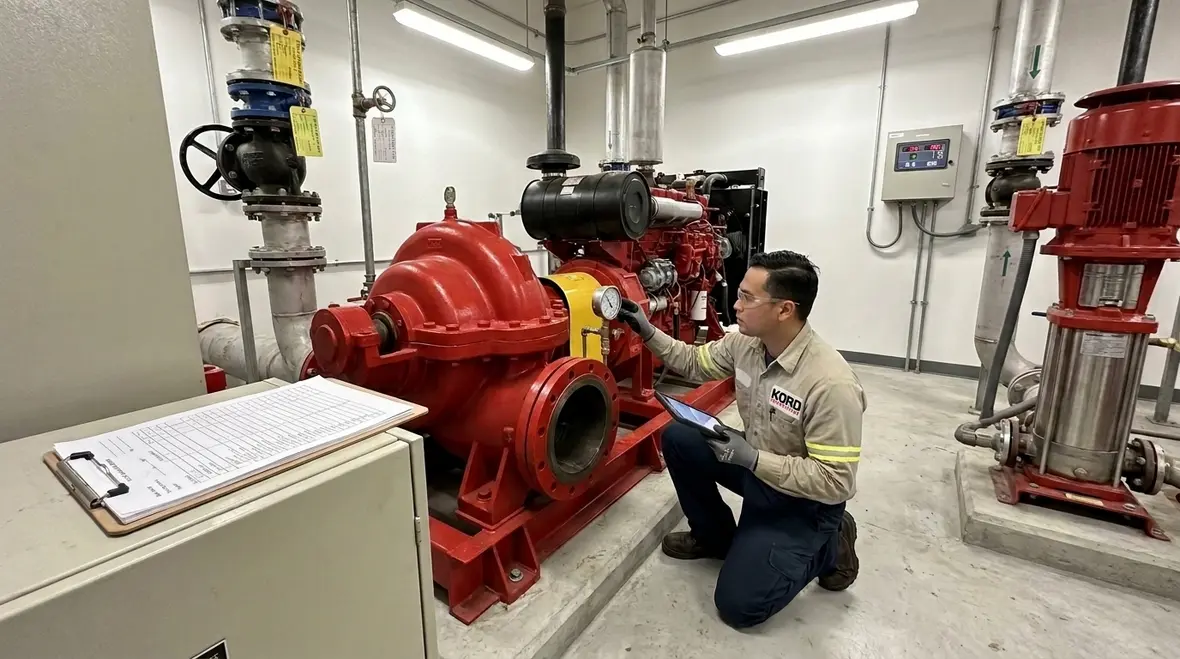
NFPA 25C Section 8.5: Fire Pump Maintenance Schedules and Best Practices
Quick Answer: NFPA 25C Section 8.5 defines how fire pump owners schedule, document, and perform maintenance to keep pumps reliable under demand. Best practices center on aligning interval-based tests with documented procedures, qualified personnel, and rapid correction of deficiencies.
What Section 8.5 requires and why schedules matter
NFPA 25C Section 8.5 governs fire pump maintenance schedules and the operational discipline needed to keep pumps, controllers, and related accessories dependable. In commercial, industrial, and retail environments, the risk is rarely a single failure. Instead, schedule gaps lead to gradual degradation in seals, impellers, bearings, controllers, and valves that only becomes obvious during a critical test or actual demand scenario.
In practice, NFPA 25C Section 8.5 fire pump maintenance schedules best practices start with translating the required maintenance intervals into facility level work plans, then verifying that each scheduled task includes the right acceptance criteria, test data capture, and corrective action workflow.
Near the top of the program, it helps to connect the schedule to actual service execution, not just the calendar. Kord Fire Protection’s full fire protection services page naturally supports that bigger picture by showing how fire pump testing, sprinkler work, alarms, and maintenance planning can stay on one coordinated compliance track.
How to build a compliant maintenance schedule (without missing the “real work”)
A compliant schedule does not only list dates. It connects each maintenance activity to the exact pump arrangement and the supporting systems that affect pump performance. That includes jockey pump compatibility, suction and discharge conditions, pressure sensing accuracy, power reliability, and controller functions.
1) Start with a pump-by-pump equipment inventory
Section 8.5 maintenance schedules fail in audits when the facility uses a generic list. Best practice is to build an inventory that includes:
- Pump type and configuration (electric, diesel, horizontal, vertical, etc.)
- Controller model and software version, where applicable
- Associated components (pressure maintenance devices, relief devices, strainers, check valves)
- Fuel system and exhaust components for diesel units
- Valve lineup, including any supervised or locked-open positions
2) Convert NFPA intervals into a calendar with operational buffers
Fire pump maintenance often requires controlled conditions, adjusting settings, verifying flow characteristics, and inspecting valves. Facilities that schedule only “inspection time” frequently underestimate the time needed for repairs, retesting, and documentation. A best practice schedule includes buffer windows for corrective actions so documentation remains current.
3) Lock in documentation standards as part of the schedule
Auditors and insurers typically look for traceability: what was done, when it was performed, who performed it, what readings were observed, and what deficiencies were corrected. A practical approach uses standardized forms and a repeatable reporting format tied to each asset ID in the inventory.
Inspection and maintenance best practices that prevent common failures
Fire pumps experience predictable wear patterns. Section 8.5 maintenance discipline helps facilities catch these conditions early. The following best practices focus on mechanisms that commonly degrade and cause performance issues during testing.
Control system reliability and start sequence integrity
Many failures originate in the controller, not the pump. Best practices include verifying alarm circuits, confirming correct start signals, checking transfer behavior, and ensuring timers and interlocks function as intended. For electric pump sets, power quality and terminations are common problem points. For diesel sets, battery health, charging performance, and sensor accuracy frequently affect reliability.
Valves, check devices, and suction side health
Suction and discharge valves influence both performance and test outcomes. Best practice maintenance includes inspection of valve position indicators, verifying travel where applicable, and ensuring strainers are clean and intact. Sticking check valves can cause recirculation losses or abnormal pressure readings. If suction conditions degrade, the pump can show reduced flow, cavitation risk, or unstable discharge pressure.
Hydraulic components and rotating equipment condition
Rotating components require attention to alignment, vibration, bearing condition, and seal performance. Even when a pump passes a start test, vibration and temperature trends can signal developing issues. A best practice maintenance plan includes measurement baselines and trending, not just pass or fail snapshots.
Diesel specific focus: fuel, cooling, and exhaust readiness
For diesel pump sets, fuel quality and water contamination control directly affects starting and long run performance. Best practice includes confirming correct fuel system conditions, monitoring coolant health, and inspecting exhaust related components per the maintenance scope. Facilities that only address starting problems typically miss the root causes that later prevent stable performance under demand.
Commercial compliance challenges and how facilities manage them
Commercial facilities often face staffing constraints, access limitations, and building schedule conflicts. These realities make it easy to fall into noncompliant patterns such as delayed corrective actions, incomplete deficiency documentation, or maintenance performed by mixed experience levels. A structured approach reduces friction while supporting compliance.
Align pump maintenance with broader water based system schedules
Fire pump performance ties directly into sprinkler system operation and water supply reliability. Many facility owners benefit from coordinating fire pump maintenance with water based fire protection system maintenance planning. For context, Kord Fire Protection provides guidance on water based fire protection system maintenance breakdowns and how installation and maintenance concepts connect across system components: NFPA 25 overview and complete water based fire protection systems maintenance breakdown.
For facilities also managing sprinkler systems, the installation baseline matters for how systems behave under test. Review NFPA 13 overview for automatic fire sprinkler system installation to understand the system context that affects pump discharge and water delivery.
Plan for retesting and deficiency closure cycles
Best practice operational workflow includes a clear closure cycle: identify deficiency, document impact, correct, retest, and update records. When deficiencies remain open, recurring failures often appear at the next interval because underlying issues such as valve binding, controller miscalibration, or suction restriction persist.
Use qualified specialists for pump specific work
Because fire pumps integrate mechanical, electrical, and sometimes fuel system components, consistency depends on experienced technicians. Partnering with providers that maintain repeatable testing procedures and documentation practices supports compliance and reduces downtime during corrective work.
When facility teams want an independent reference for industry context and reliability practices, Fire Pumps Association resources at firepumps.org can provide additional educational grounding for owners and operators.
Smart documentation and recordkeeping for NFPA 25C Section 8.5
Schedule compliance depends on records that reflect actual conditions and outcomes. Best practices include:
- Recording controller readings, test parameters, and observed pump behavior during scheduled maintenance
- Capturing valve lineup status for each test scenario, especially if valves are secured or supervised
- Documenting corrective actions with dates, work scope, and verification results
- Maintaining equipment identifiers so reports match installed assets
- Tracking recurring deficiencies to drive root cause solutions rather than repeated quick fixes
Facilities that treat recordkeeping as an afterthought often experience expensive rework when inspection teams question missing data or cannot reconcile test results with deficiency closures.
Frequently Asked Questions
Get your fire pump maintenance schedule audit ready
Facility owners and operators can reduce risk by aligning NFPA 25C Section 8.5 fire pump maintenance schedules best practices with a disciplined inventory, verified test procedures, and documented deficiency closure. Kord Fire Protection supports commercial compliance with ongoing testing, maintenance, and reporting workflows that match real operating conditions. Contact Kord Fire Protection to review your current program, identify schedule gaps, and build an audit ready maintenance cadence.
kordfire.com.au | kordfire.com | water based system maintenance context

Join Our Newsletter!
Get the latest fire safety tips delivered straight to your inbox From our Newsletter.


