High-Stack Warehouse Sprinkler System Design and Layout
Quick Answer: High-stack warehouses demand sprinkler systems that protect taller racking, tighter aisles, and challenging airflow. A strong warehouse sprinkler system design considers obstruction rules, storage height, commodity hazard, and water delivery performance. When layout is optimized early, compliance improves and downtime drops. And yes, it saves money, not just paperwork.
For facilities planning early coordination, Kord Fire Protection also provides fire sprinkler system service support that fits naturally into layout review, upgrades, and long-term system readiness. When supply performance becomes part of the conversation, their fire pump services are equally relevant for dependable water delivery in larger warehouse environments.
Why high-stack storage changes sprinkler planning
In a high-stack warehouse, the warehouse sprinkler system design cannot stay “good enough.” When pallet rows rise, heat and smoke behave differently, sprinkler coverage can become obstructed, and water must reach fire conditions where people and ceilings cannot. Early during layout, designers must study rack height, bay spacing, and ceiling clearances, then connect those facts to how sprinklers will flow and disperse.
That is exactly why Kord Fire Protection’s related article on warehouse sprinkler system design for high piled storage pairs so well with this topic. It reinforces the idea that tall storage is not just a taller version of a normal room. It is a different performance problem with different consequences when layout decisions are delayed.
For industrial, retail, and commercial facilities, this becomes even more important because different sites run different storage patterns. One warehouse may store cartons, another stores plastics, another stores mixed commodities. So the sprinkler plan must match the actual risk, not the risk that was assumed on day one. Warehouses are famous for changing inventory profiles faster than anyone updates the marked-up drawing set, which is a polite way of saying the fire protection strategy needs to be smarter than the average clipboard.
How to optimize rack and ceiling coordination
Start coordination before the overhead fills up
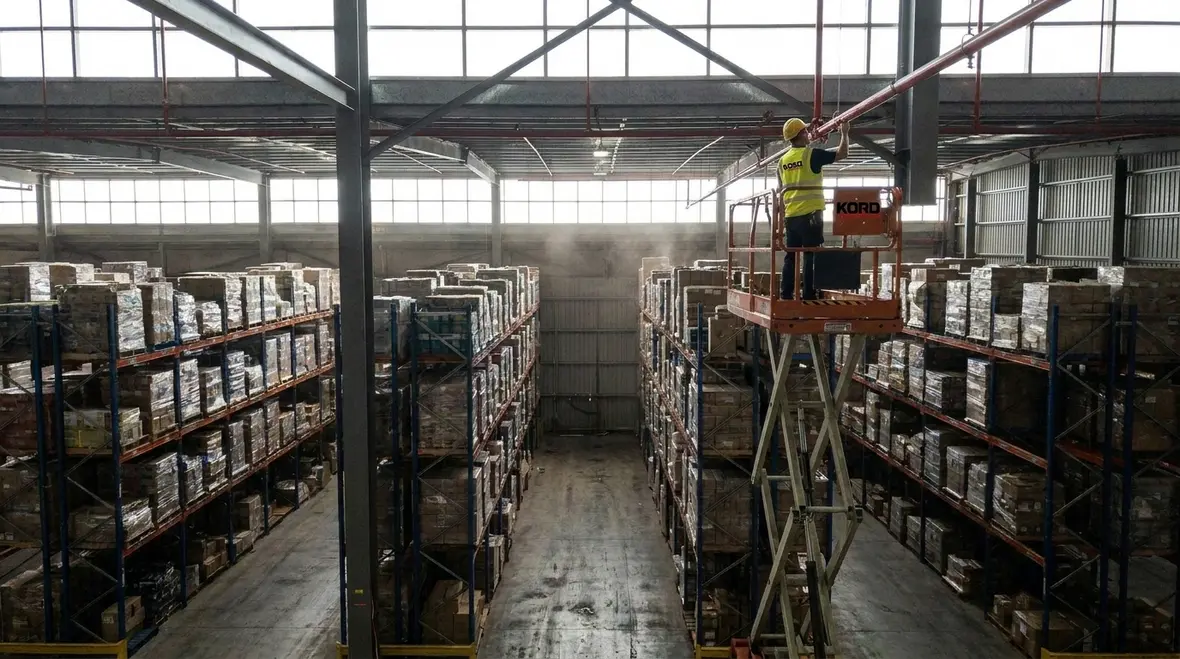
Once racks go high, the ceiling stops being “overhead” and starts acting like a stage ceiling. And the sprinklers need to perform on that stage. Therefore, teams should coordinate structural steel, beams, lighting, walkways, ductwork, and rack placement with the sprinkler layout.
First, designers map the protected area and identify obstructions that affect water distribution. Next, they decide how to handle ceilings that are not flat, such as soffits, beam clusters, or mezzanine-like features. Then they confirm the sprinkler placement rules for clearance and the way water sprays across rack faces. Kord Fire Protection’s article on sprinkler head clearance requirements in warehouses is useful here because it highlights how easily clearance issues can quietly damage performance long before anyone notices during inspection.
When this coordination happens early, the system avoids the common problem of “as-built surprises.” In other words, a plan drawn in an office cannot fight reality on site unless reality gets briefed first. That sounds obvious, yet warehouses still manage to create crowded overhead conditions where every trade arrives with one more cable tray, one more fixture, or one more idea that was “definitely on the latest plan.” It usually was not.

What designers check for water distribution and obstruction control
Coverage only works when water reaches the right places
A successful plan needs more than correct sprinkler type. It needs correct design density, correct discharge performance, and a layout that does not waste water on the wrong surfaces. To get there, designers study obstruction effects from rack cross-members, stored goods, and ceiling features.
They then evaluate discharge patterns and make spacing adjustments. If sprinklers sit too close to obstructions, they may deliver water where it does not help. If they sit too far, coverage gaps can appear when storage rises. Consequently, the layout should use a repeatable approach: verify rules, model the coverage intent, then confirm the field arrangement can match the drawing. That practical mindset aligns closely with Kord Fire Protection’s piece on designing a warehouse sprinkler system layout that works, which emphasizes that real-life warehouse performance matters more than pretty lines on a plan sheet.
Also, when warehouses use high airflow from fans, dock doors, or ventilation systems, the fire conditions can drift. Therefore, the system layout should consider how air movement can push smoke and heat toward or away from sprinkler operation. It is not guesswork, it is planning. And in a busy facility, airflow has a wonderful habit of pretending it is invisible right up until it starts changing the problem.
Storage height, commodity risk, and spacing decisions
Risk classification should match the actual warehouse, not the imaginary tidy version
High-stack protection hinges on how storage behaves under heat. Each facility uses its own mix of materials, packaging, and load configuration. Then those factors influence the sprinkler system design, including spacing, water supply requirements, and whether the system needs additional zones or control valves.
For example, light and easily ignited packaging can produce fast fire growth, while pallet and commodity arrangements can change how flames travel between tiers. Therefore, designers must review rack type, tier spacing, and whether commodities sit under beams, in open frames, or in enclosed rack structures. Kord Fire Protection also discusses broader compliance and planning concerns in its warehouse fire safety regulations guide, which supports the same core message: storage details drive protection decisions.
In practice, the goal is not to “add more sprinklers.” Instead, designers aim to target the protection concept. They select the right sprinkler approach, define the protected ceiling level intent, and then align the water delivery with that intent. When the warehouse sprinkler system design matches the storage plan, inspections feel smoother and operations stay calm. That is a much better outcome than discovering halfway through commissioning that the warehouse has evolved into a fire protection plot twist.
Supply, pumps, and zone strategy for dependable performance
A good layout still needs water that shows up on time
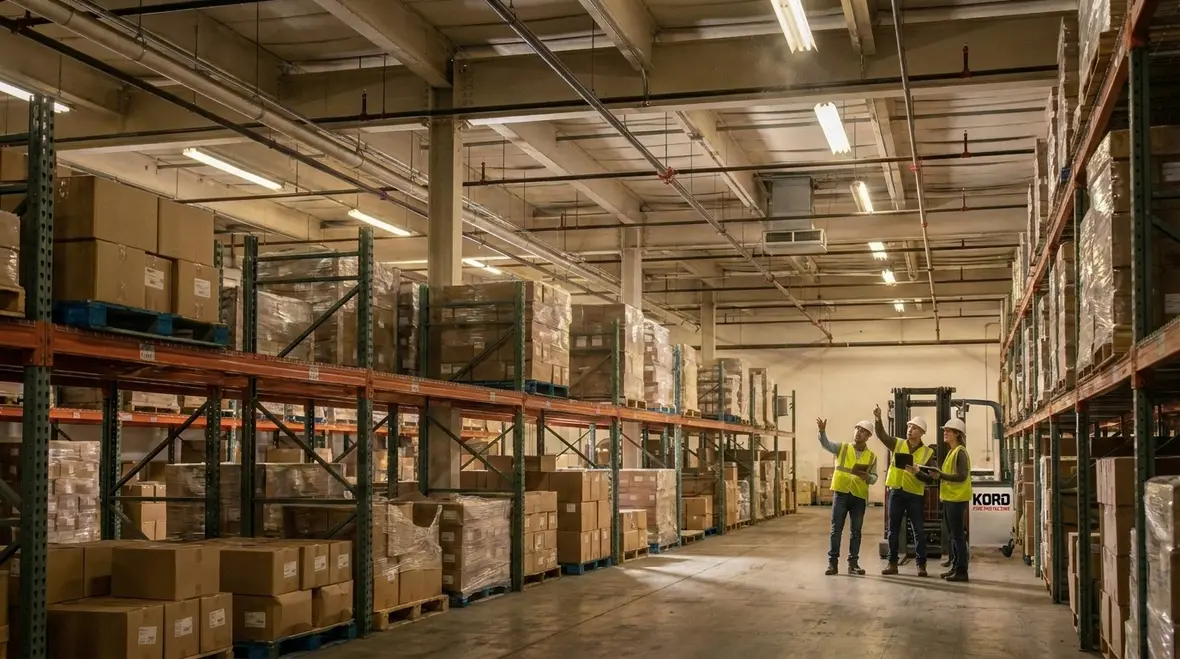
Even a perfect layout fails if the water supply cannot deliver on demand. So teams verify supply capacity, pump sizing, controller logic, and zoning approach. Then they confirm that the system supports the expected demand over the required duration.
For high-stack warehouses, zones matter because they control flow, isolation, and system response. Moreover, zoning helps limit the impact of a valve action during maintenance or a localized event. This is where field constraints often appear, such as pipe routes that collide with cable trays or where future rack expansions were planned but never documented. It is also where Kord Fire Protection’s fire pump power supply reliability content becomes useful context, because dependable pump operation is part of the same performance chain.
Designers therefore coordinate pipework routes with the same discipline used for sprinklers. They ensure the hydraulic calculations reflect real constraints, and they validate that the install team can build the plan without improvising. Improvisation is fun on TV, but on a sprinkler manifold it becomes expensive. In large warehouse environments, that expense tends to arrive with schedule delays, rework, and the special kind of silence that happens when everyone realizes the ceiling is already full.
Using Kord Fire Protection as a vital partner
Optimizing a complex site takes coordination across design intent, compliance needs, and real-world installation. That is where Kord Fire Protection can become a vital partner through its fire sprinkler system service. They help keep projects aligned from planning through delivery, and that alignment protects both safety outcomes and project timelines.
Because high-stack warehouses evolve, Kord Fire Protection can support practical decisions such as ensuring the layout intent survives drawings, approvals, procurement, and installation. They can also assist with workmanship considerations that affect coverage and operation, such as sprinkler placement accuracy, obstruction handling, and coordination with other trades. When water supply support is part of the scope, the dedicated fire pump page is also worth visiting because pump reliability is not some side quest in a high-demand warehouse system.
Ultimately, the partnership reduces friction. It helps avoid the situation where everyone argues about the drawing, while the warehouse continues operating like a busy ocean of forklifts. With the right support, the sprinkler system design stays reliable, inspectable, and built to perform.
Dual-column checklist for faster site-ready layout reviews
Warehouse layout inputs
- Rack height, tier count, and aisle widths
- Commodity type, packaging, and storage pattern
- Ceiling configuration, beams, and soffits
- Obstructions from lighting, ducts, and walkways
- Ventilation and airflow influence areas
Sprinkler and system deliverables
- Hydraulic demand targets and zoning plan
- Sprinkler spacing and placement intent
- Water supply and pump performance verification
- Control valves, monitoring, and labeling plan
- Installation coordination and inspection readiness
FAQ: High-stack warehouse sprinkler system planning
Final thoughts and call to action
High-stack warehouses demand more than a standard sprinkler plan. When the layout, obstructions, storage risk, and water delivery work together, facilities gain protection that inspectors can trust and operators can rely on. That is the real value of a site-ready approach: fewer surprises, better coordination, and a system that behaves the way the drawings promised it would.
If your site is building up, re-racking, or expanding, reach out to Kord Fire Protection and align your fire sprinkler project early. Visit fire sprinkler system service to start a practical, site-ready path, and explore the fire pump page when supply performance needs a closer look.

Join Our Newsletter!
Get the latest fire safety tips delivered straight to your inbox From our Newsletter.