
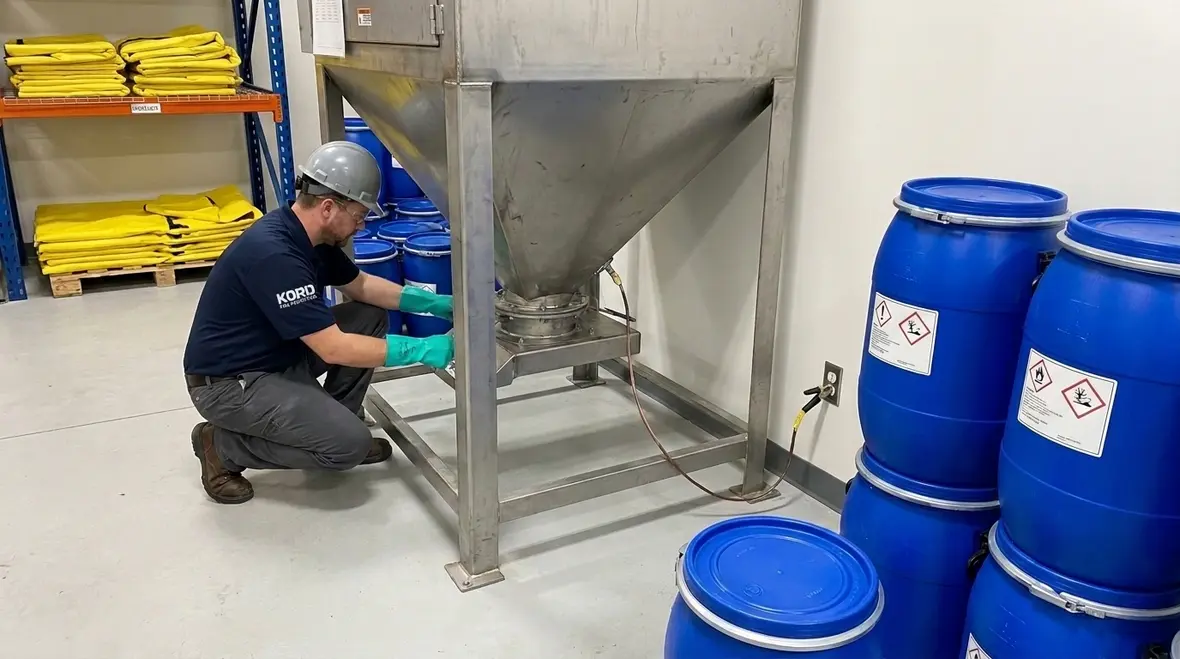
NFPA 33 Section 15.8: Powder Storage and Handling Rules
Quick Answer: NFPA 33 Section 15.8 sets enforceable controls for storing and handling combustible powders to prevent ignition, limit dust accumulation, and reduce fire spread. Facilities must align container, ventilation, housekeeping, and inspection practices with the hazards of the specific powder and process conditions.
Facilities that want broader planning around inspections, maintenance rhythm, and long term system readiness can also review manufacturing fire suppression planning with Kord Fire Protection for a practical look at how compliance support fits into real operations.
What NFPA 33 powder storage handling requirements actually control
NFPA 33 powder storage handling requirements focus on the ignition hazards created by combustible powders and the practical realities of commercial storage. Section 15.8 addresses how powders are kept, transferred, and protected so that ignition sources, conductive and static buildup, and dust releases do not escalate into a fire or explosion.
In day to day operations, compliance depends less on paper and more on recurring field verification. Kord Fire Protection supports facilities with targeted inspections, documentation, and maintenance planning aligned to how systems perform under real loading, cleaning cycles, and maintenance turnover.
How Section 15.8 defines the hazard mindset for powder systems
Powder storage and handling rules do not treat “powder” as a single uniform hazard. The controlling factors include powder characteristics, enclosure layout, process airflow patterns, transfer equipment, and the likelihood of dust release. For facilities, the compliance posture should assume three outcomes are always possible:
- Dust accumulation forms in areas not designed for safe housekeeping access.
- Static electricity or conductive bonding failures occur during loading and discharge.
- Airborne dust concentrations or localized hot spots can reach an ignition source.
Section 15.8 requires that handling methods and storage practices manage these outcomes through practical engineering and disciplined maintenance.
Storage controls: containment, segregation, and ignition source management
Container condition and compatibility
Powder storage must use containers and transfer equipment that maintain integrity throughout normal wear, cleaning, and vibration. Common failure points include degraded gaskets, damaged seals, and improperly latched closures that allow small leaks to become chronic dust sources.
Commercial facilities should implement inspection routines that verify:
- Seals, clamps, and closures remain functional and correctly seated.
- Containers do not show corrosion or mechanical damage that creates release points.
- Materials of construction and liners remain compatible with powder characteristics.
Segregation and access control
Section 15.8 expectations typically align with keeping combustible powder away from ignition sources and limiting unnecessary personnel access to storage areas. Practical controls include restricting ignition generating activities near storage zones and ensuring clear access pathways for emergency response and housekeeping tools.
Retail and light industrial sites often struggle with shared rooms and mixed use storage. The most effective compliance approach treats powder storage like a dedicated hazardous area, even when the building has limited real estate.
Static control and bonding expectations during storage transitions
Powders can charge during movement and discharging. Static control requires correct bonding and grounding strategies where storage transitions occur, including loading and unloading points. Failures often stem from added equipment later in the project lifecycle or replacement components installed without bonding continuity checks.
Facilities should treat bonding verification as maintenance, not a one time commissioning activity.
Handling and transfer: protecting against release, buildup, and ignition
Transfer system alignment with actual operating conditions
Handling practices must reduce the chance of dust release during conveying, scooping, pneumatic transfer, bag dumping, and manual movements. Operational drift is common. Examples include changes in powder grade, altered feed rates, or revised maintenance schedules that affect airflow and dust capture performance.
To close this gap, facilities should confirm transfer systems meet design intent under current conditions, including:
- Hose and coupling integrity during transfers.
- Correct routing of discharge points to limit dust fall out.
- Airflow balance where ventilation or dust collection interfaces exist.
Dust collection and containment effectiveness
Where dust collection or enclosure systems are used as part of safe handling, the critical question is not whether equipment exists, but whether it performs consistently. Reduced suction, clogged filters, and poorly maintained ductwork create the conditions for dust accumulation elsewhere in the room.
Common failure points include missing filter pressure drop monitoring, inadequate filter changeout intervals, and duct joints that loosen after maintenance. Inspections should validate performance indicators and verify that dust captured by the system is properly conveyed or collected without overflow.
Housekeeping standards that prevent chronic dust hazards
Housekeeping requirements are among the most overlooked parts of NFPA 33 compliance. Powder residue and dust layers can act as fuel even when the powder is not actively being handled. Facilities should emphasize cleaning methods that do not aerosolize dust.
Practical controls include:
- Cleaning frequencies matched to production cycles and seasonal changes.
- Access for safe cleaning around vents, frames, ducts, and transfer interfaces.
- Clear documentation of cleaning methods and responsibilities.
Kord Fire Protection helps commercial teams develop defensible inspection and maintenance practices so housekeeping does not become a reactive exercise.
Inspection, testing, and maintenance: what auditors and insurers look for
Compliance is a system. Section 15.8 expectations typically require that facilities maintain safe conditions through documented inspection and ongoing corrective action. Inspectors and insurers commonly focus on evidence that problems are identified early, fixed promptly, and prevented from recurring.
What good looks like in routine documentation
Facilities should keep records that connect observations to corrective actions. A strong program includes:
- Scheduled inspections of containers, seals, transfer equipment, and bonding points.
- Maintenance logs for dust control and dust collection components.
- Housekeeping audits with cleaning method confirmation.
Common compliance gaps in commercial and industrial facilities
Across warehouses, manufacturing bays, and bulk storage rooms, the recurring issues include:
- Dust accumulation in overhead areas, behind equipment, or along cable trays where access is difficult.
- Transfer connections that remain “good enough” until a production ramp reveals leaks and residue.
- Chassis mounted or mobile handling equipment that skips grounding checks during quick changeovers.
These gaps rarely exist because teams ignore safety. They typically exist because powder systems require repeatable verification that depends on consistent maintenance ownership. Kord Fire Protection provides recurring support to maintain compliance momentum.
Compliance partnership: how Kord Fire Protection supports ongoing NFPA 33 readiness
Commercial fire and life safety compliance becomes fragile when inspections are treated as stand alone events. Kord Fire Protection works as a continuing partner for documentation quality, inspection discipline, and maintenance scheduling that reflects how powder systems actually operate.
If your site also manages engineered fire protection systems, integrating powder hazard controls with overall fire prevention and protection planning helps reduce gaps during audits and incident investigations.
For related guidance on fire protection planning, equipment interfaces, and practical compliance processes, refer to Kord Fire Protection.
Frequently Asked Questions
Call to action
Review your powder storage rooms, transfer points, bonding checks, and dust control performance against NFPA 33 Section 15.8. Then lock in an inspection and maintenance cadence that matches actual production. For commercial facilities that need dependable verification and audit ready documentation, contact Kord Fire Protection to assess current controls and build a continuing compliance plan.

Join Our Newsletter!
Get the latest fire safety tips delivered straight to your inbox From our Newsletter.



