Logic Testing for Commercial Fire Pump Controllers in Australia
Quick Answer
Commercial fire pump controllers run on logic that must stay dependable. Over time, sensors drift, software settings change, and components age. Regular logic testing helps confirm the controller performs as designed, so the system starts, transfers, and pumps water when it matters most.
For facilities that need coordinated support beyond a one-off inspection, Kord Fire Protection also offers fire pump service that covers inspections, repairs, maintenance, and testing, making it a natural fit when logic testing needs to feed into a broader reliability plan. ([kordfire.com](https://kordfire.com/fire-pump/?utm_source=openai))
Why commercial fire pump controllers deserve planned testing
In the first 100 to 150 words, let’s get right to it: commercial fire pump controllers sit at the heart of many industrial, retail, and facility fire protection systems across Australia. They do more than “monitor.” They decide when to start pumps, how to respond to pressure changes, and when to signal alarms. And yes, they do it with logic that can quietly drift out of spec.
Just like a movie plot with a hidden twist, the real risk often shows up later. A controller might look fine during routine checks, yet fail a specific sequence during a real demand. Therefore, regular logic testing protects the people on site, the assets in the building, and the compliance expectations that facilities teams must meet.
At Kord Fire Protection, this becomes more than a service item. It becomes a reliable partnership where testing, reporting, and maintenance planning work together, instead of living as separate tasks on different calendars. Because fire protection should not be a “figure it out later” situation. That’s how you end up with emergency lighting that works perfectly, right up until the night you need everything else.
That approach fits especially well with a structured commercial fire pump maintenance schedule, where inspections and testing are handled on purpose instead of in a panic. ([kordfire.com](https://kordfire.com/commercial-fire-pump-maintenance-schedule-optimization/?utm_source=openai))
What logic testing actually checks, beyond a basic inspection
A visual check is not the same as a decision-path test
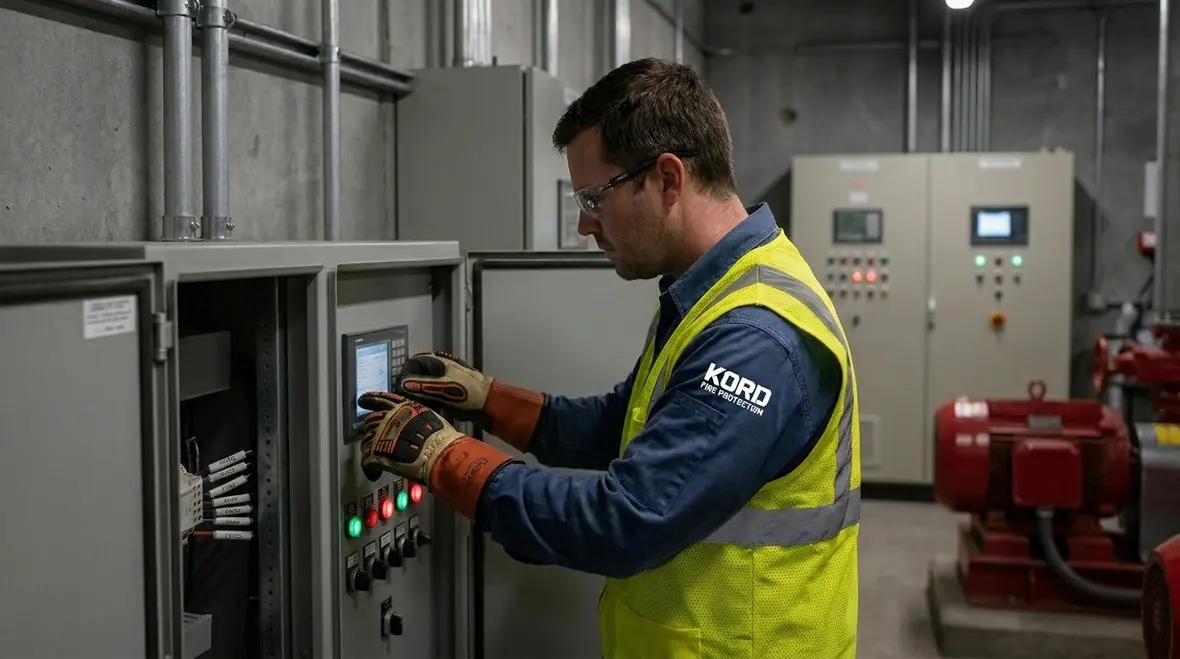
Some teams confuse “controller checks” with simple visual inspections. However, logic testing goes deeper. It validates the controller’s decision paths and confirms that each required input and output behaves correctly under controlled conditions.
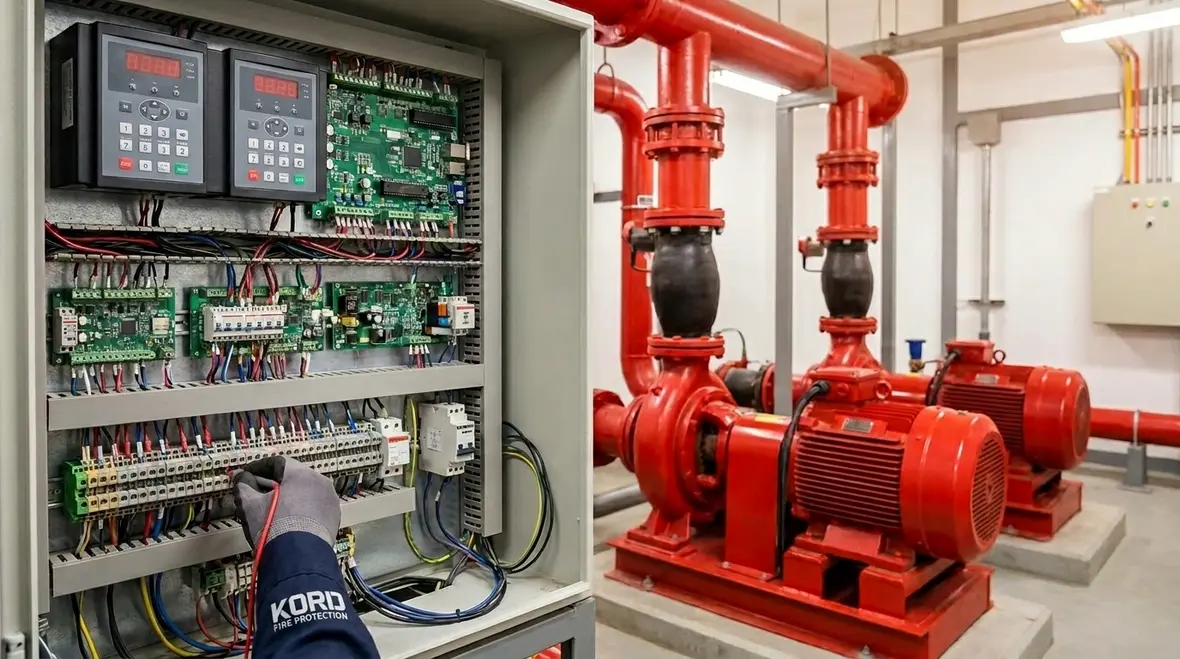
During testing, technicians typically verify the controller can perform key sequences such as start logic, stop logic, alarm logic, and transfer logic. In addition, they confirm that control inputs from field devices, like pressure switches or flow switches, match expected states. Then the controller outputs should respond exactly as the system design requires.
- The controller reads inputs correctly and does not misinterpret sensor signals
- Time delays and setpoints match the approved design and remain stable
- Each pump starts in the correct order, with correct sequencing
- Fault conditions trigger the correct alarms and inhibit or permit outputs as designed
- Auxiliary outputs, like signaling devices and interface relays, behave as expected
As a result, facilities teams get confidence that the system will act the way the drawings and approvals assume. Kord Fire Protection’s guidance on electric controller failures likewise emphasizes testing alarms, supervisory circuits, and pump start sequences as designed, which aligns closely with the practical focus of logic testing. ([kordfire.com](https://kordfire.com/why-electric-fire-pump-controllers-fail-maintenance-guide/?utm_source=openai))
How time, wear, and changes can break controller logic
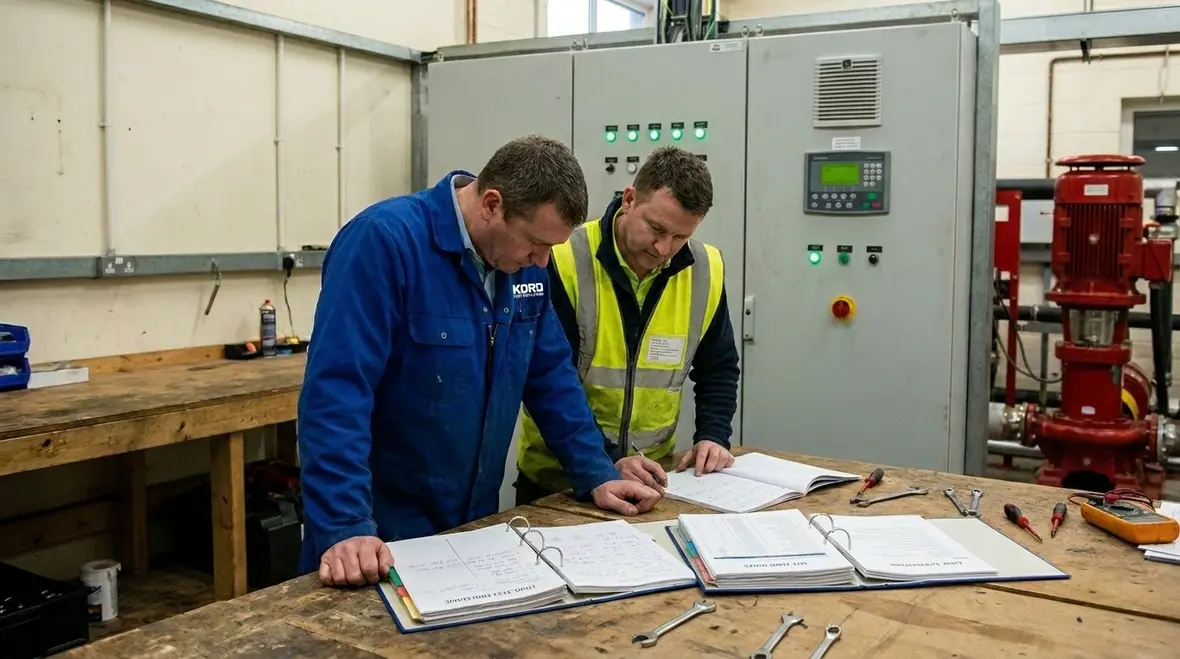
Over time, real-world conditions press on fire pump systems. Therefore, logic testing matters because components do not age uniformly. Sensors drift. Wiring connections loosen. Circuit boards experience stress cycles. Even when nothing looks obviously wrong, the logic can behave differently than planned.
In many sites across Australia, changes happen constantly. A new process line gets added. A retail tenancy changes usage patterns. An industrial facility upgrades a power system. Meanwhile, technicians may adjust tags, rename points, or update interface equipment for other projects. If those adjustments touch the fire pump controller inputs or outputs, the controller’s assumptions can shift.
Furthermore, software configuration and setpoint drift can occur after service events, repairs, or “quick fixes.” And sometimes, well intentioned troubleshooting leads to a setting that passes a basic look but fails a specific test step. Fire protection systems should not rely on luck. That’s a hobby, not a safety strategy.
That concern overlaps with Kord Fire Protection’s troubleshooting guidance, which notes that a controller may appear to be the problem when the actual cause involves power quality, pressure feedback, or undocumented maintenance changes upstream or downstream. ([kordfire.com](https://kordfire.com/fire-sprinkler-pump-controller-troubleshooting-guide/?utm_source=openai))
Logic failures often hide until the system is demanded
Small faults can wait quietly for the worst possible moment
The biggest danger is not that a controller stops working completely. Instead, the system may fail in a narrow way. Maybe a pump starts but does not achieve the expected ramp sequence. Or the controller may handle one condition correctly while mishandling another. In a real fire event, those small faults can cascade.
For example, the logic may rely on correct pressure feedback. If the feedback arrives late, or arrives with a signal that the controller interprets as out of range, the controller may delay action or trigger a fault. Then, what should have been a smooth response becomes an uncertain one.
In addition, communication faults can appear during high demand when other equipment draws current or changes power stability. Because of that, testing under controlled conditions helps reveal weaknesses before the moment of truth arrives.
In short, regular logic testing closes the gap between “seems okay” and “will perform.” It also lines up with Kord Fire Protection’s broader fire pump testing approach, where system integration with alarms and sprinklers is checked to reflect real-world challenges rather than checkbox assumptions. ([kordfire.com](https://kordfire.com/fire-pump-testing-and-certification-process-explained/?utm_source=openai))
Australian site realities: industrial, retail, and multi-facility operations
Different facilities face different pressures, yet the principle remains the same. Industrial sites need reliable performance through harsh conditions. Retail sites need continuity without disrupting daily trading. Multi-facility operators need consistency across many sites, not a one-off approach.
Therefore, planned logic testing schedules help facilities teams align fire pump maintenance with operations. Technicians can coordinate downtime windows, verify testing sequences, and document results in a way that supports internal audits.
Also, sites often have multiple zones and interfaces. A controller may communicate with alarm panels, monitoring devices, or interface relays. Consequently, testing confirms that the full chain works, not just the controller box sitting on a wall like a silent, stubborn sentry.
Kord Fire Protection supports this reality with a service model that focuses on coordination and clarity. When teams across Australia share the same standard of testing and reporting, management decisions get easier. Nobody enjoys chasing paperwork after an emergency drill. You want the data now, not later.
How to schedule logic testing without disrupting operations
Build the testing plan around the site, not against it
A smart schedule works with the site, not against it. First, facilities teams should align controller logic testing with inspection cycles and maintenance windows. Then they should plan testing steps that minimise impact to operations and keep on site coordination straightforward.
- System criticality and history of faults or repairs
- Age of the equipment and known wear points
- Recent changes to sensors, wiring, power supply, or interface devices
- How quickly the site can support controlled testing conditions
- Reporting needs for audits, insurance, and internal governance
Transitioning from a reactive mindset to a planned program reduces surprises. And if you are thinking, “We’ll do it when we have time,” then consider this: time is the one resource fires never negotiate for. So plan early, document properly, and keep the system honest.
For a useful companion read, Kord Fire Protection’s article on industrial fire pump maintenance preventive schedules reinforces the value of correctly positioned test valves, documented routines, and practical scheduling in real facilities. ([kordfire.com](https://kordfire.com/industrial-fire-pump-maintenance-preventive-schedule-plan/?utm_source=openai))
Why Kord Fire Protection becomes a vital partner
Testing alone does not protect a site. What protects a site is the full loop: test, document, report, correct, and prevent repeat faults. Kord Fire Protection helps facilities manage that loop for commercial fire pump systems across Australia.
They work with teams to ensure logic testing focuses on real system performance. They also help translate test findings into clear next steps, so maintenance teams can prioritise actions without guesswork. And because fire systems connect to broader site safety, Kord Fire Protection coordinates service planning with a practical understanding of how facilities run day to day.
If you want a partner who shows up, tests properly, and communicates like a professional, then Kord Fire Protection can be that partner. Because your fire pump controller should behave like the hero in the final act, not like the guy who says “I thought someone else handled it.” Their fire pump service page specifically highlights inspections, repair, maintenance, testing, detailed documentation, and 24/7 on-call support. ([kordfire.com](https://kordfire.com/fire-pump/?utm_source=openai))
FAQ
Conclusion
Regular logic testing helps commercial fire pump controllers prove they will act correctly when the system is demanded. It reduces hidden failures, supports compliance, and protects both people and property. For industrial and retail facilities across Australia, planning this work matters.
If you want a partner who tests thoroughly and communicates clearly, contact Kord Fire Protection through https://kordfire.com/fire-pump/ to schedule your next logic test.

Join Our Newsletter!
Get the latest fire safety tips delivered straight to your inbox From our Newsletter.