
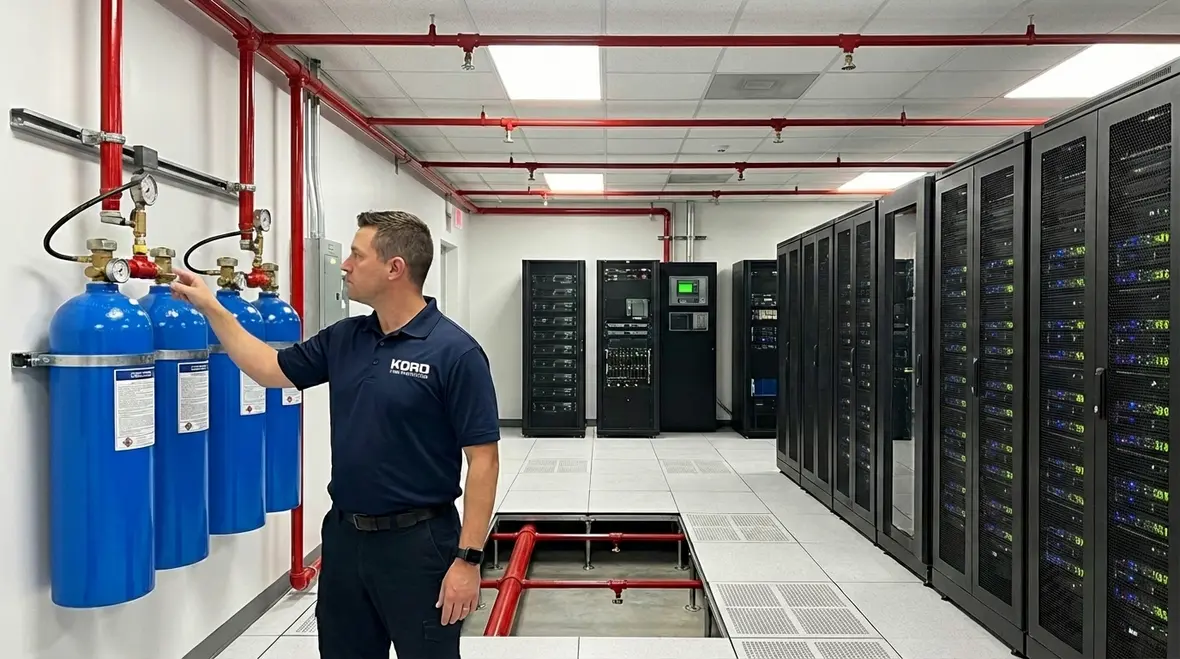
Fire Suppression System for Server Room Guide
In today’s digital world, uptime is everything. One overheated rack or one electrical spark can bring an entire operation to its knees. That is why a fire suppression system for server room environments is not a luxury. It is a necessity. From small data closets to enterprise data centers, protection must be precise, fast, and clean. Kord Fire Protection technicians often explain it this way: servers are like high performance athletes. They run hard, generate heat, and need the right support team standing by. Fire protection is that team.
This guide walks through design, layout planning, nozzle placement, detection integration, and commissioning steps. Moreover, it explains how to build a system that protects equipment without damaging it. Because when flames meet electronics, nobody wins.
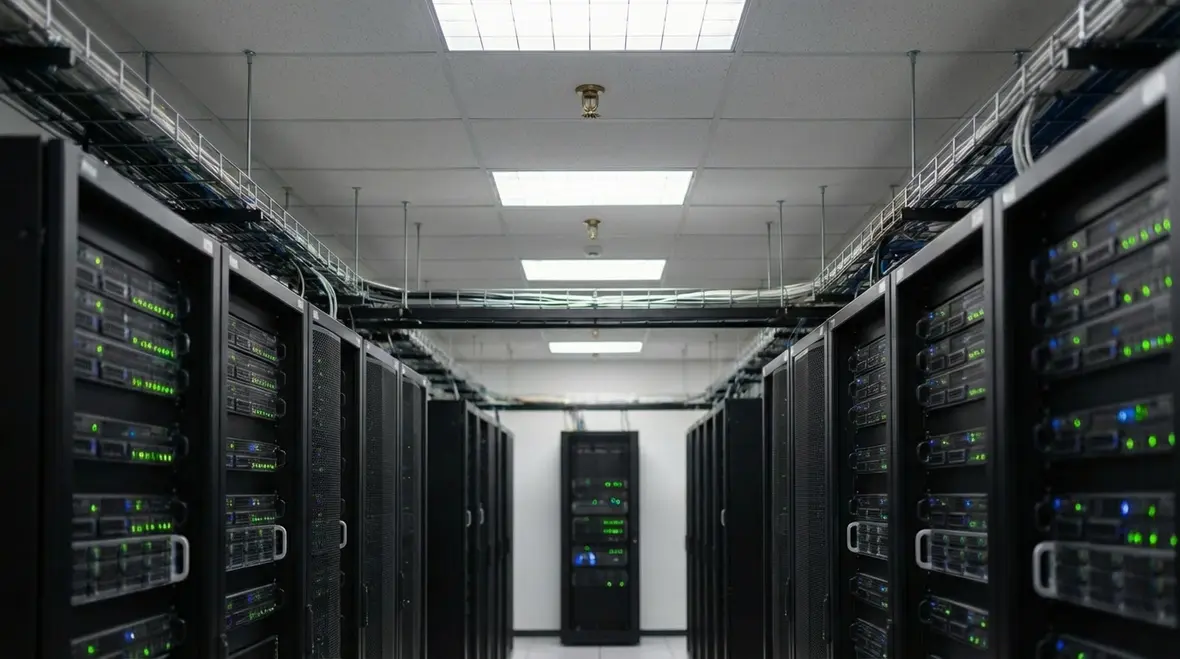
Why Server Rooms Require Specialized Fire Protection
Server rooms are not like storage spaces or office areas. They contain sensitive electronics, dense cabling, raised floors, and constant airflow. Therefore, traditional sprinkler systems alone may not provide adequate protection. Water can control fire, yes. However, it can also destroy servers faster than the flames.
A proper fire suppression solution for data centers uses clean agents such as FM 200 or Novec 1230. These agents extinguish fire quickly without leaving residue. In addition, they do not harm electronics when discharged correctly. Kord Fire Protection technicians emphasize that speed is everything. A clean agent system activates within seconds, stopping combustion before it spreads through cable trays or rack enclosures.
Furthermore, server rooms often operate 24 hours a day. That means risks never clock out. Electrical faults, overloaded circuits, or failed cooling systems can ignite trouble at any hour. Consequently, the protection system must remain active, monitored, and ready at all times.
If you want to compare overall protection strategies, you can explore how different clean agent options are applied across critical facilities in Kord Fire’s guide to clean agent fire suppression for critical equipment. The same principles that protect MRI suites and control rooms also apply directly to server room environments.
How to Design a Fire Suppression System for Server Room Spaces
Design begins long before equipment installation. It starts with understanding the room itself. Kord Fire Protection technicians always assess room volume, ceiling height, airflow patterns, and rack arrangement. Without these details, system performance can suffer.
First, engineers calculate the total cubic footage. Clean agent systems rely on precise concentration levels. Too little agent will not suppress the fire. Too much may exceed safety thresholds. Therefore, accurate measurements are critical.
Next, designers evaluate air handling systems. Because server rooms use strong cooling systems, air movement can dilute suppression agents. As a result, dampers and automatic shutdown controls must integrate with the system. When suppression activates, ventilation pauses. It is a coordinated dance, and timing matters.
Additionally, risk classification plays a role. Most server rooms fall under Class C fire hazards involving energized electrical equipment. Thus, the chosen agent must safely suppress electrical fires without conducting electricity.
Designers also account for future expansion. After all, technology grows faster than a sequel in a superhero franchise. Therefore, systems should allow for additional cylinders or extended piping if rack capacity increases.
For a broader design perspective, Kord Fire’s best server room fire suppression solutions overview breaks down how factors like room size, occupancy, and equipment sensitivity influence which suppression technology is the best fit.
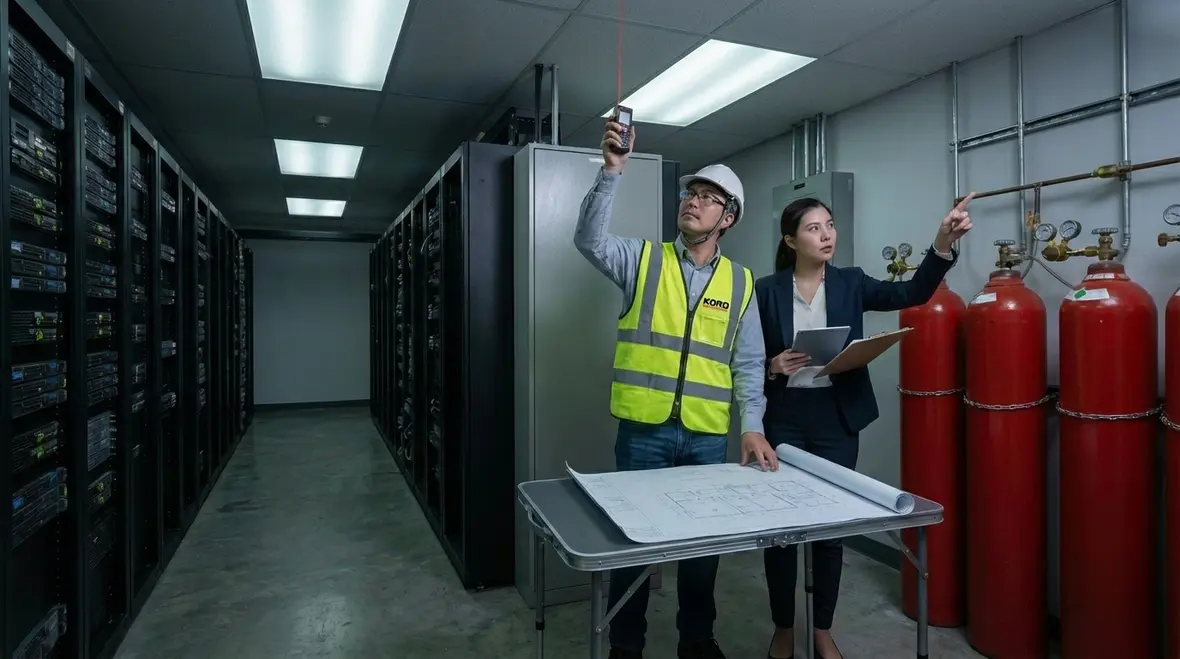
Layout Planning and Nozzle Placement
Effective protection depends on proper distribution. The agent must reach every corner of the protected space. Dead zones are unacceptable. Even one unprotected pocket can allow a small flame to become a big problem.
Layout Planning
During layout planning, technicians map cylinder placement, piping routes, and protected zones. They ensure the system covers underfloor spaces and above ceiling voids if cables run through those areas. Moreover, they confirm that discharge will not be obstructed by tall racks or containment panels.
Nozzle Placement
Nozzle placement determines how evenly the clean agent disperses. Technicians calculate spacing based on room geometry and manufacturer specifications. They position nozzles to avoid direct blasts into equipment while still achieving full coverage. Because while servers are tough, nobody enjoys a high pressure surprise to the face.
Importantly, computational flow calculations verify that pressure and agent concentration remain consistent throughout the piping network. Kord Fire Protection technicians rely on software modeling to ensure compliance with NFPA standards. Consequently, performance is predictable, not guesswork.
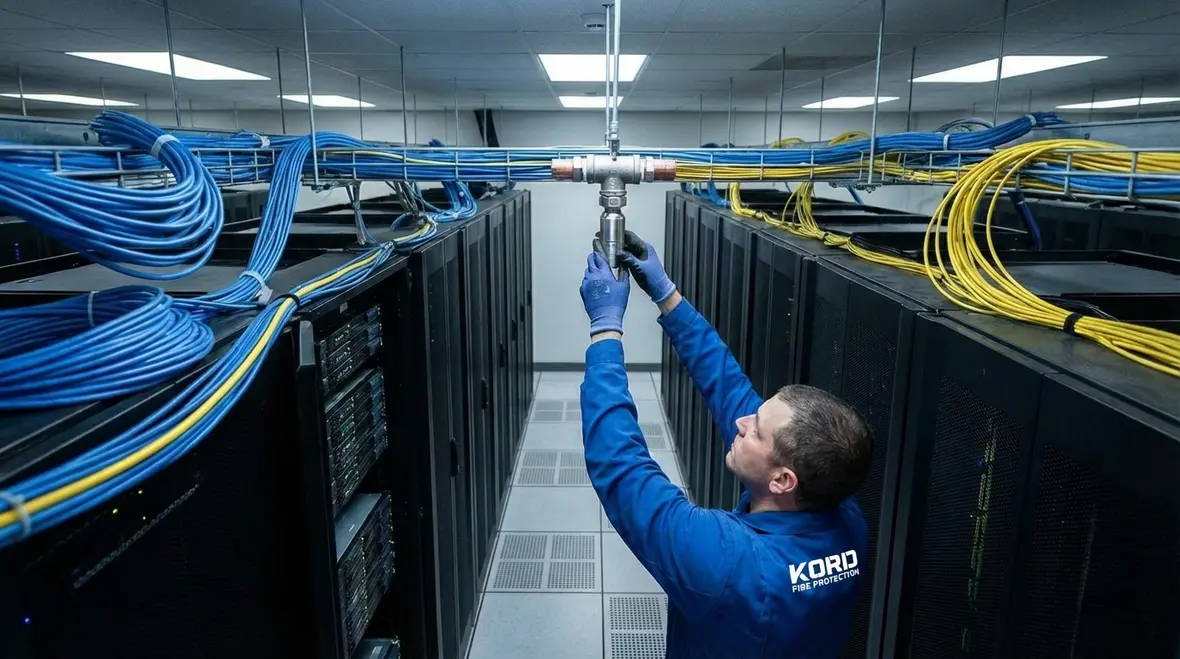
Detection Integration and Control Systems
Suppression without detection is like a smoke alarm without batteries. It looks reassuring but does very little. Therefore, detection integration stands at the heart of every fire suppression system for server room environments.
Most systems use a double interlock or cross zone detection method. This setup requires two separate detectors to activate before discharge occurs. As a result, false alarms rarely trigger full suppression. Nobody wants an accidental discharge because someone burned popcorn in the break room down the hall.
Detection methods often include:
- Photoelectric smoke detectors for early warning
- Heat detectors for temperature spikes
- Aspirating smoke detection systems for ultra early detection
Aspirating systems are particularly valuable in high value data centers. They continuously sample air and detect microscopic smoke particles long before visible smoke appears. Consequently, staff can respond before conditions escalate.
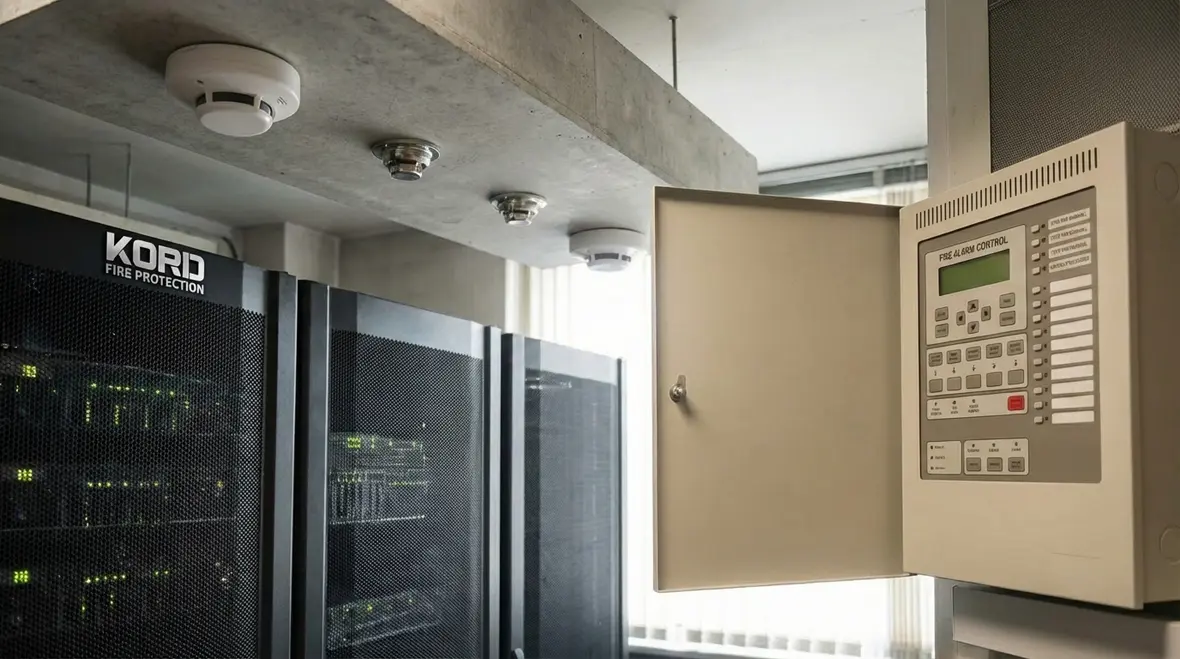
Integration also extends to building management systems. When the system activates, it can shut down HVAC units, isolate power, and trigger alarms. Kord Fire Protection technicians program these sequences carefully. Every second counts, and coordinated responses prevent reignition.
For a deeper dive into how server room risks interact with detection and control, Kord Fire’s article on server room fire safety options that actually work walks through hazards, early warning strategies, and practical configuration tips.
Commissioning Steps That Ensure Reliability
Installation alone does not guarantee protection. Commissioning transforms equipment into a functioning safety system. Without it, even the most advanced design remains theory.
Commissioning typically includes:
- Visual inspection of piping and nozzles
- Pressure testing of cylinders
- Verification of control panel programming
- Functional testing of detection devices
- Room integrity testing
Room integrity testing, often called a door fan test, measures how well the room holds the suppression agent. Because if the agent leaks out too quickly, it cannot maintain the required concentration. Technicians use calibrated fans and gauges to confirm retention time meets standards.
Furthermore, they simulate alarm conditions to verify system response. Strobes flash. Alarms sound. HVAC shuts down. However, actual agent discharge only occurs under controlled acceptance testing if required. This careful process ensures readiness without unnecessary cleanup.
Kord Fire Protection technicians stress documentation during commissioning. Detailed records provide proof of compliance and simplify future inspections. In other words, paperwork today prevents headaches tomorrow.
To understand why retention time and sealing are so critical, Kord Fire’s explanation of room integrity testing shows how even a well designed server room system can underperform without proper commissioning.
Maintenance and Long Term Performance
Even the best fire suppression system for server room applications needs routine care. Dust accumulates. Sensors drift. Batteries weaken. Therefore, regular inspections protect the investment.
Industry standards typically require semiannual inspections and annual testing. During these visits, technicians check cylinder pressure, inspect nozzles, test detection devices, and confirm panel functionality. Additionally, they review any changes to room layout that might affect coverage.
Whenever new racks are added or walls shift, the suppression design may require updates. After all, protection must evolve alongside technology. Ignoring modifications can compromise effectiveness.
Moreover, staff training plays a key role. Employees should understand alarm signals and evacuation procedures. While clean agents are safe for occupied spaces, evacuation ensures maximum safety during discharge events.
Common Mistakes to Avoid in Server Room Protection
Even well intentioned projects can stumble. However, awareness prevents costly errors.
- Ignoring airflow dynamics during design
- Placing nozzles too close to obstructions
- Skipping room integrity testing
- Failing to integrate HVAC shutdown controls
- Overlooking underfloor cable spaces
Each of these missteps can weaken system performance. Kord Fire Protection technicians often remind clients that fire protection is both science and strategy. Cutting corners might save money upfront. Yet it can cost far more later.
If you are comparing overall strategies and want a bigger picture of how server rooms and full data centers should be protected, Kord Fire’s data center clean agent fire suppression guide connects design, testing, and maintenance into one continuous lifecycle.
FAQ About Server Room Fire Suppression
Protect What Powers Your Business
Server rooms carry the heartbeat of modern operations. Therefore, protecting them demands precision, planning, and expertise. From layout planning to commissioning, every step shapes system reliability. Kord Fire Protection technicians design, install, and maintain solutions that respond in seconds when it matters most.
Do not wait for smoke to reveal vulnerabilities. Contact Kord Fire Protection today and ensure your fire suppression strategy stands ready, steady, and strong. To explore next steps, review Kord Fire’s best server room & data center fire suppression solutions and connect with their team to tailor a clean agent system for your specific server room.
Know Your Weapon Before You Fight the Flame
Kord Fire Protection is your go-to when it comes to all things fire protection. For over 20 years, we’ve been serving Southern California with the quality service and equipment to keep your home or business safe at all times. Our competitive prices reflect our unwavering commitment to protecting what matters most in the event of a fire emergency. Give us a call, send an email, or use that form!

Join Our Newsletter!
Get the latest fire safety tips delivered straight to your inbox From our Newsletter.


