Fire Alarm Circuit Design to Reduce Voltage Drop in Commercial Buildings
In large commercial buildings, the fire alarm system has one job: it must work when it matters. To help make that happen, Kord Fire Protection technicians often start with a solid fire alarm circuit design that controls how power flows, how devices load the circuit, and how voltage behaves during a real event. Then they plan for what happens before the alarm ever sounds, like what voltage drop looks like when the building is busy, weather changes, or maintenance adds new devices. In other words, they treat voltage drop like the uninvited guest at a business meeting. You can’t always stop it from showing up, but you can make sure it never runs the show.
Because this topic lives in the practical world of panel boards, wire runs, and field device ratings, the article below shows how technicians reduce risk in real networks, without turning the job into a mystery novel.

What causes voltage drop in commercial fire alarm circuits
Voltage drop happens when current travels through conductor resistance. As the circuit draws more current, the voltage at the far end falls compared to the panel output. Therefore, the system might still light up during testing, yet behave differently during alarm mode when loads shift.
Kord Fire Protection technicians explain it like this. First, longer cable runs increase resistance. Second, smaller wire sizes increase resistance even more. Third, wiring methods that add resistance at connections can push the drop higher. For example, a loose terminal or a less than clean splice can act like a tiny roadblock. And just like traffic, the system notices when the road gets worse.
In addition, fire alarm circuits in commercial buildings often include notification appliances, signaling devices, and auxiliary powered components. So the real load profile matters. If the design does not match the actual devices, the circuit may drift toward undervoltage during an event.
Why load profile matters more than a quick visual check
A panel can look perfectly normal on a calm day and still leave the farthest appliances with less voltage than they need once the building shifts into full alarm. That is why technicians do not stop at seeing a green light on the panel. They look at current draw, device count, branch distance, and how the circuit behaves when multiple appliances are active at once. Fire alarm circuit design is not about making the drawing look tidy. It is about making sure the last device on the run gets enough power when the moment gets loud.

How Kord technicians use voltage drop calculations in fire alarm circuit design
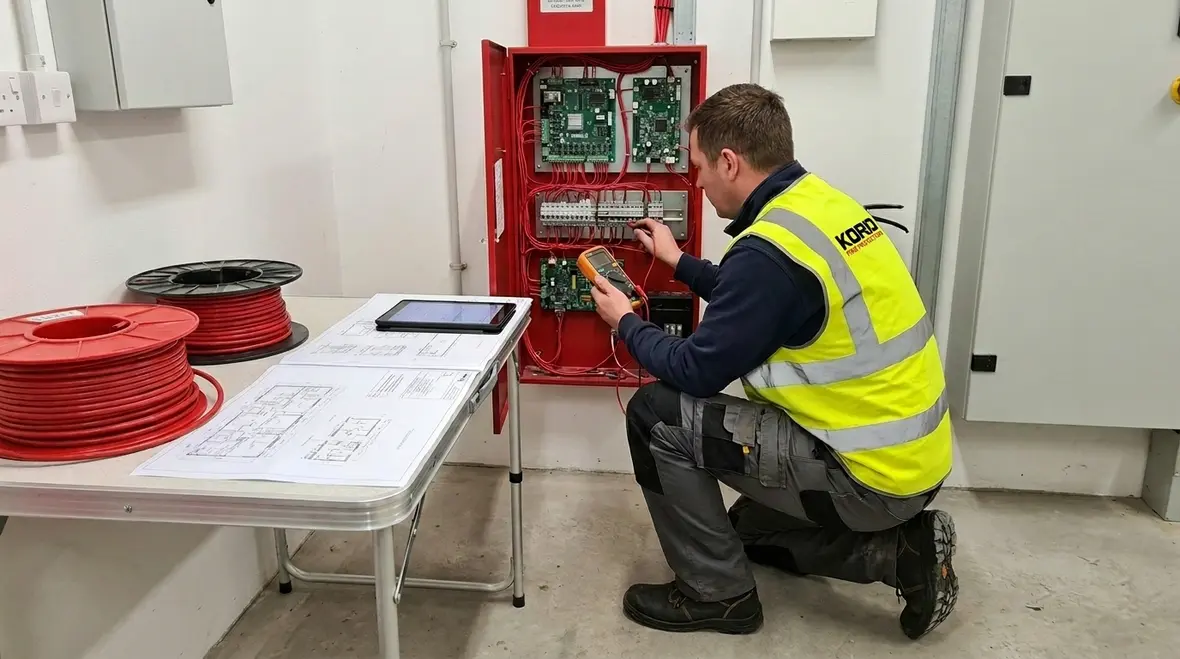
Mitigating voltage drop starts with math, but Kord Fire Protection technicians keep it grounded. They compute expected current for every device and then calculate the total resistance across the run. Next, they compare the predicted end of line voltage to the equipment minimum operating range.
Then they verify the design assumptions. For instance, they confirm device current ratings, check that the loop includes the correct number of sounders or strobes, and validate that the wire type matches what the spec requires. After that, they review the power source and standby needs. If the system includes batteries and the panel draws extra current during alarm, the voltage drop story can change fast.
Also, technicians use conservative approaches. That means they do not assume close enough cable lengths or it will probably be fine terminal conditions. In fire protection, probably is not a standard. Probably is a vibe.
The value of conservative assumptions
Conservative design gives the circuit breathing room. If the measured cable length ends up a little longer, if a future tenant improvement adds another device, or if the alarm current is slightly higher than expected, the design still has a margin. That margin is not wasted effort. It is what keeps a minor field change from becoming a major system headache later.
Plan conductor sizing and layout to reduce losses
Once the team understands the likely current and run length, they focus on conductor sizing and layout. Larger conductor size lowers resistance, so end of line voltage stays stronger. However, you cannot just jump to the biggest wire everywhere, because labor, pathways, and cost matter. Instead, Kord Fire Protection technicians target the portions of the circuit that hurt most: the long runs and the branches that carry the heaviest load.
Then they look at routing. For example, they can often shorten a run by adjusting tray paths or device locations during coordination. Additionally, they reduce the number of transitions that introduce extra resistance. And when installers need splices, they use proper methods and quality components, so the circuit does not quietly pick up hidden losses.
Just as importantly, they plan for future changes. A design that only meets today’s count may fail tomorrow when someone adds devices for a tenant buildout. Therefore, good layout planning includes spare capacity where code and engineering allow.
Control device loading and use proper supervision settings
Device loading plays a major role in voltage drop. Notification appliances often drive the highest current, especially when multiple devices operate at the same time. Kord Fire Protection technicians check the required current draw per appliance and ensure the circuit design supports simultaneous operation.
Then they confirm supervision settings and signaling modes. Some systems use different output configurations for sounder, strobe, or combination devices. If the system uses a mode that increases current draw during alarm, the voltage drop calculations must match that mode.
At the same time, they prevent mismatched equipment. New devices brought in during renovations can have different electrical characteristics than the original parts. So technicians verify device compatibility, including input and output behavior and any standby or alarm mode differences. In simple terms, they stop the circuit from becoming a franken-loop that technically works until it doesn’t.
How renovations quietly change the numbers
Commercial buildings rarely stay frozen in time. Suites are reworked, walls move, appliances get swapped, and someone eventually asks whether one more device can just be added to the same circuit. Sometimes yes. Sometimes that one more device is the exact thing that eats the remaining voltage margin. That is why updated calculations and recordkeeping matter just as much as the original design package.
Strengthen field connections and avoid installation mistakes
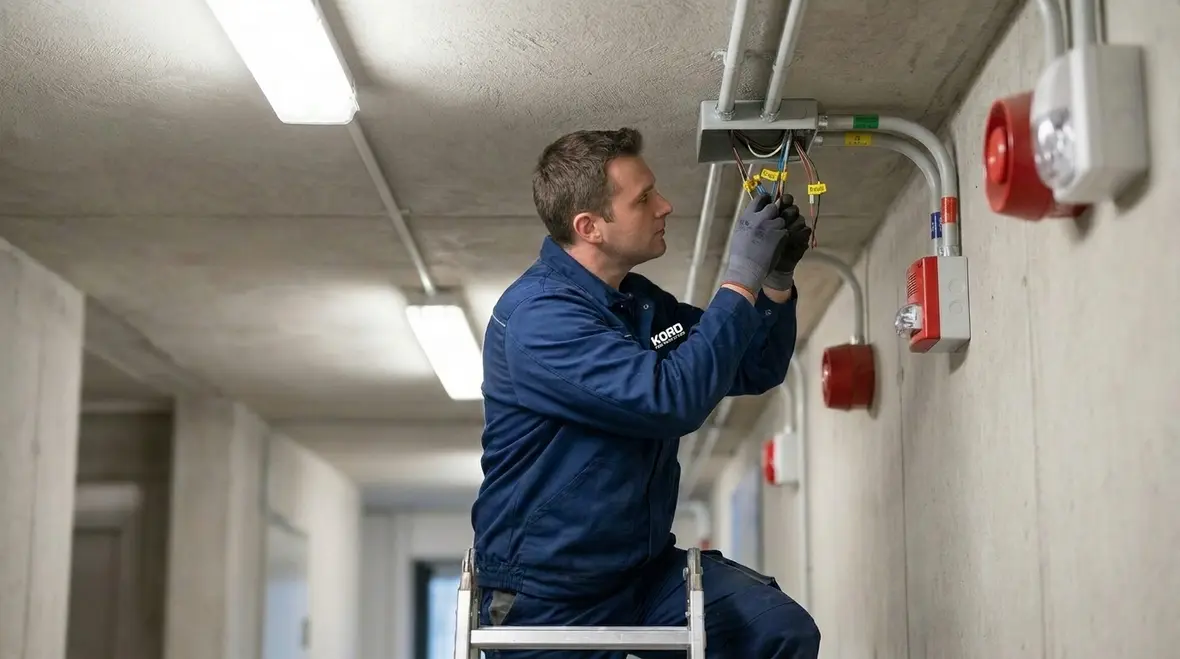
Even a great design can lose voltage if field workmanship adds resistance. Therefore, Kord Fire Protection technicians pay close attention to terminations. They inspect wire preparation, verify torque or termination method where required, and check that conductors land properly on the terminal points.
They also watch for common issues that quietly raise resistance. These include oxidation on conductors, loose screws, undersized lugs, or wrong wire type used during fast installation. In busy construction schedules, teams sometimes treat a terminal block like it will hold on somehow. Voltage drop does not care about optimism.
In addition, technicians confirm that polarity and pairing remain correct. Miswiring can lead to higher current paths or improper supervision behavior. And when the panel sees unexpected results, it may mask a voltage problem behind trouble indicators.
What drives higher voltage drop
Longer runs, smaller conductor size, higher device current, extra resistance at connections, and load changes during alarm mode.
What Kord technicians do to reduce it
They calculate end of line voltage, verify device current ratings, validate wire type, plan routing and spares, and enforce proper termination practices.
Verify performance during testing and service life
Calculations matter, yet field verification keeps the team honest. Kord Fire Protection technicians verify voltage at key points, especially at end of line during alarm conditions. They measure under the actual load state whenever possible, because a circuit that looks fine under standby can behave differently when devices activate.
Then they review system changes after installation. Renovations, tenant improvements, and device replacements can alter the load profile. Therefore, technicians keep service records that show what changed, when it changed, and how it impacts voltage drop margins. That habit prevents surprises later, like finding out the new strobe draws more current than the original and nobody told the panel.
They also test for supervision stability. Voltage drop that climbs too high can cause trouble events or misread states. By tracking trends, technicians can act before the circuit crosses a practical limit.
When service records become a design tool
A useful maintenance history helps technicians spot patterns before they become failures. If one branch has repeated trouble signals, if certain devices routinely drift toward the edge of their operating range, or if alarm changes happened after several tenant improvements, the paperwork starts telling a story. Good records are not busywork. They are how teams connect today’s trouble with yesterday’s change order.
FAQ
Conclusion
Mitigating voltage drop in large scale commercial fire alarm networks takes more than luck and a steady hand on the screwdriver. It needs a disciplined approach to fire alarm circuit design, careful conductor choices, accurate device loading, solid terminations, and real verification under alarm conditions. Kord Fire Protection technicians bring that method to the field, so the system performs when it should, not when it feels like it.
If your building has long runs or frequent tenant changes, contact Kord Fire Protection to review your network margins and upgrade your plan. For local support, explore Corona Fire Protection Services, or learn more about Fire Alarm Services for inspections, testing, upgrades, and ongoing support that keeps commercial systems ready when it counts.

Join Our Newsletter!
Get the latest fire safety tips delivered straight to your inbox From our Newsletter.