
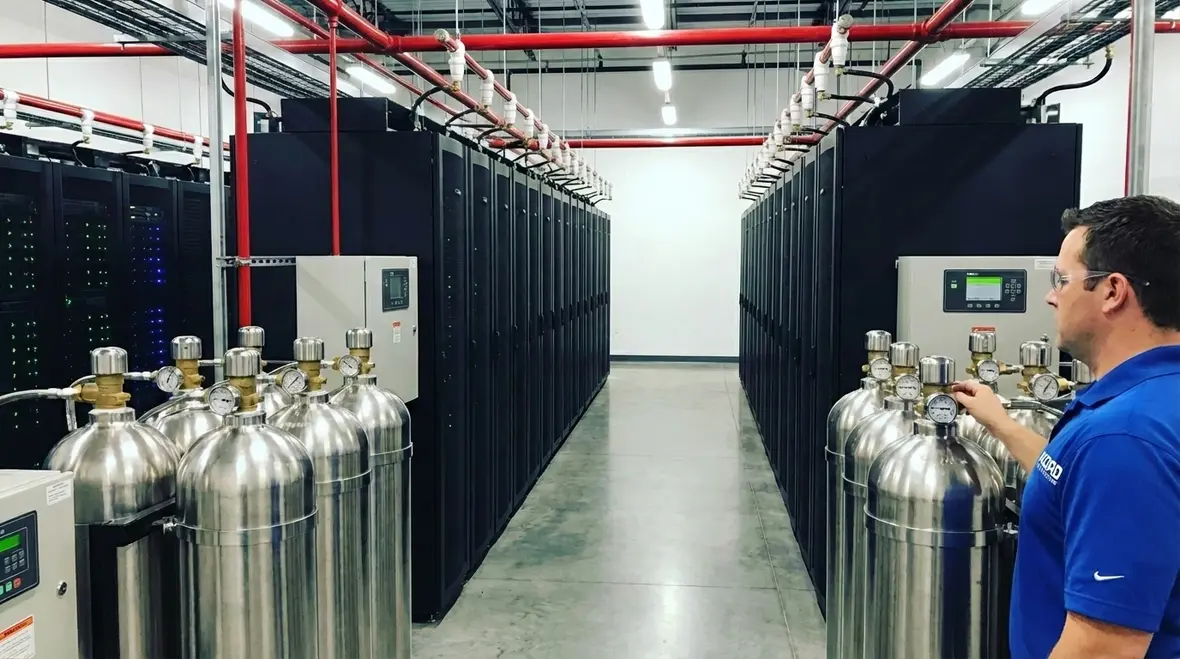
Best Clean Agent for Data Centers Compared
In the quiet hum of a data center, where servers blink like constellations and information flows faster than city traffic at rush hour, fire protection is not optional. It is mission critical. That is why facility managers turn to a clean agent for data centers, a system designed to stop fire without soaking sensitive electronics. As Kord Fire Protection technicians often explain during site visits, the right suppression system does not just put out flames. It protects uptime, reputation, and revenue. And in a world where downtime feels like a scene from a tech horror movie, that matters.
This guide walks through the best clean agent systems available today, comparing FM 200, Novec 1230, and Inergen with clarity and calm authority. For a broader look at how these agents protect different types of critical facilities, you can also explore Kord Fire’s overview of clean agent fire suppression systems, including Fluoro-K, CO2, and more.
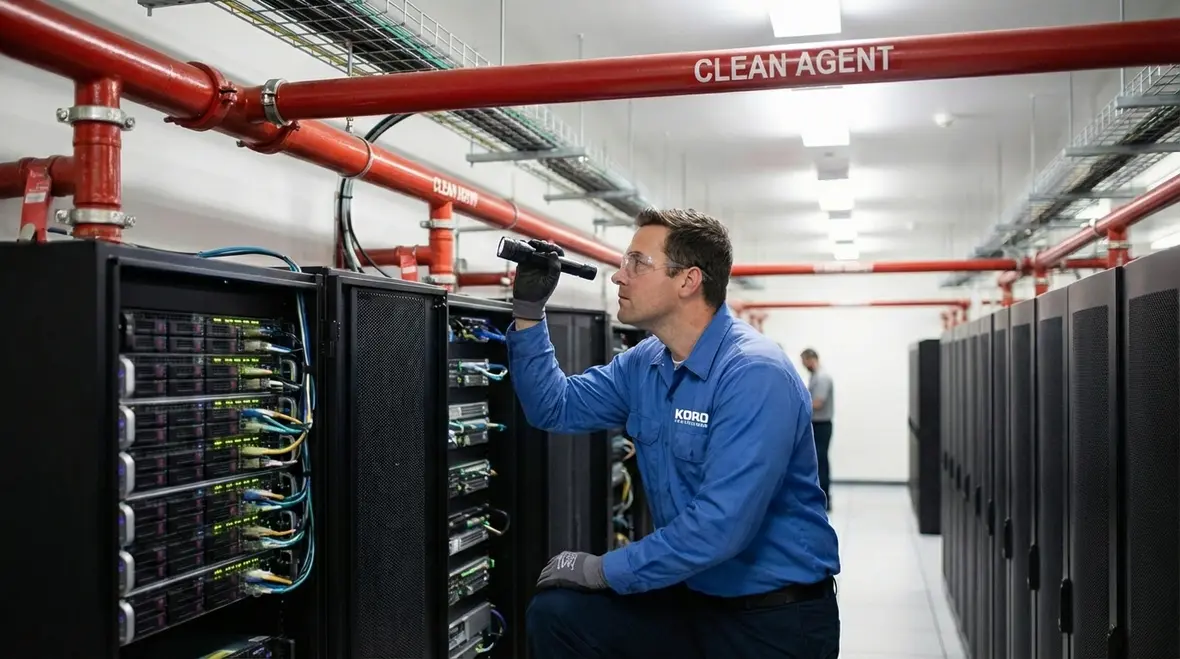
Understanding Clean Agent Fire Suppression in Server Environments
A clean agent system extinguishes fire without water, residue, or damage to electronics. Instead of drenching racks and cables, it releases a gas that interrupts combustion. As a result, flames disappear while hardware remains dry.
Data centers rely on these systems because even a small electrical fire can cascade into catastrophic data loss. Traditional sprinklers may stop the fire, but they also create a second disaster. Therefore, operators choose gaseous fire suppression systems that act fast and leave no mess behind.
Kord Fire Protection technicians often describe it simply. The goal is to remove heat or interrupt the chemical reaction of fire without harming the equipment doing the heavy lifting. Think of it as stopping the villain in the movie before the city gets leveled. Efficient. Clean. No dramatic explosions.
If you want to go deeper into how these systems are engineered across different industries, Kord’s clean agent fire suppression for critical equipment guide breaks down how clean agents protect MRI suites, control rooms, and other technology-heavy spaces without missing a beat.

FM 200 vs Novec 1230 vs Inergen: Clean Agent Comparison
When evaluating a clean agent for data centers, three names dominate the conversation: FM 200, Novec 1230, and Inergen. Each offers unique strengths, and each behaves differently under pressure.
FM 200
FM 200 is a hydrofluorocarbon agent that suppresses fire by absorbing heat. It discharges quickly, usually within 10 seconds, which makes it effective in high value server rooms. Because it requires a lower concentration than inert gases, it typically needs less storage space.
However, FM 200 has a higher global warming potential compared to newer alternatives. While it remains widely used, environmental regulations continue to influence its long term outlook.
Novec 1230
Novec 1230 is often praised for its environmental profile. It has an extremely low global warming potential and breaks down rapidly in the atmosphere. Like FM 200, it absorbs heat to suppress fire, and it is safe for occupied spaces at design concentrations.
Because of its chemical makeup, Novec 1230 also requires compact storage, which suits facilities where floor space is precious. In data centers where every square foot generates revenue, that is no small detail.
Inergen
Inergen works differently. It is a blend of nitrogen, argon, and carbon dioxide. Instead of absorbing heat, it reduces oxygen levels to a point where combustion cannot continue. Importantly, it lowers oxygen only to levels that remain safe for people.
Since Inergen is stored as a compressed gas, it often requires larger cylinders and more storage space. Yet, it has virtually no environmental impact, making it attractive for sustainability focused operations.
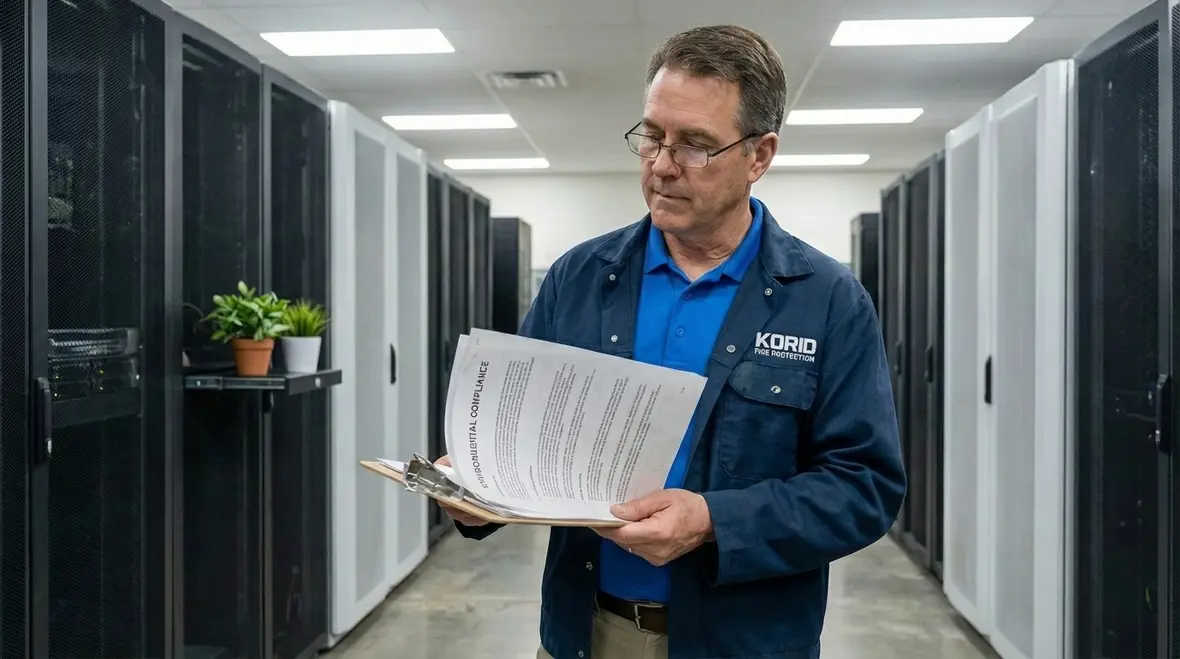
Environmental Impact and Regulatory Pressure
Environmental responsibility is no longer a marketing slogan. It is a boardroom discussion. Therefore, selecting the right fire suppression solution means understanding long term regulatory trends.
FM 200, while effective, carries a higher global warming potential. Consequently, some regions have introduced phasedown strategies affecting hydrofluorocarbons. Novec 1230, on the other hand, offers a dramatically lower environmental footprint. It breaks down in days rather than years.
Inergen stands out because it uses naturally occurring gases. It has zero ozone depletion potential and negligible global warming impact. As Kord Fire Protection technicians often point out during environmental audits, sustainability goals increasingly influence system selection. Choosing a clean agent for data centers is no longer just about fire. It is about future compliance.
If your organization is actively tracking standards and code requirements, Kord’s breakdown of the clean agent standard for fire suppression systems explains how design, testing, and documentation work together to keep systems compliant over their full life cycle.
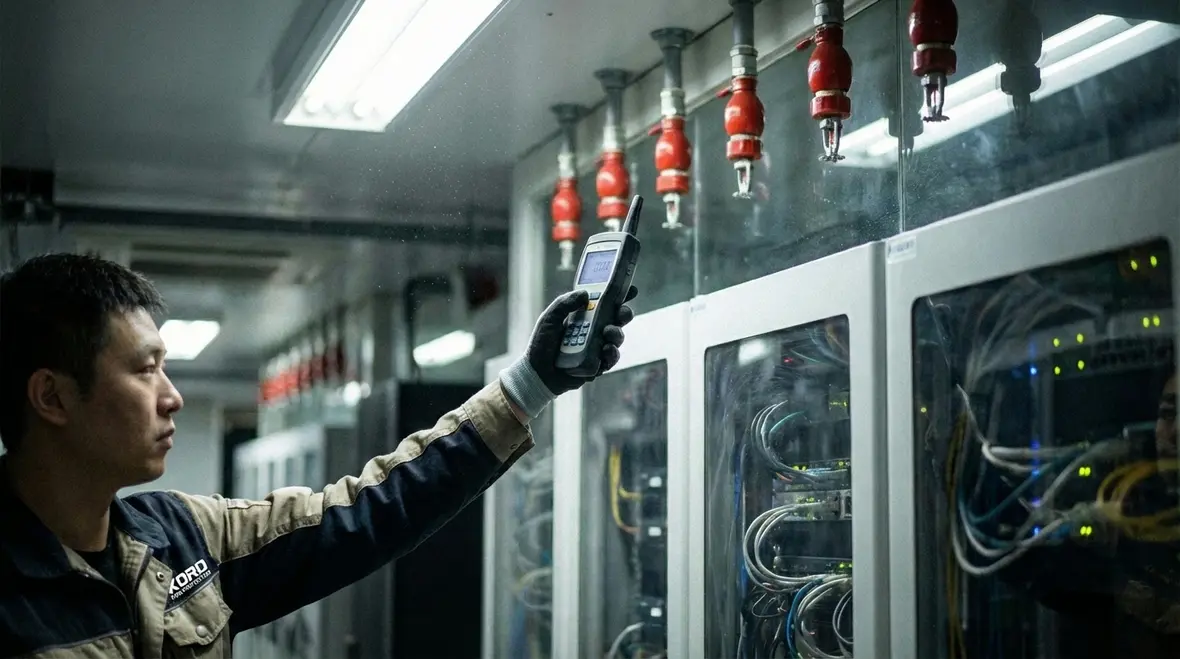
Discharge Behavior in Live Server Rooms
Speed and distribution define success in a live server room. A fire suppression system must flood the protected space evenly and quickly.
FM 200 and Novec 1230 typically discharge within seconds, creating a rapid concentration that interrupts combustion. This swift response limits heat exposure to sensitive components. Moreover, both agents leave no residue, so cleanup focuses on inspection rather than repair.
Inergen releases as a high pressure gas and reduces oxygen levels gradually but effectively. Because it depends on achieving a specific concentration, room integrity becomes critical. Even small leaks can affect performance. Therefore, regular enclosure integrity testing is essential.
Kord Fire Protection technicians emphasize airflow considerations. Data centers move massive volumes of air for cooling. If dampers fail to close or ventilation continues running, agent concentration can drop below effective levels. In short, the system must work in harmony with mechanical infrastructure. Fire suppression is not a solo act. It is an orchestra.
Refill, Downtime, and Business Continuity
After a discharge, the clock starts ticking. Every hour offline costs money.
FM 200 and Novec 1230 systems often allow for relatively straightforward refilling, depending on cylinder availability. However, supply chain factors can affect refill timelines, especially in regions with tighter environmental controls.
Inergen cylinders require high pressure refilling and careful transport. Because of the volume of gas involved, replenishment logistics can take longer. That said, availability of industrial gases is generally stable.
Kord Fire Protection technicians advise clients to plan for redundancy. Some facilities install preaction sprinkler systems as secondary protection or maintain spare cylinders on site. After all, in the data world, hope is not a strategy. Preparation is.
Side-by-Side Technical Overview
Agent Comparison Snapshot
FM 200
Environmental impact: Higher global warming potential
Discharge behavior in server environments: Rapid heat absorption, fast knockdown
Refill and downtime considerations: Moderate refill speed, regulated in some regions
Novec 1230
Environmental impact: Very low global warming potential, short atmospheric life
Discharge behavior in server environments: Fast discharge, clean evaporation
Refill and downtime considerations: Efficient refill process, strong compliance outlook
Inergen
Environmental impact: Minimal environmental effect, naturally occurring gases
Discharge behavior in server environments: Oxygen reduction, requires tight enclosure
Refill and downtime considerations: Larger cylinders, potentially longer logistics
Each option serves a purpose. The right choice depends on facility size, sustainability targets, storage capacity, and risk tolerance.
How to Choose the Right Clean Agent for Data Centers
Selecting a suppression system begins with risk assessment. Technicians evaluate room volume, ceiling height, airflow patterns, and fuel load. Additionally, they consider human occupancy and evacuation time.
Budget also plays a role, yet it should never overshadow reliability. A slightly lower upfront cost means little if regulatory changes force early replacement. Therefore, many operators now favor solutions with long term environmental stability.
Kord Fire Protection technicians often walk clients through real world scenarios. What happens if a battery rack ignites? How quickly will the agent disperse? How soon can operations resume? These conversations move beyond theory and into practical resilience.
In some cases, hybrid strategies provide added security. For example, combining a clean agent for data centers with advanced detection systems reduces the chance of full discharge. Early warning equals smaller problems. And smaller problems mean fewer sleepless nights.
If you’re comparing options beyond FM 200, Novec 1230, and Inergen, Kord’s overview of Fluoro-K fire suppression as an eco solution shows how next generation agents are reshaping the clean agent conversation for data centers and other sensitive environments.
Frequently Asked Questions
Final Thoughts and Next Steps
Fire protection in a data center is not about reacting to disaster. It is about preventing interruption before it begins. FM 200, Novec 1230, and Inergen each offer powerful protection when engineered correctly. The key lies in thoughtful design, environmental awareness, and expert guidance.
Connect with Kord Fire Protection technicians to evaluate your facility, explore the right clean agent solution, and ensure your servers stay cool, calm, and uninterrupted. Their data center focused resources, like the data center clean agent fire suppression guide, can help you translate theory into a practical roadmap for upgrades and maintenance.
If you are ready to take the next step, Kord Fire’s dedicated clean agent suppression system for critical assets service page outlines how design, installation, and ongoing service work for high stakes environments like data centers. From agent selection to room integrity testing, you do not have to navigate the decision alone.
Schedule a consultation, review your current system against modern standards, and build a suppression strategy that protects uptime today while staying aligned with tomorrow’s environmental and regulatory expectations.
Know Your Weapon Before You Fight the Flame
Kord Fire Protection is your go-to when it comes to all things fire protection. For over 20 years, we’ve been serving Southern California with the quality service and equipment to keep your home or business safe at all times. Our competitive prices reflect our unwavering commitment to protecting what matters most in the event of a fire emergency. Give us a call, send an email, or use that form!

Join Our Newsletter!
Get the latest fire safety tips delivered straight to your inbox From our Newsletter.


