
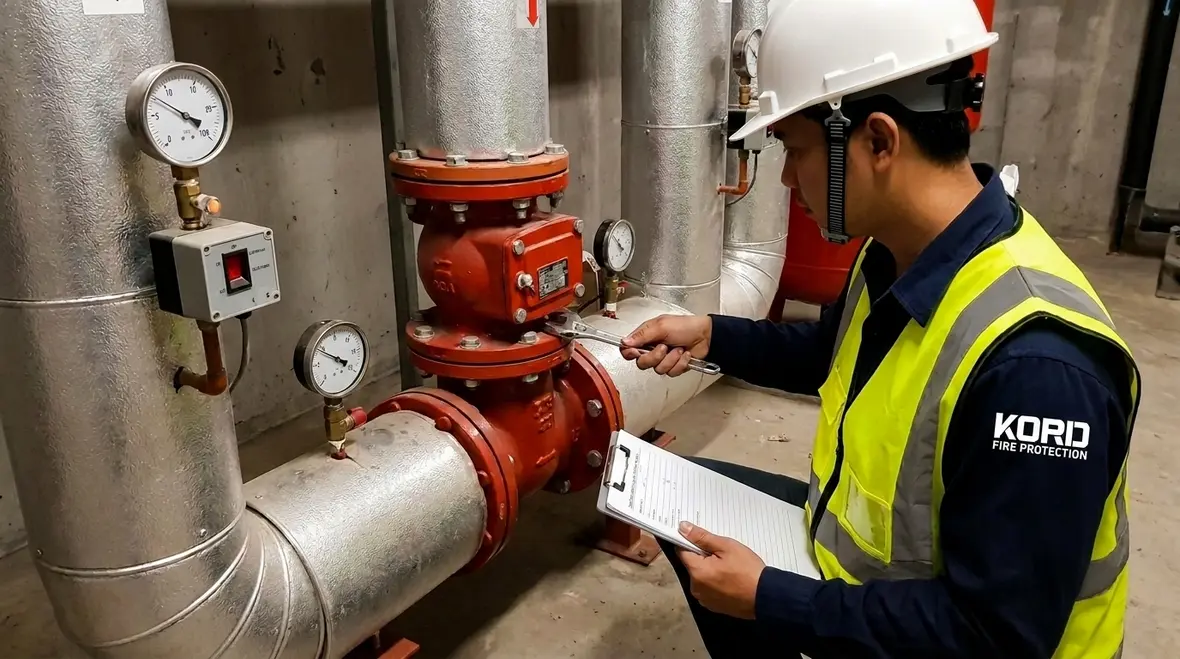
NFPA 25C Section 13.3: Control Valve Inspection and Testing Requirements
Quick Answer: NFPA 25C Section 13.3 establishes inspection and testing expectations for control valves in water-based fire protection systems. It focuses on verifying valve position, operability, and readiness for service, while preventing common failure modes such as seized mechanisms, leakage, and incorrect supervision.
For facilities that want a practical service path alongside code understanding, Kord Fire Protection’s full fire protection services page fits naturally here because control valve reliability is never just a paperwork hobby. It lives or dies in inspection access, testing discipline, and follow-through.
Why NFPA 25C Section 13.3 matters for commercial fire protection readiness
Control valves determine whether a water based system can deliver water when needed. In many commercial, industrial, and retail settings, valves sit in tampered or harsh environments: equipment rooms, ceiling spaces, mechanical closets, and pump rooms. Over time, lubrication loss, corrosion, and partial travel conditions can prevent full flow even when alarms and supervision indicate “normal.” Within the overall maintenance program, NFPA 25C Section 13.3 control valve inspection testing requirements help maintain system operability by requiring hands on verification of valve condition, access, and functional performance.
Where Section 13.3 fits in a water based fire protection maintenance program
NFPA 25C is used for maintaining water based fire protection systems, including inspection and testing cycles aligned with system hazards and configuration. Control valves support both system performance and signaling. In most facilities, maintenance planning must integrate:
- System scope: sprinkler, standpipe, and other water based components
- Valve roles: system isolation, zone control, and control for water supply arrangements
- Supervision method: mechanical position indicators, tamper switches, or water flow based monitoring
- Access and maintenance constraints: locked enclosures, seasonal staffing changes, or limited downtime windows
For a broader maintenance context, Kord Fire Protection summarizes how ongoing system upkeep supports reliability in commercial environments: NFPA 25 overview and maintenance breakdown.
What Section 13.3 expects from inspection: position, condition, and supervision integrity
NFPA 25C Section 13.3 centers on confirming that control valves support correct system operation. Inspection activities typically focus on observable and measurable conditions that can degrade function without triggering immediate alarms.
1) Valve position verification and supervision alignment
Inspectors verify that valves remain in the required position for normal operation. Common issues include:
- Valves left partially closed after maintenance or tenant work
- Supervisory switches out of adjustment, creating false “supervisory normal” indications
- Visual indicators disconnected from stem travel due to wear or loose hardware
Operationally, this step requires tracing from valve to supervision device, confirming that the supervision reflects actual valve position, not a degraded mechanical indicator.
2) Mechanical condition checks: corrosion, obstruction, and leakage
Control valve inspection should look beyond surface conditions. Failure points often include:
- Corrosion on stems and seats that can lock the valve or prevent full seating travel
- Debris accumulation near actuators or linkages that restrict motion
- Evidence of seepage, dripping, or staining that indicates seal degradation
In commercial facilities, inspection access is often the limiting factor. Valves may be behind piping insulation, in ceiling plenums, or in rooms with restricted entry. Kord Fire Protection emphasizes maintaining workable access so inspections and testing can occur without bypassing procedures.
3) Valve identification, tagging, and maintainability
Valves must be identifiable and correctly associated with system zones. Mislabeling is a frequent operational risk during emergencies and routine maintenance. Inspectors confirm markings, orientation, and that maintenance personnel can locate each valve quickly and safely.
How testing verifies operability: functional performance, travel, and flow implications
Inspection confirms readiness. Testing verifies whether the valve can perform its job under controlled conditions. For control valves, testing typically addresses operational integrity, including movement, seat condition, and whether the valve supports system flow when placed to service.
Operational testing mechanics that reduce risk
Effective testing programs treat valve operation as a controlled mechanical event. Testing generally follows these discipline points:
- Confirm downstream conditions and system status to prevent unintended water discharge
- Operate the valve with controlled movement to confirm smooth travel
- Assess whether the valve returns reliably to the required position
- Record results that indicate trending risk, such as increased required force or delayed return
Facilities often underestimate how valve design affects test procedures. For example, some valves are sensitive to actuator alignment or stem lubrication condition. A test that is performed without proper baseline knowledge can damage seals or create extended out of service time.
Common failure modes that testing should uncover
- Stiction: valve movement becomes sluggish or incomplete due to corrosion or dried lubricant
- Partial closure: valve travel does not reach the designed open position, reducing system flow capacity
- Seal deterioration: leakage persists even after the valve returns to its normal position
- Incorrect configuration: valve installed as a different type or with non matching supervision hardware
Kord Fire Protection aligns testing practices with common commercial constraints, including minimal disruption operations and coordination with electrical and building management teams. This approach supports audit ready documentation and better field predictability.
Compliance challenges in the field and how to prevent them
Even well staffed facilities can struggle with Section 13.3 execution. The most frequent barriers are operational, not technical.
Access and scheduling conflicts
Valves may be located where maintenance access requires shutting down adjacent systems or temporarily removing insulation. When schedules slip, valves remain untested longer than planned. Preventive scheduling and access planning reduce last minute operational risk.
Documentation quality and traceability
Compliance hinges on traceability. Inspection and test records should clearly connect each control valve to its supervision device, test method, measured observations, and corrective actions. Poorly recorded valve IDs and ambiguous notes slow down corrections and weaken defensibility during inspections.
Supervision and electrical interface drift
Supervisory switches and indicators can degrade over time due to vibration, moisture ingress, or improper calibration. Testing routines should include verifying that supervision remains consistent with actual valve position after maintenance work.
For complementary code context, Kord Fire Protection also provides a useful reference for installation and lifecycle awareness: NFPA 13 overview for automatic fire sprinkler system installation. For water based system maintenance planning, the following reference supports broader operational alignment: complete water based fire protection systems maintenance breakdown.
Best practices for ongoing control valve reliability
- Maintain valve accessibility: remove obstructions and restore access pathways promptly after work.
- Establish a valve criticality profile: prioritize valves with higher risk zones, complex supervision, or frequent tenant turnover.
- Trend operating effort and observations: small changes can indicate impending seizure or seal failure.
- Coordinate with electrical and BMS teams: confirm supervisory alarms reflect real valve state.
- Use calibrated tools and standardized reporting: ensure inspectors capture comparable results across cycles.
If the facility maintains multiple pump rooms and water supply configurations, trade coordination becomes crucial. For pump and water supply planning considerations that often interface with valve operability, Fire Pumps organizations provide additional technical context.
Frequently Asked Questions
Call to action
Review your control valve program now to confirm each valve has inspection and testing coverage aligned with NFPA 25C Section 13.3. Kord Fire Protection can help facilities reduce operational risk by standardizing access, supervision verification, and test documentation across commercial, industrial, and retail sites. Contact Kord Fire Protection to schedule a compliance focused valve inspection and testing review before critical inspection windows.
For additional code and maintenance alignment resources, see fire sprinkler code California explained and related Kord Fire Protection materials.

Join Our Newsletter!
Get the latest fire safety tips delivered straight to your inbox From our Newsletter.


