NFPA 25C Chapter 14: Complete Obstruction Investigation Guide for Fire Piping
Quick Answer: NFPA 25C Chapter 14 sets out a disciplined approach to investigating suspected obstructions in fire piping systems. The process confirms whether flow impairment exists, identifies likely causes, documents corrective actions, and verifies system readiness so facilities stay code compliant and operationally protected.
What NFPA 25C Chapter 14 obstruction investigation fire piping systems requires, and why it matters
In commercial, industrial, and retail facilities, fire piping performance depends on unobstructed flow paths. NFPA 25C Chapter 14 obstruction investigation fire piping systems focuses on responding when inspections, testing, or operational observations suggest the system may not deliver the required hydraulically effective flow. Obstructions can be subtle: partially blocked strainers, debris migration, construction residue, closed or mispositioned valves, damaged hangers causing pipe deformation, or corrosion scale that reduces pipe capacity.
Facilities often discover issues through symptoms such as pressure abnormalities, unexpected test results, delayed water delivery during control valve checks, or repeated inspection findings that point to the same location. NFPA 25C Chapter 14 provides a repeatable investigation workflow that helps teams avoid guesswork and supports credible compliance documentation.
When an investigation is triggered: signals, thresholds, and practical compliance triggers
NFPA 25C Chapter 14 obstruction investigation fire piping systems typically comes into play when system performance does not align with expected behavior during maintenance cycles. In day to day operations, common triggers include:
- Hydraulic or flow test results outside expected ranges based on the facility’s design, record drawings, and prior baseline readings.
- Repeated control or inspection anomalies such as the same pressure drop pattern after flushing, or the same branch line showing inconsistent behavior.
- Visual or operational indications of blockage risk including valve position discrepancies, damaged strainers, leaking joints that suggest internal disturbance, or evidence of debris migration.
- After-impact and construction events such as renovations, ceiling replacements, new equipment installation, or water supply modifications that can disturb piping and dislodge sediment.
Commercial compliance teams also align investigations to their internal maintenance program and recordkeeping requirements. Best practice focuses on establishing a baseline before the investigation, then comparing readings gathered during the investigation to that baseline so findings remain defensible during authority having jurisdiction reviews.
How the obstruction investigation is executed: step-by-step field workflow
NFPA 25C Chapter 14 obstruction investigation fire piping systems is not simply a “look and guess” exercise. It follows a methodical workflow that narrows suspected zones, confirms whether an obstruction exists, and identifies the most probable cause before corrective action begins. A typical investigation workflow in the field includes the following phases.
1) Confirm the problem and isolate the likely zone
The investigation starts by verifying the symptom that triggered the event. Teams review system records, including as-built drawings, valve lists, test results, and prior maintenance notes. Technicians then isolate suspect areas by comparing segment behavior. The goal is to narrow from the entire system to a specific section or branch that best explains the abnormal performance.
If your team is already evaluating sprinkler performance issues, related inspection and repair support can be coordinated through Kord Fire Protection’s fire sprinkler system service page, which fits naturally into broader maintenance planning for commercial properties. ([kordfire.com](https://kordfire.com/fire-sprinkler-service/?utm_source=openai))
2) Verify valve lineup and mechanical condition
One of the most common and avoidable contributors to perceived obstruction is a wrong valve position, a valve that does not fully open, or a valve with internal seating problems. Investigators confirm:
- Control valves are fully open and sealed or supervised as required by the system configuration.
- Check valves are oriented correctly and operate without sticking.
- Isolation and test valves are in the correct mode during testing and inspection.
- Any auxiliary valves tied into the waterflow path are correctly positioned.
This step prevents unnecessary dismantling when the “obstruction” is actually a valve actuation or mechanical condition.
3) Evaluate strainer and filter components
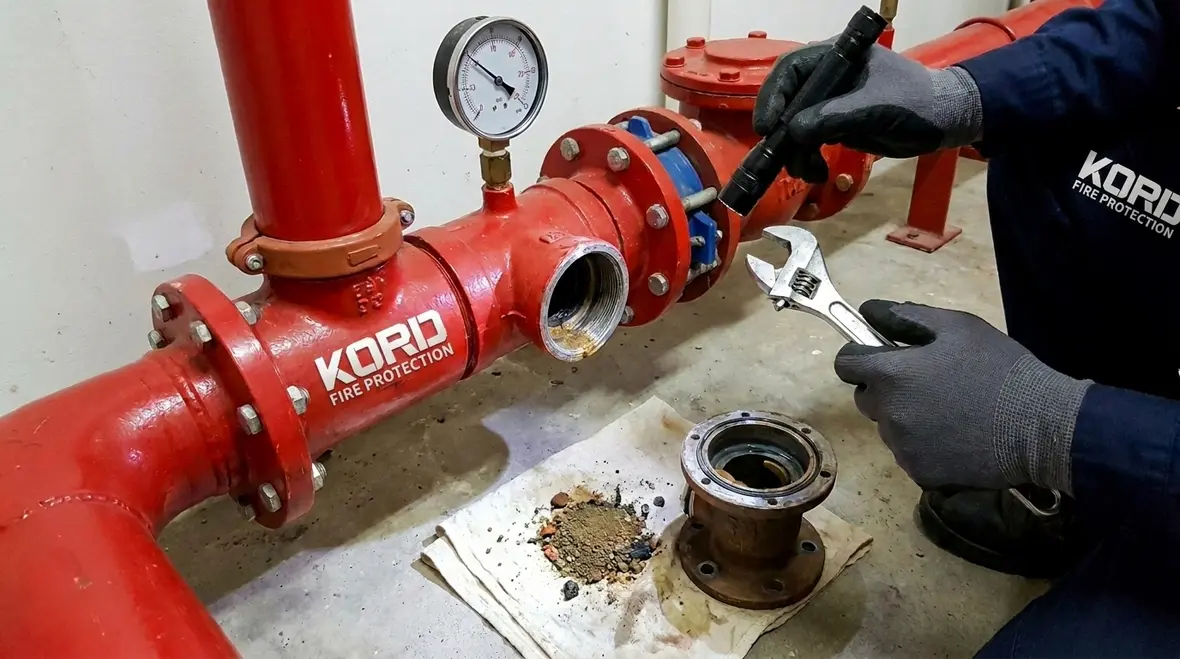
Strainers, water filters, and similar devices protect downstream components. When these accumulate debris or scale, they can imitate an obstruction by creating a flow restriction. Investigators inspect, clean, and verify the correct reassembly. They also confirm that strainer screens are installed properly and that gaskets and seals prevent bypass that could conceal a partially blocked condition.
4) Confirm pipe section integrity and internal contamination risk
Once valve lineup and strainer performance are verified, technicians evaluate the pipe section integrity and internal condition. Common failure points include:
- Construction debris or thread sealant residue introduced during installation or modifications.
- Corrosion scale accumulation reducing effective area, especially in older systems.
- Misaligned pipe supports causing sag or deformation that traps debris.
- Improper repair work that introduces internal restrictions at joints.
Investigators may use available access points, inspection ports, and sectional testing methods where permitted by site configuration. The investigation typically aims to determine whether flow impairment exists in the suspected segment.
5) Decide on the corrective action and document evidence
When the investigation confirms a blockage or obstruction mechanism, the team selects corrective action such as cleaning, flushing, replacement of compromised pipe sections, or service of affected components. Documentation becomes a core deliverable. Records typically include:
- Baseline readings and test conditions.
- Valve lineup and operational status during investigation.
- Locations investigated and the rationale for selection.
- Findings such as debris type, scale presence, and component condition.
- Corrective actions completed and follow-up verification results.
This documentation supports compliance continuity and protects the facility’s operational readiness.
Where obstruction risks concentrate in fire piping systems
Obstructions typically form or accumulate at predictable locations. Understanding these hotspots improves investigation speed and reduces unnecessary disruption to occupants and operations.
Dead ends, low points, and flow transitions
Areas that promote debris settlement or trap flow, such as low points, dead ends, or transitions between pipe sizes, frequently become the origin of partial blockages. Scale and sediment tend to collect where velocity drops and water movement changes direction.
Strainers and reduced-bore components
Strainers are protective but can become restrictive. Reduced bore devices and certain fittings can also create higher friction losses that mimic obstruction effects. The investigation should differentiate between “normal restriction” and true blockage by comparing to baseline behavior.
Valve bodies and check valve internals
Valve internals can trap debris or develop deposits. A check valve that sticks can reduce effective flow or alter pressure readings, which may lead teams to suspect downstream obstruction. Confirming mechanical operation avoids misdirected work.
Recent modifications and renovation disturbances
Renovations often introduce debris, dislodge scale, or alter valve supervision and lineup. Even minor work near overhead piping can generate contamination that later travels to vulnerable sections. Facilities that operate in cycles of tenant improvement should treat post construction verification as part of the ongoing compliance strategy.
Tools, testing methods, and operational checks that strengthen outcomes
A successful obstruction investigation uses the right combination of evidence gathering and verification. Investigators typically coordinate water supply, pressure measurement, and staged isolation to confirm whether impairment persists after corrective actions.
Pressure and flow verification
Technicians compare measured pressure values during controlled operating conditions to expected trends. Because other factors such as supply variations and concurrent loads can impact readings, investigators confirm test conditions remain consistent with prior documented baselines.
Component inspection and cleaning verification
When a strainer or internal component is cleaned, the investigation verifies that the component returns to a restored condition. Teams confirm installation integrity, including proper seating, gaskets, and alignment. Follow-up readings validate that the system behavior returns toward expected performance.
System readiness and post correction confirmation
NFPA 25C Chapter 14 obstruction investigation fire piping systems relies on verification after corrective actions. That means confirming the system operates as intended and documenting the results so future inspections can reference the corrected condition.
For facilities with water-based protection systems, teams often coordinate these activities alongside related maintenance expectations. Kord Fire Protection supports integrated compliance planning for ongoing service through its broader full fire protection services offering. Additional technical context on related code maintenance themes appears in these resources: ([kordfire.com](https://kordfire.com/full-fire-protection-services/?utm_source=openai))
Commercial maintenance realities: staffing, scheduling, and audit-ready documentation
Even when investigations follow the right technical steps, facilities can still fail compliance if documentation, access coordination, or corrective action verification lacks rigor. Commercial sites often face time windows, occupied space constraints, and coordination needs across engineering, contractors, and facilities management.
Common real-world challenges include:
- Limited access to pipe sections and valve locations which slows isolation and increases downtime risk.
- Record drawing gaps that make it difficult to map suspect zones accurately.
- Inconsistent baseline data leading to ambiguous conclusions during investigations.
- Repeated findings that indicate unresolved root causes such as ongoing contamination sources.
Kord Fire Protection supports commercial facility operators with practical compliance processes, including investigation documentation designed for audit readiness and follow-up verification that closes the loop. For teams planning ongoing service, aligned maintenance intervals across water-based systems reduces the chance that partial obstructions progress unnoticed.
Service partnership details can vary by region. For additional regional information, see:
Frequently Asked Questions
Next step: schedule an obstruction risk and readiness review
Commercial systems that show abnormal performance deserve an evidence-based investigation, not repeated guesswork. Kord Fire Protection can help facilities plan compliant testing, validate baseline performance, identify obstruction risk concentrations, and document corrective actions so operations stay audit-ready. Contact Kord Fire Protection to schedule a review and establish an ongoing maintenance strategy aligned with NFPA expectations for water-based fire protection and fire piping performance.

Join Our Newsletter!
Get the latest fire safety tips delivered straight to your inbox From our Newsletter.