
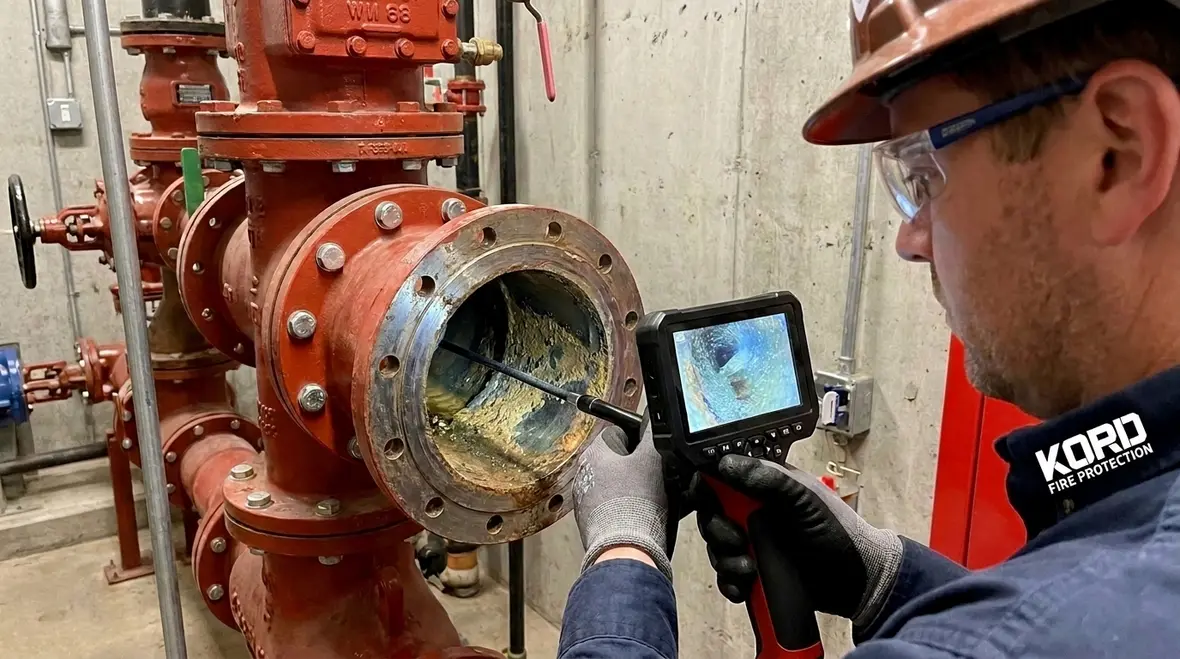
NFPA 25C Section 14.2: Internal Inspection of Fire Protection Piping Procedures
Quick Answer
NFPA 25C Section 14.2 sets procedural requirements for internally inspecting fire protection piping to verify internal condition and serviceability. It defines how systems get inspected, how findings get documented, and what follow up actions are expected when internal corrosion, scale, or obstructions impair performance.
What NFPA 25C Section 14.2 requires for internal inspections
NFPA 25C Section 14.2 internal inspection fire protection piping focuses on confirming that water based fire protection piping remains internally clean, properly sized, and free of conditions that could reduce water delivery. In practical commercial operations, this procedure addresses an ongoing reality: piping that looks “fine” externally can still accumulate internal scale, corrosion byproducts, sediment, microbiologically influenced corrosion, or debris that gradually reduces flow area.
Facilities commonly impacted include commercial offices, retail spaces, distribution centers, industrial plants, and institutional occupancies that rely on sprinkler, standpipe, hose, or other water based systems. Maintenance teams typically handle this work as an interval based, documented compliance task coordinated with the facility’s fire protection program, risk management plan, and life safety inspection schedule.
For a broader maintenance context near the top of this article, Kord Fire Protection’s NFPA 25 overview for complete water-based fire protection systems maintenance breakdown is a natural companion read if you’re mapping internal piping inspections into a larger compliance program.
When internal inspection applies and how facilities plan access
Internal inspection under NFPA 25C Section 14.2 internal inspection fire protection piping is not treated as a one off “check.” It requires planning for access, safe impairment controls, and coordination with the building fire protection status. The most common commercial challenge is operational continuity. Many facilities cannot shut down fire protection piping without structured impairment procedures, tenant coordination, and sometimes temporary protection measures.
Key planning steps for compliance readiness
Confirm system scope: Identify which piping segments fall under internal inspection requirements based on system configuration, water source, and prior maintenance history.
Review prior documentation: Compare past internal inspection findings, flushing results, and corrosion indicators to target the highest risk sections first.
Plan impairment and notifications: Align with the facility’s fire safety management process and local authority requirements. Coordinate with occupants, security, and fire watch if required.
Prepare for disassembly: Ensure valves, unions, couplings, and test connections support safe removal and reassembly of required components.
Operationally, Kord Fire Protection commonly supports facilities by integrating internal inspection planning into the water based fire protection systems maintenance breakdown, using a schedule that reduces repeat shutdowns and avoids overlapping impairments across multiple systems.
Internal inspection procedure: what teams actually do in the field
NFPA 25C Section 14.2 internal inspection fire protection piping drives procedural discipline. The internal inspection process generally follows a practical sequence that ensures internal conditions can be observed and accurately assessed. While the exact methodology depends on the piping arrangement and the system type, the field process typically involves controlled access, internal observation at selected points, and verification through documentation.
1) Establish controlled access points
Technicians establish access at locations that allow internal viewing and safe sampling of the pipe’s internal condition. Access usually involves using existing drain test connections, inspection points, or controlled openings where allowed by the system design. Teams also verify that removing components will not compromise pressure boundary integrity or create uncontrolled leak paths.
2) Manage water conditions and debris
Before opening piping sections for internal inspection, the work group establishes whether the piping contains standing water, active flow, or settled sediment. Many failure points occur when scale and debris dislodge during disassembly, spreading into other segments. Proper capture, containment, and cleaning of dislodged material support accurate inspection results and reduce the need for repeat corrective actions.
3) Inspect internal surfaces for performance affecting conditions
Internal inspection typically looks for conditions that can impair fire flow, including corrosion, tuberculation, deposits, scale, and obstructions. The most common operational indicators in commercial systems include:
Internal corrosion and pitting: Reduces wall integrity and increases roughness that decreases flow.
Scale and sediment buildup: Narrows flow passages and can migrate into control valves and sprinklers.
Debris accumulation: From construction residue, continued maintenance byproducts, or degraded system components.
Signs of water quality driven corrosion: Including uneven corrosion patterns and deposits consistent with microbiologically influenced corrosion.
4) Document findings with system relevant detail
NFPA 25C Section 14.2 internal inspection fire protection piping emphasizes traceable documentation. Commercial compliance fails most often at the documentation layer, not the inspection layer. Reports should include the location, date, piping segment identification, observed conditions, and any immediate corrective recommendations. Where equipment like fire pumps, check valves, and strainers exist, documentation should connect observed piping condition to potential downstream effects.
For context on maintenance expectations across water based systems, Kord Fire Protection provides a practical reference in its overview of complete water based fire protection systems maintenance breakdown.
Review: NFPA 25 overview for water based fire protection system maintenance breakdown
Common failure points that trigger corrective action
Internal inspection should not only confirm “pass” or “fail.” It should drive actionable corrective work aligned with the facility’s risk profile and the operational importance of the affected piping. The following failure points repeatedly create compliance pressure in commercial, industrial, and retail environments.
Deposits that limit hydraulic performance
Even moderate scale or sediment can reduce effective pipe diameter, increasing friction losses and lowering delivered flow and pressure. In heavily tenanted retail or mixed-use buildings, this can lead to uneven performance that becomes evident during system tests or flow related complaints.
Localized corrosion at fittings and low points
Corrosion often concentrates at elbows, tees, reducers, and trapped low points where water stagnates. Facilities that focus only on large straight runs miss localized failures that can significantly affect flow and system reliability.
Debris migration into sensitive components
When debris is disturbed during maintenance without proper controls, it can migrate to smaller downstream components such as valves, strainers, waterflow switches, and in worst cases sprinklers. This creates an additional compliance and inspection burden that can escalate costs quickly.
Inadequate reassembly and sealing controls
Another frequent issue arises after inspection when components are reassembled without verified torque, gasket integrity, or alignment. Water leakage and corrosion acceleration can follow, undermining the purpose of internal inspection.
Kord Fire Protection and related service partners support facilities by pairing internal inspection with a broader water based system approach that includes verification of installation and maintenance practices. For additional installation context, see:
NFPA 13 overview: automatic fire sprinkler system installation
After inspection: what “compliant follow up” looks like
When internal inspection identifies impairing conditions, follow up actions should restore system reliability and support future inspection performance. In commercial facility operations, this is where budgets, downtime windows, and coordination drive results.
Recommended follow up actions
Internal cleaning or flushing: Remove deposits where hydraulically and operationally appropriate. Flushing should account for debris capture and downstream protection.
Component replacement: Replace sections or fittings with corrosion damage that threatens integrity or creates persistent deposit conditions.
Review water quality and corrosion drivers: Address conditions that sustain corrosion, including stagnation, chemistry issues, and system design factors.
Verification testing: Perform post corrective work verification to confirm system readiness and confirm that debris did not migrate into critical components.
Update the facility maintenance program: Adjust inspection frequency, sampling locations, and internal access planning based on observed trends.
Commercial facilities also benefit from aligning internal inspection outcomes with local code interpretation and enforcement practices. Where California requirements and enforcement expectations affect your documentation and process, Kord Fire Protection offers additional practical guidance in its California focused sprinkler code explanation.
Fire sprinkler code in California explained
For facilities that operate with high reliability expectations around fire pumps and water delivery, external technical resources from firepumps.org can also support engineering level understanding during corrective planning.
How to keep NFPA 25C internal inspection audit ready
Audit readiness depends on repeatable processes and clean traceability. Internal inspection fire protection piping work fails during audits when documentation is incomplete, locations are vague, or corrective actions cannot be tied to the observed findings.
Audit ready documentation checklist
System identification: Building name, system type, and piping segment identification that matches drawings.
Inspection method and access points: How access was obtained and what internal condition was observed.
Findings with operational relevance: Deposits, corrosion severity indicators, and any obstruction conditions.
Photographic evidence when applicable: Controlled, consistent imagery that supports findings.
Corrective action plan: Cleaning, replacement, and verification steps with dates and responsibilities.
Updated maintenance schedule: If future inspections need different access points or intervals.
Kord Fire Protection supports commercial maintenance teams by coordinating NFPA aligned work through structured scheduling and service documentation, reducing the operational friction that usually comes from repeated system impairments and fragmented inspection records. For reference on Kord Fire Protection service positioning and related information, see Kord Fire Protection resources at kordfire.com and kordfire.com.au.
Frequently Asked Questions
Conclusion and call to action
NFPA 25C Section 14.2 internal inspection fire protection piping protects system performance by addressing internal corrosion, scale, sediment, and obstructions that reduce flow. If your facility needs audit ready documentation, coordinated impairment planning, and field validated inspection results, contact Kord Fire Protection to schedule internal piping inspections and corrective follow up under a structured commercial maintenance program.

Join Our Newsletter!
Get the latest fire safety tips delivered straight to your inbox From our Newsletter.


