Comms Room Fire Suppression Mistakes and Fixes
There is a quiet room in almost every building that holds more power than the boardroom. It hums. It blinks. It never sleeps. And when it burns, everything stops.
That is why comms room fire suppression deserves more respect than it often gets. Inside those racks sit switches, servers, patch panels, and the digital backbone of the business. Yet too many installations miss critical details. According to Kord Fire Protection technicians, the problem is rarely the intent. It is the oversight. Small assumptions. Tight budgets. Last minute retrofits. And sometimes, pure optimism.
This article explores what most installations get wrong, why it happens, and how to fix it before a small spark turns into a six figure lesson.

Why Smaller Telecom Rooms Carry Bigger Risks Than Expected
Many facility managers focus on large data centers. They install clean agent systems, layered detection, and strict maintenance plans. However, the smaller telecom room down the hallway often receives far less attention.
That is where the danger hides.
Smaller telecom rooms overlooked risks include:
- Limited ventilation leading to faster heat buildup
- Cable congestion that traps heat and fuels fire spread
- Inadequate separation from storage materials
- No automatic suppression at all
Because these rooms seem minor, decision makers treat them like oversized closets. In reality, they connect entire floors, remote branches, security systems, and cloud access. One failed switch can shut down phones, access control, and payment systems in minutes.
Kord Fire Protection technicians often explain it this way. The room may be small, but the impact radius is not. It is like ignoring a tiny leak under the sink. Eventually, the floor gives way.
Moreover, smaller rooms tend to evolve over time. Extra equipment gets added. Temporary cabling becomes permanent. Before long, the fire load doubles, yet the original protection remains unchanged.
If you are looking at a space that has quietly grown from “small comms closet” into the backbone of your operations, it may be time to treat it with the same discipline used in full data centers. Resources like Kord Fire’s data center fire prevention strategies for modern facilities can offer a blueprint for applying big-room thinking to small but critical telecom spaces.
What Most Installations Get Wrong in Detection Coverage
Fire suppression is only as good as the detection that triggers it. Unfortunately, improper detection coverage ranks among the most common mistakes in telecom fire protection setups.
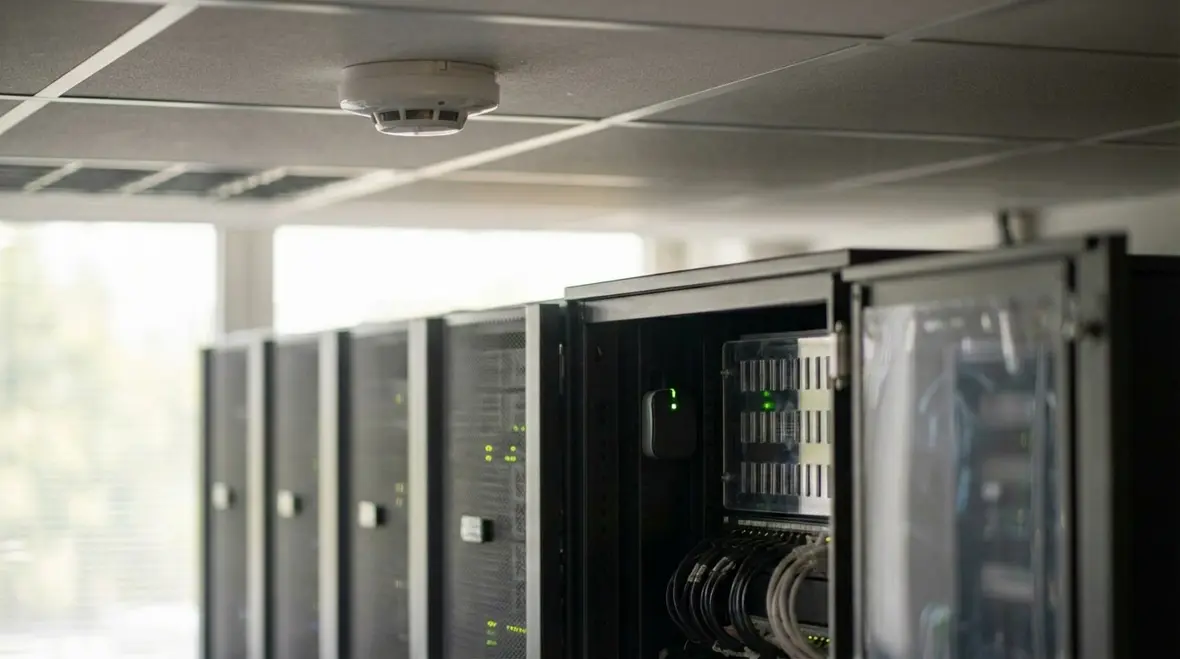
In many cases, installers place a single ceiling detector in the center of the room and call it done. On paper, it checks a box. In practice, it leaves blind spots.
Consider the airflow. Network racks pull cool air from the front and exhaust hot air from the back. Consequently, smoke may rise in narrow channels or linger inside cabinets before reaching the ceiling. By the time a standard detector activates, the fire may already have grown.
Kord Fire Protection technicians frequently recommend layered detection strategies, such as:
- Ceiling mounted smoke detectors
- In rack detection for high density cabinets
- Aspirating smoke detection systems for early warning
- Heat detection in specific risk zones
Additionally, coverage must account for obstructions. Cable trays, containment systems, and partitioned spaces can block smoke movement. Therefore, detector placement should reflect actual airflow patterns, not just room dimensions.
After all, smoke does not read floor plans.
For facilities where server rooms and comms spaces blend together, it helps to zoom out and look at the total risk picture. Guides like Kord Fire’s overview of the best server room and data center fire suppression solutions show how detection, suppression, and human response plans should work together, not as isolated checkboxes.
Comms Room Fire Suppression and the Myth of One Size Fits All
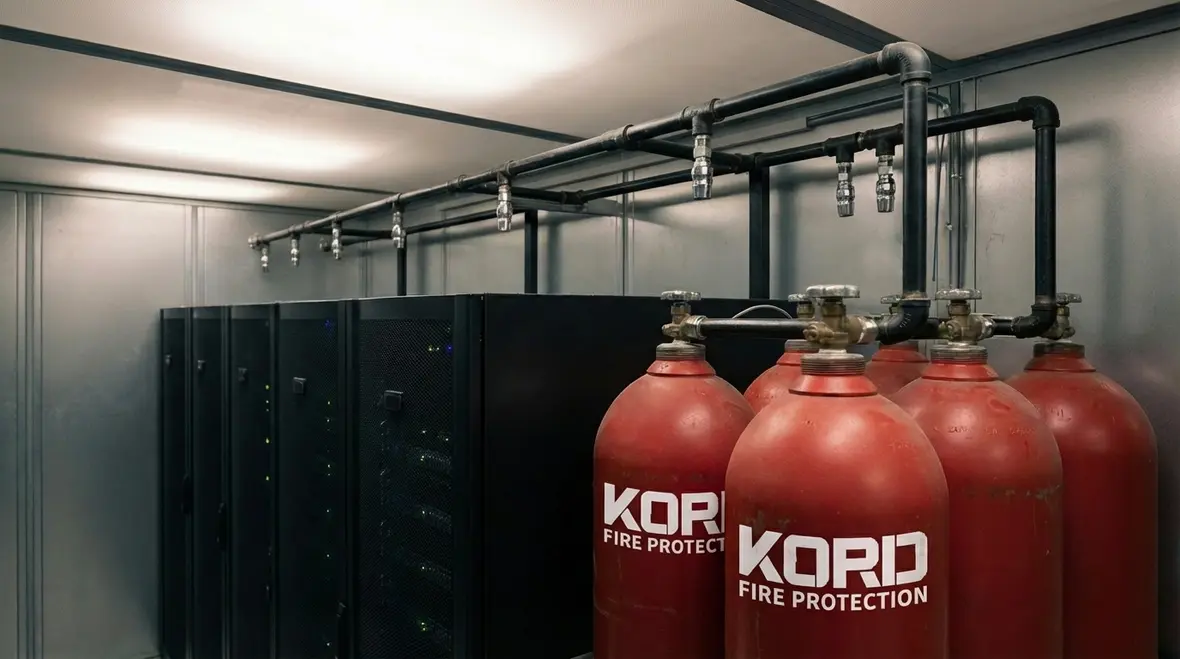
When it comes to comms room fire suppression, many assume that any clean agent system will do the job. However, not all rooms share the same volume, leakage rate, or equipment sensitivity.
Some installations use systems designed for larger data halls without adjusting discharge timing or concentration. Others select lower cost options without evaluating enclosure integrity. As a result, the agent may not reach or maintain the required concentration to extinguish the fire.
Kord Fire Protection technicians emphasize enclosure integrity testing. If the room cannot hold the agent long enough, the system cannot perform as intended. It is that simple.
Furthermore, discharge nozzles often receive little attention. Poor placement can create uneven distribution, leaving pockets where fire can persist. In a tightly packed telecom space, even small distribution gaps matter.
Choosing the correct system also depends on:
- Room volume and ceiling height
- Type and density of equipment
- Human occupancy patterns
- Integration with existing alarm systems
In other words, fire protection is not a vending machine. One button does not fit all.
Retrofit Constraints That Sabotage Good Intentions
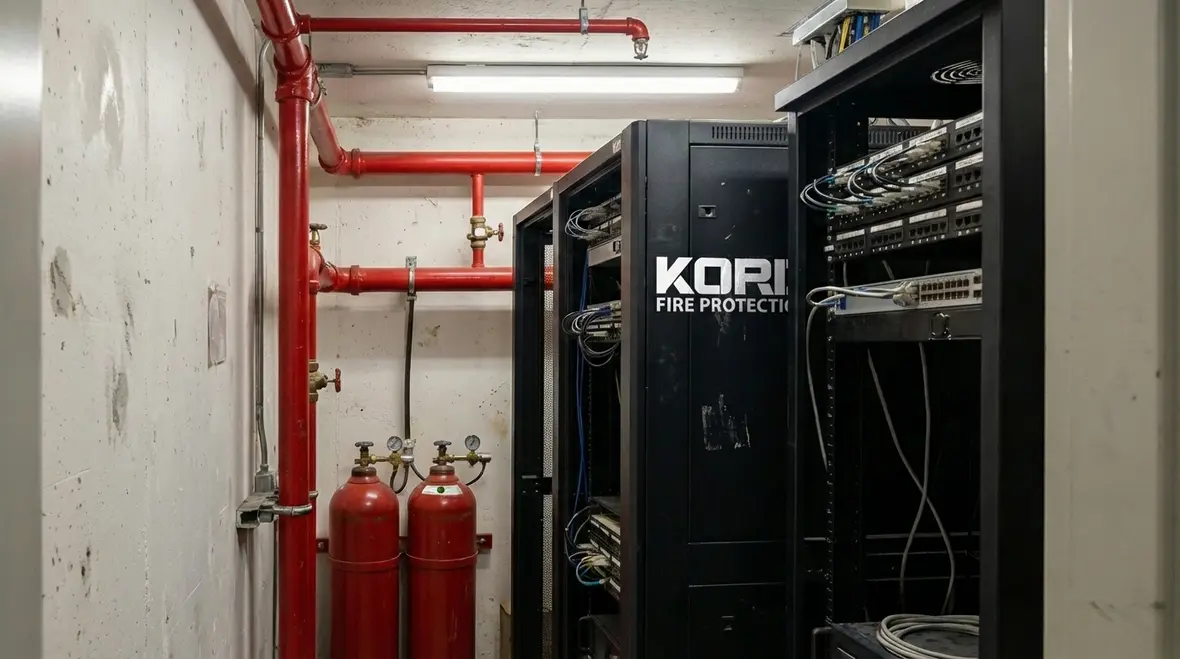
Most telecom rooms were not built with fire suppression in mind. They were storage spaces first. Technology hubs second. Fire protection came later.
Retrofit constraints create real challenges:
- Limited ceiling space for piping
- Concrete walls that complicate nozzle placement
- Shared risers with other building systems
- No room for cylinders inside the space
Because of these limits, some installations compromise design standards. For example, cylinders may be placed far from the hazard, increasing pipe length and pressure loss. Alternatively, detection devices may be spaced based on convenience rather than code.
Kord Fire Protection technicians often walk into retrofit projects where the room has already been filled with racks. There is barely space to stand, let alone run pipework. Nevertheless, proper planning can still deliver a compliant solution.
Early coordination with electrical and IT teams makes a significant difference. When fire protection joins the conversation late, the room layout is already fixed. And as any technician will say, moving a pipe is easier than moving a fully populated server rack.
How Should a Comms Room Fire Protection System Be Designed?
This is the question many facility managers type into search engines at 2 a.m. after reading an audit report.
A well designed system follows a clear process.
1. Risk Assessment
First, specialists evaluate the equipment type, power density, and business impact of downtime. This step defines the performance objective.
2. Enclosure Evaluation
Next, they assess wall construction, penetrations, and leakage paths. Sealing cable entries and door gaps often improves system effectiveness dramatically.
3. Detection Strategy
Then, they select detection types based on airflow and rack layout. Early warning systems may be justified in high value environments.
4. Suppression Selection
After that, they choose the appropriate clean agent or alternative solution, sized precisely for the room volume.
5. Integration and Testing
Finally, they integrate alarms, shutdowns, and signaling, followed by full commissioning and testing.
Kord Fire Protection technicians stress that documentation and training matter just as much as hardware. Staff must understand what happens during discharge, how to respond, and how to reset systems safely.
Because when alarms sound, clarity beats panic every time.
For teams that want to align comms room protection with broader data center practices, Kord Fire’s data center clean agent fire suppression guide offers a deeper dive into design, testing, and maintenance steps that translate directly into smaller but equally critical telecom environments.
Where Installations Drift Off Course
Even with good intentions, projects drift. Budgets tighten. Deadlines loom. Therefore, shortcuts appear.
Common missteps include:
- Skipping enclosure sealing to save time
- Using generic layouts without room specific calculations
- Failing to update protection after equipment expansion
- Ignoring annual inspection and maintenance
Moreover, some businesses assume that because the system has never discharged, it must be working perfectly. That logic is like saying a parachute is fine because it has never been opened. Comforting, perhaps. Accurate, not necessarily.
Regular inspections identify pressure loss, detector faults, and control panel issues before they become failures. In addition, updates ensure that system capacity matches current equipment loads.
Smaller Telecom Rooms Overlooked Risks and Detection Gaps
To bring these issues together clearly, consider the following comparison drawn from field observations shared by Kord Fire Protection technicians.
Area of Concern
Smaller telecom rooms overlooked risks
Improper detection coverage
Retrofit constraints
What Often Happens
Treated as low priority storage spaces
Single ceiling detector only
Design altered to fit remaining space
What Should Happen
Assessed as critical infrastructure with full risk review
Layered detection including in rack or aspirating systems
Coordinated planning to meet code and performance standards
This contrast highlights a simple truth. The gap between average and excellent protection often lies in planning, not technology.
FAQ About Telecom Room Fire Protection
Protect the Quiet Room Before It Speaks in Smoke
The telecom room rarely asks for attention. It simply performs. Yet when protection falls short, the silence breaks with alarms, downtime, and regret. Kord Fire Protection technicians encourage businesses to review their systems before problems surface. A careful assessment today can prevent costly disruption tomorrow.
Engage specialists who understand design, detection, and retrofit realities. Because when it comes to protecting critical infrastructure, proactive planning always wins. If you are ready to align your comms room with proven practices from larger facilities, connect with Kord Fire’s team through their server room fire suppression solutions and broader clean agent fire suppression services to turn that quiet room into a quietly protected one.
Know Your Weapon Before You Fight the Flame
Kord Fire Protection is your go-to when it comes to all things fire protection. For over 20 years, we’ve been serving Southern California with the quality service and equipment to keep your home or business safe at all times. Our competitive prices reflect our unwavering commitment to protecting what matters most in the event of a fire emergency. Give us a call, send an email, or use that form!

Join Our Newsletter!
Get the latest fire safety tips delivered straight to your inbox From our Newsletter.