NFPA 25C Chapter 1 Administrative Requirements: Complete Guide for California Fire Protection
Quick Answer
NFPA 25C Chapter 1 establishes the administrative rules that govern how facilities in California must manage, document, and oversee inspection, testing, and maintenance for fire protection systems. These requirements drive contractor qualifications, documentation, scheduling, and corrective action accountability.
Why Chapter 1 Matters for Commercial Compliance in California
Many facilities assume that compliance begins with field inspections and ends with a completed checklist. In practice, NFPA 25C Chapter 1 administrative requirements California fire protection set the operational framework that determines whether maintenance work is valid, traceable, and defensible during audits, insurance underwriting, and local authority review.
For commercial, industrial, and retail environments, the administrative layer becomes especially important because systems often span multiple vendors, multiple buildings, and different occupancy schedules. Chapter 1 helps facilities standardize accountability for records, the control of documentation, the timing of required activities, and the process for addressing deficiencies that affect system reliability.
Where California facilities frequently struggle is not the lack of technical knowledge, but the lack of a consistent administrative process. Without clear documentation control and correction discipline, even properly performed maintenance can fail to satisfy code-driven expectations.
A natural next step for facilities building a stronger compliance program is reviewing fire sprinkler system service support from Kord Fire Protection, especially when ongoing inspection, maintenance, and repair coordination needs to stay organized across commercial properties. ([kordfire.com](https://kordfire.com/fire-sprinkler-service/?utm_source=openai))
What Chapter 1 Admin Requirements Actually Require
Chapter 1 functions as a governance layer for NFPA 25C. It addresses how the organization plans maintenance, who is responsible for coordination, what records must be kept, and how deficiencies are handled. The intent is to ensure that inspections and tests occur under controlled conditions and that results are not lost, overwritten, or disconnected from corrective actions.
In day-to-day operations, these topics typically influence:
- Scope and system coverage across water-based and related fire protection components.
- Inspection and testing responsibility for qualified personnel and approved service processes.
- Recordkeeping that connects the inspection findings to repairs, replacements, and verification.
- Corrective action workflow that establishes timing, documentation, and follow-up.
- Coordination with facility leadership, operations, and contractors during scheduled shutdown windows.
For a practical perspective on how NFPA 25 activities connect to water-based systems and maintenance outcomes, facilities often benefit from cross-referencing Kord Fire Protection’s maintenance approach for complete water-based systems: NFPA 25 overview: complete water-based fire protection systems maintenance breakdown.
Administrative Controls That Protect System Readiness
Administration under Chapter 1 is not paperwork for its own sake. It directly supports operational readiness by ensuring that inspections and tests can be repeated, verified, and traced to real hardware conditions. The most common failure points arise when administrative controls are informal.
1) Contractor qualification and documented responsibility
Chapter 1 expectations require an organized approach to who performs inspections and who assumes responsibility for outcomes. In commercial facilities, contractors may rotate due to scheduling, subcontracting, or regional coverage. Without explicit responsibility boundaries and documented procedures, record gaps develop quickly.
Kord Fire Protection supports a repeatable process for commercial sites by aligning field work with documentation standards that help maintain audit readiness across multiple system types.
2) Recordkeeping that links findings to corrective actions
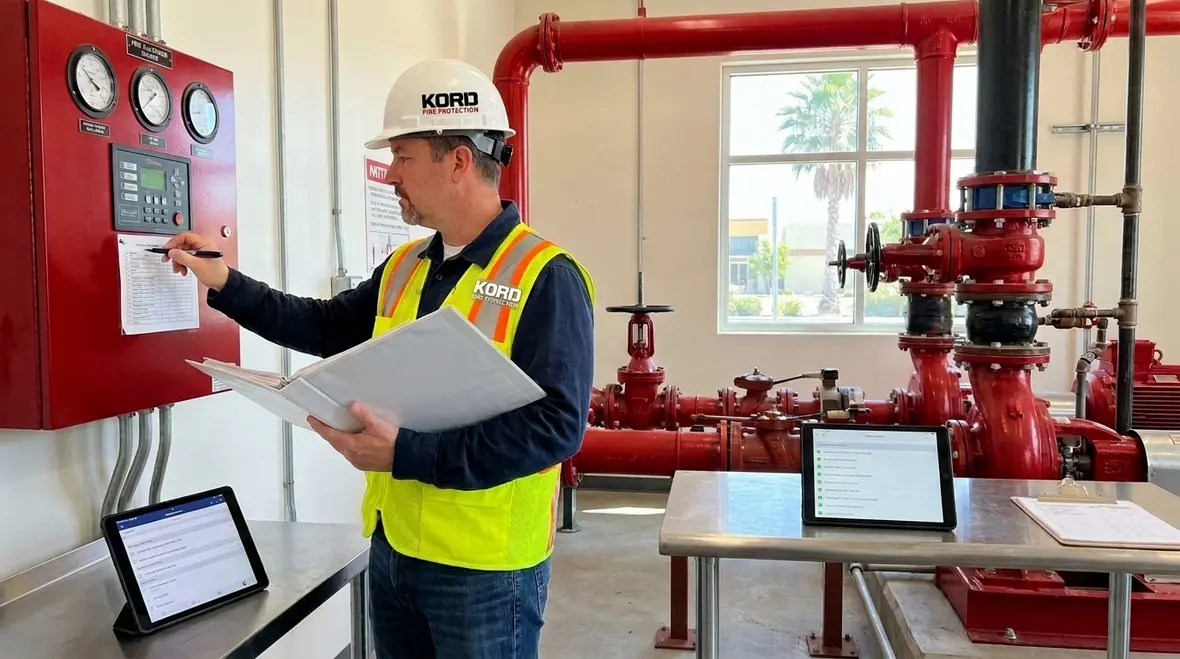
A recurring administrative issue is the separation between “inspection notes” and “repair verification.” Facilities may collect initial findings but fail to document what was corrected, when it was corrected, and what test evidence confirms correction.
Best practice is a single traceable record set where every deficiency includes:
- Identification of the affected component.
- Initial condition observed during inspection or test.
- Corrective action details and dates.
- Verification testing or re-inspection confirmation.
3) Scheduling discipline for commercial uptime
Administrative requirements also drive how testing is scheduled to minimize operational disruption. For example, system impairment practices and coordination with building operations determine whether required testing can occur without skipping steps.
Facilities that attempt to “fit” testing around tenant activity often miss the planned timing windows. Over time, timing drift creates compliance risk and operational uncertainty.
For facilities transitioning from installation to maintenance, Kord Fire Protection’s overview of sprinkler system installation helps clarify system baseline assumptions that later testing depends on: NFPA 13 overview: automatic fire sprinkler system installation. ([kordfire.com](https://kordfire.com/nfpa-13-overview-automatic-fire-sprinkler-system-installation/?utm_source=openai))
How Chapter 1 Drives Day-To-Day Maintenance Workflows
Chapter 1 administrative requirements influence the structure of maintenance programs. They define the governance that tells field teams what to do, when to do it, how to document it, and how to close out corrective items.
Start with a system inventory aligned to the code scope
Many facilities maintain a system inventory that reflects original construction documents, not the current field condition. Administrative controls must ensure inventory reflects additions, renovations, and off-line equipment. Without this alignment, inspections can miss components or apply the wrong testing assumptions.
Use a test-ready plan for water-based fire protection systems
Administrative readiness becomes critical for water-based systems because testing often depends on controlled flow conditions, pressure stability, and coordinated access. A maintenance plan should account for:
- Access to valves, drains, gauges, and test connections.
- Operational impact and building coordination.
- Documentation format and evidence collection standards.
For additional context on water-based systems and maintenance outcomes, see Kord Fire Protection’s approach: complete water-based fire protection systems maintenance breakdown.
Handle deficiencies with closure verification, not just repair completion
Administrative requirements emphasize that deficiencies must be corrected in a structured manner. The facility must confirm that repairs resolved the root cause and that the system returns to an acceptable condition through appropriate verification.
In practice, the difference between compliance and noncompliance can be whether the closure package includes test evidence that the system performs as intended after the repair.
California-Specific Compliance Challenges Facilities Should Expect
California facilities typically face a combination of code interpretation practices, local enforcement expectations, and operational realities that complicate administrative compliance. Chapter 1 becomes the bridge between “what the system is” and “how the facility proves it is maintained.”
Local coordination and documentation defensibility
Local officials and stakeholders often evaluate whether the facility can demonstrate a systematic maintenance program rather than one-off repairs. Administrative records that show consistent timing, traceability, and closure discipline reduce friction and improve review outcomes.
Commercial and multi-tenant complexity
Retail and industrial properties frequently include tenant-controlled spaces, frequent operational changes, and renovation cycles. When administrative control is weak, documentation can lag behind field changes, and inspections can become misaligned with actual system configuration.
Cross-referencing installation baselines to maintenance expectations
Maintenance testing depends on the baseline design intent and installed configuration. If renovation drawings or original documentation do not match current field hardware, inspection teams can encounter hidden mismatches that create administrative complications.
For California context related to water-based fire sprinkler code considerations, see: Fire sprinkler code California explained. ([kordfire.com](https://kordfire.com/fire-sprinkler-code-california-explained/?utm_source=openai))
Frequently Asked Questions
Next Step: Build a Chapter 1 Compliant Maintenance Program
Facilities in California can protect readiness by implementing Chapter 1 administrative controls that tie inspections, testing evidence, and deficiency closure into one traceable system. Kord Fire Protection helps commercial, industrial, and retail owners maintain compliance through structured documentation, scheduled testing coordination, and reliable field execution. Contact Kord Fire Protection to assess current records, confirm maintenance workflow gaps, and establish a repeatable Chapter 1 compliant program. ([kordfire.com](https://kordfire.com/?utm_source=openai))

Join Our Newsletter!
Get the latest fire safety tips delivered straight to your inbox From our Newsletter.