
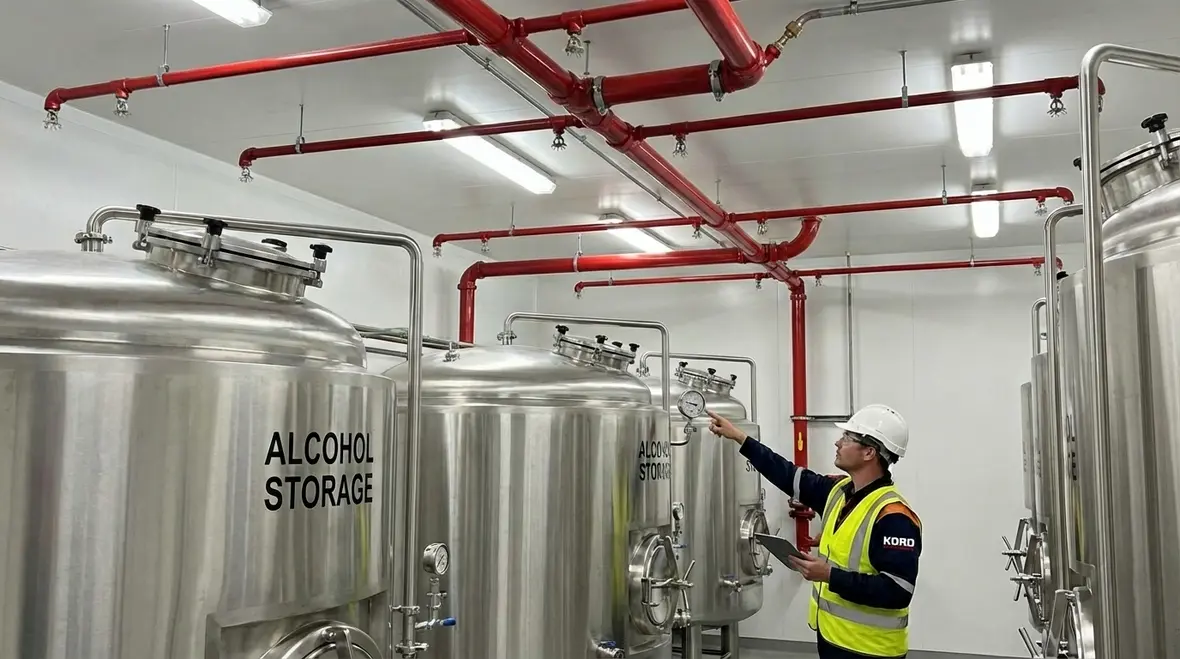
Fire Sprinkler Protection for Alcohol Tank Rooms
Fire Sprinkler Protection of Alcohol Tank Rooms: Design Considerations and Pitfalls
In facilities where high proof spirits rest quietly inside steel tanks, the risk rarely announces itself with drama. Yet the need for fire sprinkler protection of alcohol tank rooms stands as one of the most critical life safety decisions a facility owner can make. Within the first few seconds of ignition, alcohol vapors can flash, spread, and intensify with unsettling speed. Therefore, proper suppression design is not a luxury. It is survival engineering.
Kord Fire Protection technicians often explain it in plain terms. Alcohol does not forgive hesitation. It behaves differently than ordinary combustibles, and as a result, the protection strategy must reflect that reality. Throughout this article, the deeper design principles, common mistakes, and practical lessons behind protecting alcohol storage rooms will unfold with calm authority and a touch of well placed humor. Because if one cannot smile while discussing code compliance, what are we even doing?

The Unique Fire Behavior of Alcohol in Tank Storage
Alcohol based liquids, particularly ethanol and similar solvents, burn clean and hot. However, the real hazard lies in their vapors. Since vapors can accumulate near ceilings and drift toward ignition sources, they create an invisible threat. Consequently, any protection system must account for both liquid pool fires and vapor ignition.
Unlike ordinary Class A combustibles, alcohol fires demand specific suppression approaches. Standard water discharge alone may dilute some fuels, but certain alcohols are water miscible. That means the fuel mixes with water rather than floating on top. As a result, fire can continue to burn even after sprinklers activate.
Kord Fire Protection technicians frequently remind facility managers that not all flames behave like a campfire in a backyard. In fact, an alcohol tank room fire is more like a special effects scene from an action film. It looks controlled until it very much is not. Therefore, system design must anticipate flame spread, radiant heat, and vapor movement within confined spaces.
Additionally, tank configuration matters. Vertical tanks, horizontal tanks, and intermediate bulk containers each influence fire dynamics differently. Because heat rises and radiates, ceiling height and ventilation patterns play a direct role in sprinkler activation time and effectiveness.
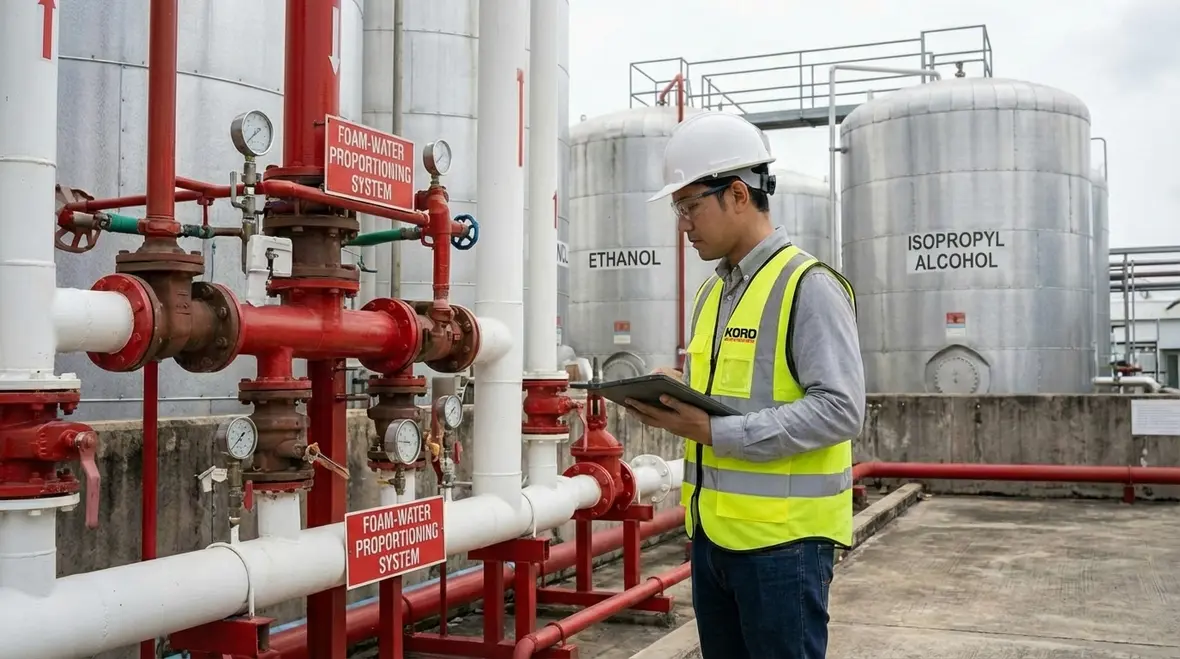
Designing Fire Sprinkler Protection of Alcohol Tank Rooms for Real World Conditions
When engineers approach fire sprinkler protection of alcohol tank rooms, they begin with hazard classification. Alcohol storage typically falls under Extra Hazard Group 2 or specific flammable liquid storage criteria, depending on the code adopted. However, design cannot rely on classification alone.
First, system density and discharge area calculations must reflect the expected fire size. Higher densities are often required compared to ordinary hazard occupancies. Moreover, sprinkler spacing must align with obstruction rules, especially around large tanks that block discharge patterns.
Foam water systems frequently enter the conversation. Since foam can create a vapor suppressing blanket over burning liquid, it provides added control for pool fires. Consequently, many facilities integrate foam proportioning systems with automatic sprinklers. That said, foam systems require precise design, testing, and maintenance. They are not set it and forget it devices.
Kord Fire Protection technicians emphasize hydraulic calculations that account for the most remote area. Furthermore, they look at water supply reliability. A system that works beautifully on paper but lacks sufficient pressure or duration in practice is like a superhero without powers. Impressive costume. Zero impact.
Ventilation design also influences sprinkler performance. Mechanical exhaust may reduce vapor accumulation; however, poorly designed airflow can feed a fire with fresh oxygen. Therefore, coordination between mechanical and fire protection disciplines is essential.
Common Pitfalls That Undermine System Performance
Even well intentioned projects can stumble. In fact, many failures stem from assumptions rather than negligence. One frequent issue involves underestimating the fuel load. Designers sometimes consider only the volume inside tanks, yet ignore secondary containers, transfer lines, or spill scenarios.
Another pitfall involves improper sprinkler selection. Standard spray sprinklers may not provide the necessary distribution for certain storage arrangements. Therefore, choosing between upright, pendent, or specific storage rated sprinklers requires careful evaluation.
Clearance violations also appear far too often. Storage placed too close to sprinkler deflectors disrupts discharge patterns. As a result, water fails to reach critical surfaces. Kord Fire Protection technicians often compare this to placing an umbrella upside down during a rainstorm. Technically present. Practically useless.
In addition, ignoring drainage can worsen outcomes. When sprinklers discharge over flammable liquids, runoff must flow safely to containment areas. Without proper trenching or slope, burning liquid may migrate beyond the original hazard zone. Consequently, secondary ignition points emerge.
Finally, inadequate inspection and testing undermine even the best designs. Foam concentrate can degrade. Valves can close. Alarm devices can fail silently. Therefore, routine maintenance remains a non negotiable part of long term reliability. Many facilities pair tank room systems with broader fire sprinkler testing programs to keep performance consistent across the site.

What Do Codes Require for Alcohol Tank Room Sprinkler Systems?
Building and fire codes provide structured guidance, yet they require interpretation. Standards such as NFPA 13 and NFPA 30 address flammable liquid storage and sprinkler design criteria. However, compliance demands more than copying tables.
Codes typically dictate minimum discharge densities, foam requirements for certain volumes, spill control measures, and fire department access. Additionally, explosion control or deflagration venting may be necessary depending on vapor concentration risks.
Kord Fire Protection technicians explain that code represents the floor, not the ceiling. In other words, meeting minimum requirements does not automatically guarantee optimal protection. Therefore, many facilities adopt enhanced measures based on risk assessments.
Authorities having jurisdiction also influence final design. Since local amendments vary, early coordination prevents costly redesign. Moreover, submitting detailed hydraulic calculations and equipment data builds trust during plan review.
Ultimately, codes establish guardrails. Yet thoughtful engineering ensures the vehicle stays safely within them.
Integrating Detection, Containment, and Suppression
Although sprinklers form the backbone of protection, they do not operate in isolation. Effective fire sprinkler protection of alcohol tank rooms integrates detection, containment, and emergency response planning.
Heat and flame detection systems can provide earlier warning before sprinklers activate. Consequently, staff gain precious seconds to initiate shutdown procedures. Gas detection sensors may also monitor vapor levels, reducing ignition risk before fire occurs.
Spill containment systems deserve equal attention. Curbs, trenches, and sloped floors limit liquid spread. As a result, sprinkler discharge remains concentrated where it is most needed. Furthermore, containment protects adjacent rooms and structural elements.
Emergency shutoff valves for transfer pumps reduce fuel supply during an incident. Kord Fire Protection technicians often describe this as turning off the faucet before mopping the floor. It sounds obvious. Yet many facilities overlook automated interlocks that stop fuel flow during alarm conditions.
Training completes the system. Employees must understand evacuation routes, alarm signals, and manual pull station locations. Because even the best engineered system cannot replace informed human response.
Advanced Layout Strategies for Tank Room Protection
Designers frequently ask how to optimize sprinkler layout around large cylindrical tanks. The answer lies in understanding shadow areas and heat collection zones.
Ceiling level sprinklers must cover open floor areas while accounting for tank top obstructions. In some cases, in rack or intermediate level sprinklers may supplement ceiling protection. However, placement must avoid mechanical damage and allow proper spray patterns.
Perimeter coverage around tank bases also matters. Since pool fires often start at floor level, discharge must reach beneath structural supports. Therefore, careful spacing and deflector positioning prevent dry spots.
Below is a simplified comparison that Kord Fire Protection technicians often use when explaining layout choices to facility owners.
| Design Element | Why It Matters |
| Higher density discharge | Controls rapid heat release from flammable liquids |
| Foam integration | Suppresses vapors and prevents re ignition |
| Clear tank spacing | Ensures unobstructed sprinkler spray patterns |
| Floor drainage slope | Directs runoff to safe containment areas |
| Reliable water supply duration | Sustains suppression during extended incidents |
Each decision influences system success. Therefore, designers must evaluate the room as a unified environment rather than isolated components.

Maintenance Realities and Long Term Reliability
Over time, even the most robust systems face wear. Valves corrode. Gauges drift. Foam concentrate can separate if stored improperly. Consequently, inspection and testing schedules must align with recognized standards.
Quarterly valve inspections confirm proper position. Annual flow tests verify water supply performance. Foam proportioning systems require periodic testing to ensure correct mixture ratios. Because too little foam reduces effectiveness, and too much wastes concentrate and may affect discharge characteristics.
Kord Fire Protection technicians approach maintenance with steady discipline. They document results, identify deficiencies, and recommend corrective action before minor issues escalate. In their view, prevention beats heroics every single time. Pairing tank room maintenance with broader full fire protection services helps facilities keep sprinklers, alarms, pumps, and extinguishers on a synchronized schedule.
Recordkeeping also supports compliance audits and insurance evaluations. Moreover, accurate documentation demonstrates due diligence, which can influence liability outcomes after an incident.
In the end, a neglected sprinkler system resembles an old gym membership. It exists. It costs money. Yet it delivers no benefit unless actively maintained.
Why Expert Guidance Changes the Outcome
Designing and maintaining fire sprinkler protection of alcohol tank rooms demands coordination across engineering, operations, and safety leadership. Since flammable liquid hazards evolve with production changes, systems must adapt accordingly.
Kord Fire Protection technicians bring field experience that bridges theory and practice. They evaluate tank arrangements, review hydraulic calculations, inspect installation quality, and verify code compliance. Furthermore, they explain complex requirements in clear language that decision makers understand.
Because ultimately, protection is not about passing inspections. It is about preserving lives, property, and business continuity. Alcohol production and storage facilities operate on tight schedules and narrow margins. Therefore, a single uncontrolled fire can disrupt supply chains and reputations overnight.
Thoughtful planning, precise installation, and disciplined maintenance create layers of defense. And while no system can promise absolute certainty, properly engineered suppression dramatically reduces risk.
Frequently Asked Questions
Conclusion: Protect What Matters Before the Spark
Alcohol tank rooms demand respect, precision, and unwavering attention to detail. Fire sprinkler protection of alcohol tank rooms is not simply a code requirement. It is a safeguard for people, property, and productivity. Kord Fire Protection technicians stand ready to evaluate, design, and maintain systems that perform when seconds count.
For facilities that store or process high proof spirits, investing in tailored protection now is far less costly than rebuilding after a preventable fire. From hazard classification and foam integration to drainage, detection, and staff training, each decision either adds a layer of resilience or leaves a gap for risk to slip through.
Contact the Kord Fire Protection team today and ensure that if a spark ever appears, your protection answers with confidence and control. Their comprehensive fire sprinkler, alarm, and suppression services help align alcohol tank room design with the rest of your life safety systems, so everything functions as one coordinated defense.
If you are planning a new tank room or upgrading an existing space, schedule a consultation to review your layout, water supply, foam needs, and long term testing plan. Protect what matters before the spark, and let Kord Fire Protection turn complex code requirements into a clear, actionable strategy for your facility.
Know Your Weapon Before You Fight the Flame
Kord Fire Protection is your go-to when it comes to all things fire protection. For over 20 years, we’ve been serving Southern California with the quality service and equipment to keep your home or business safe at all times. Our competitive prices reflect our unwavering commitment to protecting what matters most in the event of a fire emergency. Give us a call, send an email, or use that form!

Join Our Newsletter!
Get the latest fire safety tips delivered straight to your inbox From our Newsletter.


