

Commercial Kitchen Fire Suppression Design and Maintenance
Quick Answer: Strong design for commercial kitchen fire suppression starts with hazard mapping, correct suppression agent sizing, clean installation details, and disciplined commissioning and inspection. Safety managers should set clear maintenance cycles, train staff, and verify performance. Then, a partner like KORD Fire Protection helps keep systems compliant and ready, not just “installed.”
In Australia’s industrial and retail environments, commercial kitchen fire suppression is not a “nice to have.” It is a risk control that can protect people, assets, and downtime budgets when cooking fuels ignition. Right away, the design work matters: correct nozzles, proper pipe runs, reliable detection, and a maintenance plan that actually gets followed. Safety managers should treat this as a system job, not a box-checking task. And when the safety team needs real-world support, KORD Fire Protection can become a vital partner to align design, compliance, and inspection outcomes across sites.
Near the start of that planning, it also helps to connect the kitchen suppression scope with broader life-safety coordination, especially where alarms, shutdown logic, and reporting paths overlap. That is where fire alarm service systems fit naturally into the conversation, because suppression is strongest when detection, notification, and service records are moving in the same direction. For teams that want more context around hood protection itself, KORD Fire Protection also covers the topic in its commercial kitchen fire suppression systems guide.
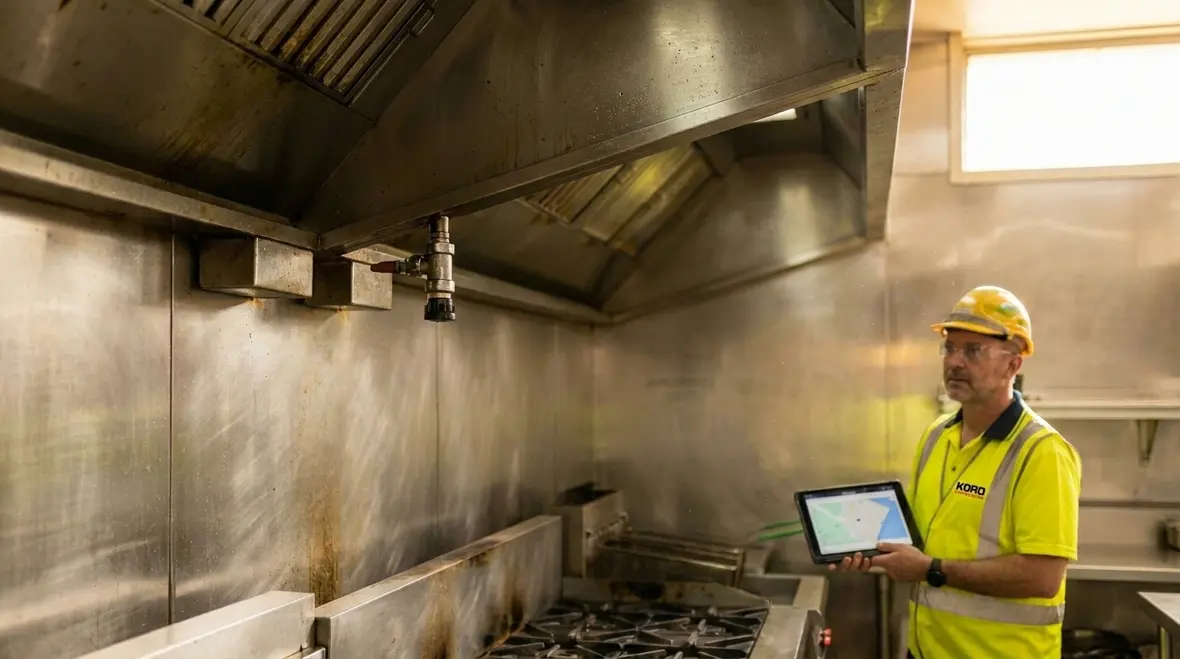
Why commercial hood hazards demand serious design
Kitchen fires rarely behave like movies. Instead of dramatic explosions, they often start as slow heat buildup, grease vapours, and ignition at the wrong moment. As a result, the suppression design must match how fires grow inside commercial hoods and ductwork. First, safety managers should confirm the cooking processes, fuel types, and ventilation patterns. Next, they should review hood construction, baffle presence, duct length, and how the hood interfaces with exhaust fans.
Because grease can accumulate in hidden places, effective systems aim at more than the visible flame. Therefore, designers should consider the full path from cooking surface through the hood cavity and into duct sections. If the system targets only one area, the fire can find the gaps like a cat slipping under a closed door. Nobody wants that scenario, especially when inspectors and insurers show up together.
Hazard mapping should happen before hardware decisions
A smart design sequence begins with the hazard, not the parts list. That means identifying fryers, charbroilers, ranges, open burners, solid-fuel appliances if present, and any equipment changes that happened after the original hood was installed. Many kitchens evolve over time, and the hood does not magically update itself out of professional pride. If equipment was swapped, moved, widened, or intensified, suppression coverage may no longer match reality. Safety managers should ask blunt questions early, because “we thought it was close enough” is not a maintenance strategy and definitely not a commissioning philosophy.
Key design best practices for safety managers
Safety managers should focus on a few essentials that determine success long before the first test discharge. Each item supports dependable performance under real conditions.
- Accurate hazard classification: Designers should verify the hazard level based on cooking equipment type, fire load assumptions, and hood configuration.
- Correct agent and enclosure strategy: The design should match the suppression medium to the hazard, so the system can control rather than merely “announce” a fire.
- Nozzle placement discipline: Proper nozzle location and coverage matter. Poor spacing can leave hot zones untouched.
- Pipe routing and discharge calculations: Contractors should follow the manufacturer and standard requirements for pipe sizes, lengths, and discharge parameters.
- Reliable detection integration: Detection must align with the hood and fire growth speed, and it should trigger the right sequence without delays.
Then, the safety manager should require a clear handover package: drawings, device schedules, set points, and evidence of commissioning. In practice, that documentation becomes the backbone for future inspections, audits, and internal training.
Design details that quietly make or break performance
The small details are usually where good systems separate themselves from expensive optimism. Nozzle caps need to stay in place until service demands otherwise. Piping should be routed cleanly so it is protected, accessible, and consistent with the approved layout. Detection links or release devices should not compete with obstructions, decorative additions, or “temporary” kitchen modifications that somehow celebrate their third birthday. Safety managers should also make sure electrical and fuel shutoff logic is understood by everyone involved, because a beautifully designed discharge path loses charm quickly if power and fuel keep encouraging the fire afterward.

How to ensure compliance with commissioning and documentation
Commercial systems fail for boring reasons: the system got installed, but nobody properly verified it. To prevent that, safety managers should demand commissioning that tests the right functions in the right order. Moreover, they should confirm interlocks work as designed, including shut down sequences that keep fans from feeding fire.
During commissioning, teams should verify detection, actuation, and that actuators, valves, and alarms operate within manufacturer and regulatory expectations. After commissioning, the documentation should be specific. Generic paperwork is like generic cereal: it looks fine until you try to use it.
At scale across Australia’s industrial, retail, and facilities portfolios, consistency matters. Therefore, safety managers should standardise commissioning checklists across sites. When KORD Fire Protection supports the project, it can help drive repeatable outcomes through proven processes, site understanding, and practical inspection readiness. Teams that want an adjacent read on how coverage boundaries affect expectations can also review what kitchen fire suppression covers and does not cover, which fits naturally into handover planning.
Documentation should help the next person, not confuse them
Useful documentation should tell the truth clearly and fast. That includes as-installed drawings, device lists, zone identification, test records, impairment notes, service history, and a simple description of how the system is supposed to behave during alarm and discharge. If a supervisor opens the file during an audit and needs interpretive dance to understand it, the package has missed the mark. The goal is not paperwork for paperwork’s sake. The goal is a record set that lets future technicians, managers, and inspectors verify system intent without guessing what happened two years ago after a rushed Friday install.
Planning maintenance, inspections, and system readiness
Maintenance turns installed suppression into dependable protection. First, safety managers should set maintenance intervals based on the manufacturer and the risk profile of each kitchen. Grease loads, cooking intensity, and staff behaviour can accelerate wear and contamination.
Next, they should define inspection tasks that go beyond a quick look. That means checking nozzles for blockage, verifying valves and release components, and confirming detection paths remain unobstructed. Additionally, staff should verify that alarms and reporting routes work, including how the system alerts control rooms or supervisors.
Then, the safety team should build a schedule that aligns with kitchen operating plans. If maintenance repeatedly happens during busy periods, teams will find shortcuts. However, good planning makes “no shortcut culture” feel easier than it sounds. Also, when inspections occur at the right intervals, commercial kitchen fire suppression systems tend to deliver stable performance and fewer surprise issues.
Readiness depends on routine, not heroic last-minute effort
A dependable readiness program is usually boring in the best possible way. Calendars are set. Responsibilities are assigned. Deficiencies are tracked to closure. Supervisors know who signs off, who escalates impairments, and who confirms the kitchen is safe to return to service. This structure matters because emergency performance is built long before the emergency arrives. If the team only starts caring when the alarm sounds, the program is already negotiating from a weak position. KORD Fire Protection can support that rhythm with service coordination that keeps inspections, records, and corrective actions from drifting into the land of “we’ll get to it.”

Training staff to respond fast, calmly, and correctly
Even the best design needs human action. When a system triggers, staff must respond with the right steps to protect lives and limit fire spread. Safety managers should train teams on what alarms mean, what they must do, and what they must never do. For example, they should clarify how to control the hazard without feeding oxygen or interfering with discharge paths.
To keep training practical, organisations can run short drills: one focused on discovery and reporting, another on evacuation and area control, and a third on coordinating with kitchen managers. Then, leadership should reinforce that correct response matters as much as the equipment.
Because pop culture loves heroes who charge into danger, it helps to set a different standard. In real life, the job is to stay safe, follow procedure, and let the suppression system do what engineers designed it to do.
Short drills beat long forgotten training sessions
Staff usually retain practical, repeated lessons better than one giant annual lecture delivered right before lunch. Training should cover alarm recognition, reporting lines, evacuation routes, manual activation where applicable, post-discharge isolation, and the all-important concept of not improvising with bad ideas and confidence. Managers should document attendance, refresh lessons after staffing changes, and tailor drills to the actual kitchen layout. A tiny café line and a large institutional kitchen do not create the same movement patterns, communication needs, or risk decisions once smoke, noise, and urgency arrive together.
Why KORD Fire Protection can strengthen the whole program
Safety managers often juggle many vendors, timelines, and compliance expectations across multiple sites. As a result, projects can drift when design intent and installation details do not fully align with the inspection reality. KORD Fire Protection can become a vital partner by bridging that gap. They can support safety managers through design alignment, installation verification, and ongoing inspection readiness for commercial kitchen fire suppression systems.
In practice, that partnership helps teams reduce rework, improve documentation quality, and keep the system’s performance aligned with the original hazard assumptions. Also, it supports a calmer operational posture during audits because the evidence is clear and the system is maintained to the right standard.
If KORD Fire Protection helps manage the service side, safety managers can spend more time on risk planning and less time chasing parts, chasing paperwork, and chasing the proverbial last email. And nobody wins when the fire panel does more work than the people assigned to it. For teams comparing system approaches, KORD also publishes related reads such as commercial kitchen fire suppression for high volume kitchens, which makes a useful companion article when operations are especially intense.
FAQ
Conclusion
Commercial kitchen fires do not wait for “later.” A strong design for commercial kitchen fire suppression should map hazards correctly, commission what matters, maintain it consistently, and train people to respond with clarity. Safety managers who build this as a program, not a one time installation, reduce downtime and protect lives.
If you need a steady partner across industrial, retail, and facilities sites in Australia, contact KORD Fire Protection to strengthen service and inspection readiness. The best time to organise a dependable system is before the next flare-up auditions for a leading role in your incident report.

Join Our Newsletter!
Get the latest fire safety tips delivered straight to your inbox From our Newsletter.



