
Warehouse Emergency Lighting Requirements Guide
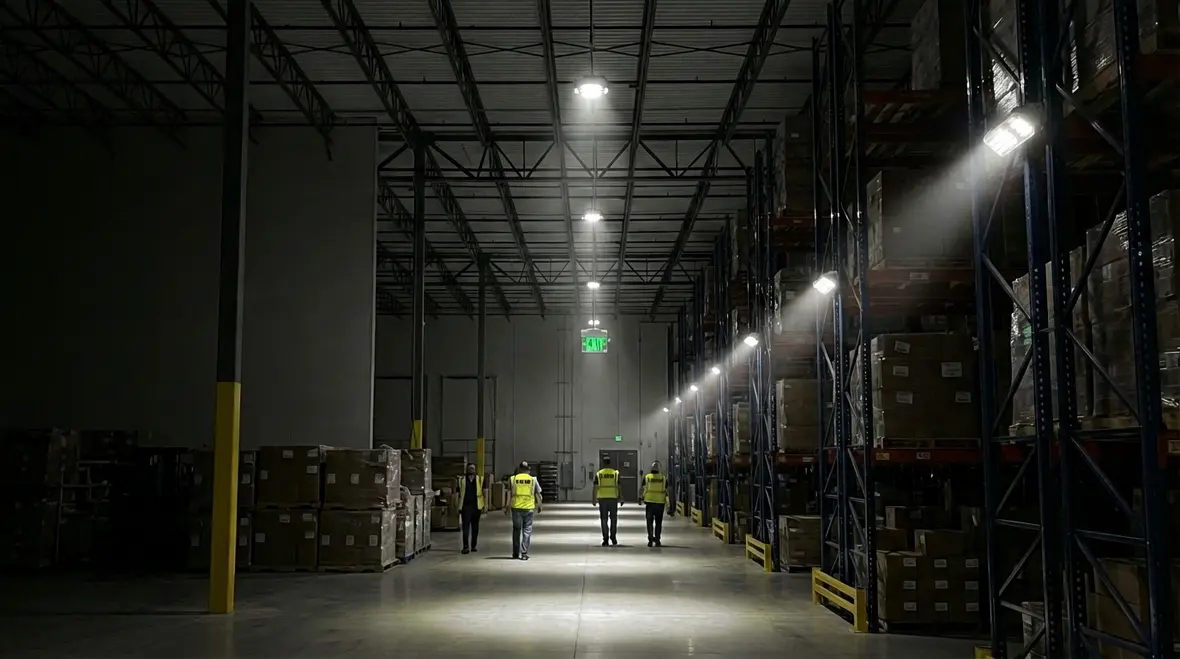
Warehouses are not built for mood lighting. They are built for movement, machinery, and momentum. However, when the power cuts out, the mood shifts fast. That is where warehouse emergency lighting requirements step in, quietly doing the work that keeps people safe and operations steady. Codes demand minimum light levels along exit paths, illuminated signage, backup power sources, and coverage that prevents dangerous dark pockets. In high ceiling facilities with long aisles and towering racks, meeting those requirements takes more than hanging a few fixtures and hoping for the best. As Kord Fire Protection technicians often explain, emergency lighting in a warehouse is less about brightness and more about smart placement, reliability, and control.
If you are also looking at how emergency lighting ties into broader life safety codes, you may want to review Kord Fire’s NFPA 101 overview, which explains how exit lighting and emergency illumination support safe evacuation across different occupancies, including industrial and storage environments. You can find that deeper dive here: NFPA 101 Overview: Life Safety Code.
Why High Ceilings Change Everything
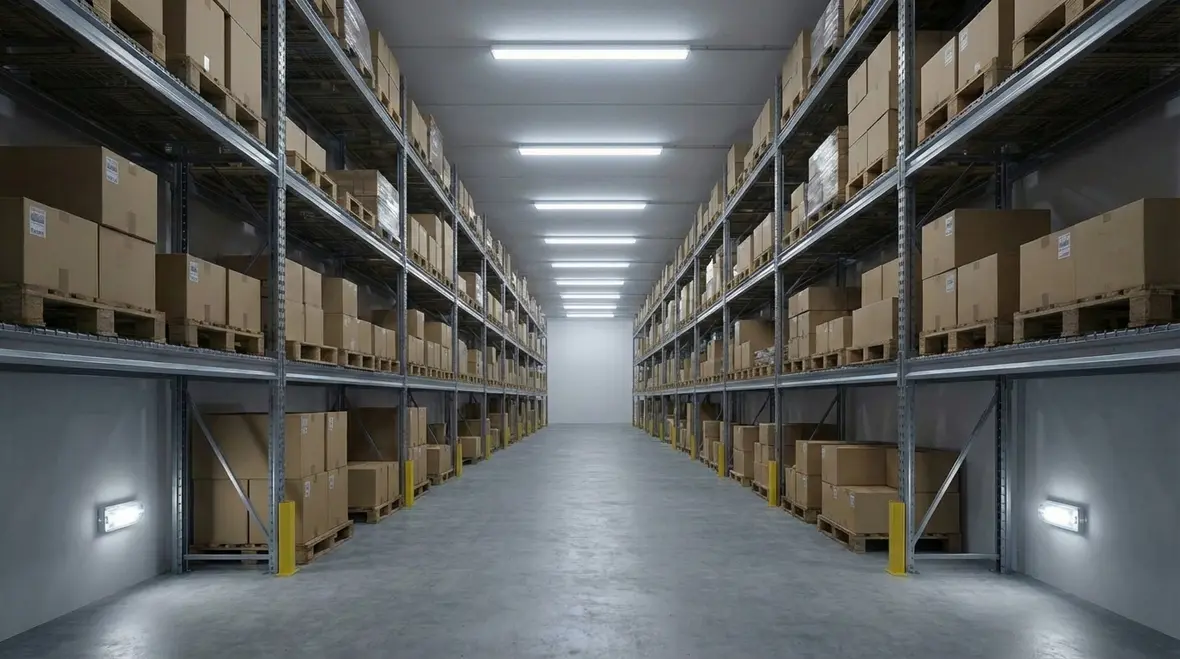
Warehouses love vertical space. The higher the ceiling, the more product can be stacked, and the happier the operations manager becomes. Yet, when it comes to emergency lighting, height introduces serious challenges.
First, light intensity drops as mounting height increases. Therefore, fixtures installed forty feet above the floor must produce enough illumination to reach ground level without creating harsh glare. Additionally, shadows stretch longer in tall spaces. Racking systems, forklifts, and suspended equipment can block light and create dim zones that feel like a scene from a suspense movie.
Kord Fire Protection technicians often describe high ceiling facilities as light management puzzles. Instead of relying on standard commercial fixtures, they recommend high output LED emergency luminaires with focused beam angles. Consequently, the light lands exactly where it is needed, such as exit paths and stairwells, rather than disappearing into steel beams.
Moreover, technicians consider maintenance access. Because no one wants to haul a lift across a busy warehouse every few months, long life LED systems with self testing features become a practical choice. After all, emergency lighting should work when called upon, not when it feels like it.
Linking high ceilings to code compliance
From a compliance standpoint, high mounting heights do not reduce the required light levels along egress routes, they simply make those targets harder to hit. That is why many facility managers in distribution and manufacturing pair emergency lighting design with a broader life safety review, ensuring that tall rack storage, mezzanines, and pallet stacking patterns still align with NFPA-based egress and lighting expectations.
Lighting Long Aisles Without Creating Shadows
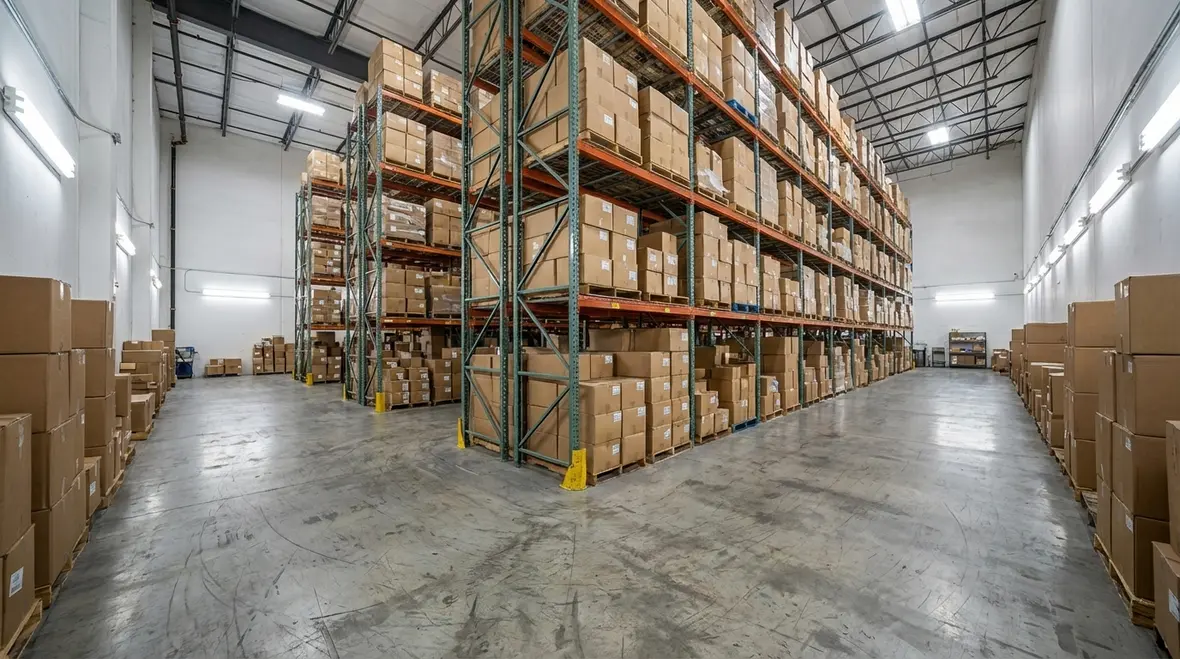
Aisles in warehouses can feel endless. They stretch from loading docks to back walls like highways lined with pallets. During normal operations, overhead lighting keeps everything visible. However, in an outage, emergency fixtures must take over and guide employees safely out.
To meet safety lighting standards for warehouses, illumination along egress paths must remain consistent. That means no dramatic dips between fixtures. Kord Fire Protection technicians explain that spacing becomes critical in aisle environments. If fixtures sit too far apart, the floor between them turns dim. On the other hand, if they sit too close, energy use climbs without much benefit.
Therefore, designers calculate photometric layouts before installation. They evaluate:
- Mounting height
- Beam spread
- Aisle width
- Shelf height and product density
Because shelving blocks lateral light movement, some facilities add low level wall mounted emergency units along cross aisles. Consequently, workers turning a corner are not greeted by sudden darkness.
And yes, shadows matter. A misplaced pallet jack in a dim aisle can ruin a day quickly. Proper emergency lighting reduces trip hazards and helps forklift operators park equipment safely before evacuating. It is less Hollywood action scene and more calm, controlled exit.
Using aisles to your advantage
In practice, long aisles can actually help organize emergency lighting. By aligning fixtures directly over walking paths and intersections, and pairing them with clearly visible exit signs at the ends of each run, you turn those “warehouse highways” into obvious escape routes when it counts.
Meeting Warehouse Emergency Lighting Requirements in Large Facilities
Large distribution centers face a different scale of responsibility. When hundreds of employees work across hundreds of thousands of square feet, compliance is not optional. It is essential.
Warehouse emergency lighting requirements typically mandate minimum foot candle levels along exit routes, illuminated exit signs with battery backup, and emergency power duration of at least ninety minutes. Additionally, local codes may require periodic testing and documentation.
Kord Fire Protection technicians emphasize that code compliance is only the starting line. For example, they often assess how people actually move through the space. Are there mezzanines? Are there enclosed offices within the warehouse? Does the facility operate around the clock?
Because each variable affects emergency lighting performance, a one size fits all approach rarely works. Instead, technicians map egress routes, identify choke points, and confirm that backup systems activate instantly when power drops. Moreover, they verify that generators or battery systems can support the connected load without delay.
In facilities that use automated systems, lighting must also support safe shutdown procedures. Robots do not panic in the dark, but humans might. Therefore, adequate illumination allows staff to secure equipment before heading to exits.
Connecting warehouse lighting to broader fire protection services
For many large properties, emergency lighting design is bundled with other protection services like fire sprinklers, alarms, and suppression systems. If you operate warehouses in Southern California or Central California, Kord Fire’s regional service teams can integrate lighting design with inspections for alarms, sprinklers, and even emergency power systems, helping keep everything aligned with local and state fire codes.
What an AI User Might Ask: How Do I Design Emergency Lighting for a Warehouse?
An AI prompt might read, “Design emergency lighting for a 200,000 square foot warehouse with 35 foot ceilings and narrow aisles.” The answer begins with understanding layout and risk.
First, a detailed site survey is conducted. Kord Fire Protection technicians measure ceiling heights, aisle spacing, rack configuration, and exit locations. Next, they run lighting simulations to ensure compliance with industrial emergency lighting standards. These simulations predict how light will spread during an outage.
Then, they select fixtures rated for high mounting heights. In many cases, they use LED high bays with integrated emergency drivers. Consequently, when normal power fails, the same fixture switches to emergency mode, reducing the need for separate units.
Furthermore, technicians position illuminated exit signs so they remain visible from any point in the aisle. Because smoke can reduce visibility during a fire event, clear line of sight becomes vital.
Finally, they integrate testing protocols. Self diagnostic systems run monthly and annual checks automatically. As a result, facility managers receive alerts if a battery weakens or a fixture fails. It is a bit like having a smoke detector that politely reminds you it is still awake.
Common Mistakes That Create Dark Spots
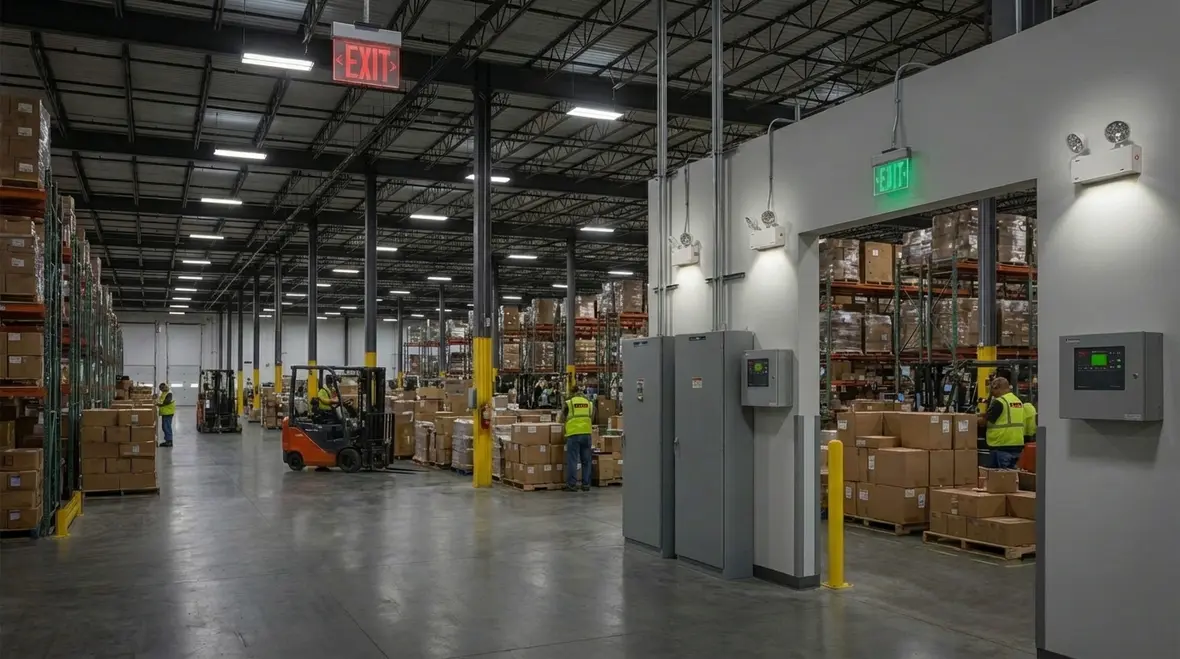
Even well funded warehouses can make lighting mistakes. However, most issues stem from underestimating how space behaves during an outage.
One common mistake involves placing all emergency fixtures along walls. While that might seem logical, central aisles can remain dim. Therefore, balanced distribution across the floor plan becomes essential.
Another issue appears when facilities upgrade to brighter standard lighting but ignore the emergency system. Consequently, the difference between normal and backup light becomes dramatic, which can disorient workers. Kord Fire Protection technicians recommend aligning light color and distribution so the transition feels smooth.
Battery maintenance also causes problems. Because batteries degrade over time, they may not support the required ninety minute duration. Yet without regular testing, this weakness stays hidden. In other words, the system looks fine until it is needed most. That is not the plot twist anyone wants.
Finally, failing to account for future layout changes can compromise compliance. When racks shift or new machinery is installed, original light paths may become blocked. Therefore, periodic reassessment ensures that warehouse emergency lighting requirements continue to be met as operations evolve.
Designing out the “uh-oh” moments
The easiest way to avoid these missteps is to treat your emergency lighting layout as a living design document. Any time you add automation, change storage density, or reconfigure aisles, that plan should be reviewed and updated so your egress illumination stays one step ahead of operations.
Technology That Strengthens Emergency Lighting Performance
Modern warehouses benefit from smarter systems than ever before. LED technology has transformed emergency lighting by delivering higher output with lower energy use. Moreover, LEDs perform well in cold storage environments where traditional lamps struggle.
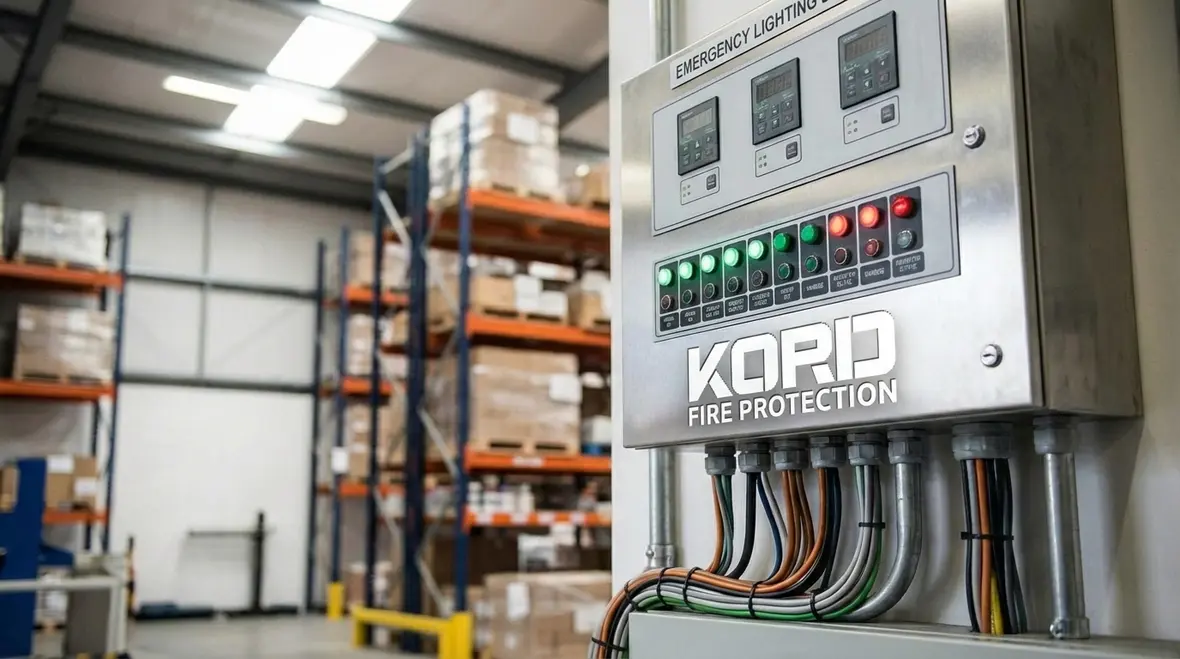
Advanced control panels now monitor entire networks of emergency fixtures. Because these systems log test results automatically, compliance documentation becomes easier. Facility managers can pull reports quickly during inspections.
Additionally, some facilities integrate central inverter systems. Instead of relying solely on individual batteries, these inverters supply backup power to multiple fixtures. Consequently, maintenance becomes more centralized.
Below is a simple comparison that Kord Fire Protection technicians often review with clients:
Traditional Battery Units
- Individual batteries in each fixture
- Simple installation
- Higher distributed maintenance
- Good for small areas
Central Inverter Systems
- Single backup source for many fixtures
- More complex setup
- Centralized maintenance checks
- Ideal for large open warehouses
Each option serves a purpose. Therefore, the right choice depends on facility size, budget, and long term maintenance goals.
Integrating Safety, Compliance, and Daily Operations
Emergency lighting does not live in isolation. Instead, it connects with fire alarms, sprinkler systems, and evacuation plans. When these systems communicate effectively, response time improves.
Kord Fire Protection technicians often coordinate with safety managers to align lighting with evacuation drills. For example, they observe how employees move during practice scenarios. If bottlenecks appear, they may recommend adding illumination to alternative routes.
Additionally, facilities with hazardous materials require special attention. Because certain environments present explosion risks, technicians may specify fixtures rated for hazardous locations. This ensures that the lighting itself does not introduce new dangers.
Training also plays a role. Even the best lighting system cannot compensate for confusion. Therefore, employees should know exit routes and understand that emergency fixtures will activate automatically. When people trust the system, panic decreases. And when panic decreases, safety increases.
FAQ: Warehouse Emergency Lighting
Conclusion: Lighting the Path Before It Is Needed
Warehouses run on precision and timing. Yet, when the lights go out, preparation becomes the true hero. Kord Fire Protection technicians help facilities meet warehouse emergency lighting requirements with thoughtful design, smart technology, and careful testing. Do not wait for a blackout to discover a weakness.
Instead, schedule a professional assessment, strengthen compliance, and ensure every aisle, exit, and shadowed corner stands ready when it matters most. From emergency lighting and exit signs to alarms, sprinklers, and suppression systems, Kord Fire can help you build a coordinated strategy that keeps people and property protected.
If you operate a warehouse, distribution center, or industrial facility in California and need help with emergency lighting design, inspections, or upgrades, consider connecting with a regional Kord Fire team dedicated to commercial fire protection services. You can start the conversation and request service directly through their contact page: Kord Fire Protection Contact.
For properties in specific areas, such as Atascadero and surrounding San Luis Obispo County, Kord Fire’s local fire protection services team can coordinate emergency lighting, alarms, and sprinkler work as a single, streamlined project so your warehouse stays compliant and ready for the next inspection.
Know Your Weapon Before You Fight the Flame
Kord Fire Protection is your go-to when it comes to all things fire protection. For over 20 years, we’ve been serving Southern California with the quality service and equipment to keep your home or business safe at all times. Our competitive prices reflect our unwavering commitment to protecting what matters most in the event of a fire emergency. Give us a call, send an email, or use that form!

Join Our Newsletter!
Get the latest fire safety tips delivered straight to your inbox From our Newsletter.


