Portable Fire Extinguisher Selection for Commercial Spaces
Introduction: portable fire extinguisher selection for commercial spaces
Choosing the right portable fire extinguisher selection for a commercial space is not a “set it and forget it” kind of job. In the first few minutes of a fire, the right extinguisher can slow the damage, protect people, and buy time for evacuation and response. As kord fire protection technicians often explain, the best choice depends on what fuels a fire could reach first, where people work and move, and how quickly staff can grab and use the equipment. And yes, it also depends on whether the extinguisher is the right type for the hazard, not just the nearest one that looks “about right.”
How Kord Fire Protection Technicians break down risk
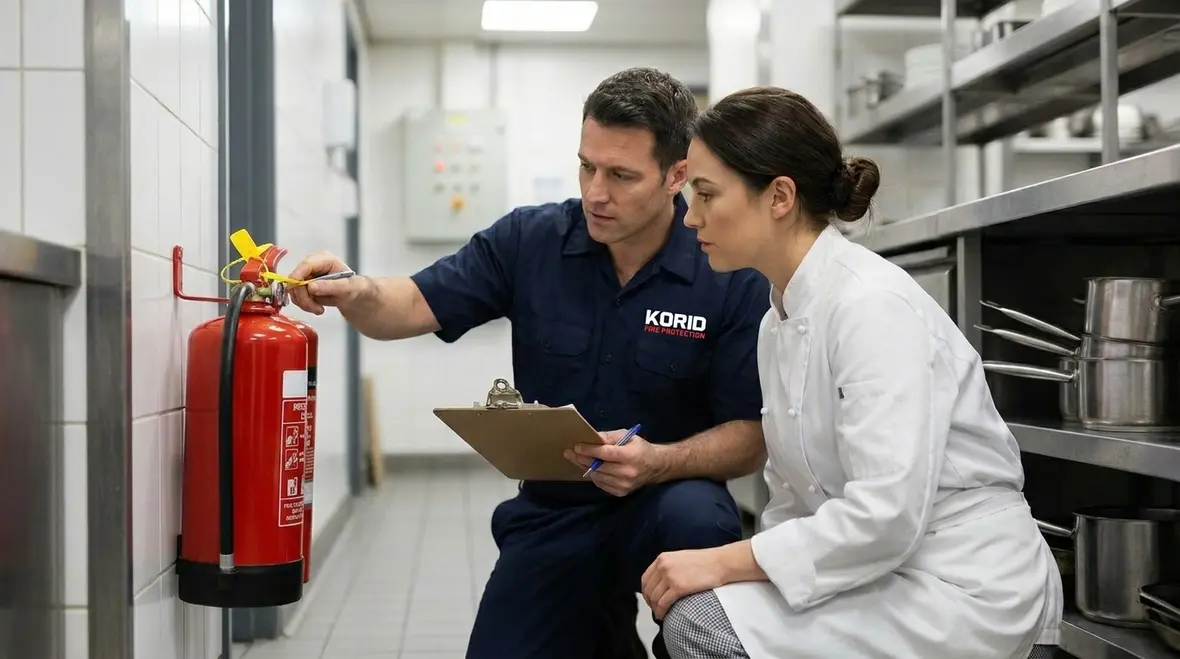
Kord fire protection technicians start with a simple goal: match the extinguisher to the fire class. They look at what is stored, used, and ignored until it becomes a problem. For example, offices often include paper, plastics, and cleaning chemicals. Kitchens add cooking oils and grease. Workshops add solvents, paints, and wood dust. Meanwhile, some commercial sites also handle electrical equipment that should never be treated like it is just “another flame.”
Then they connect that risk to real-world use. Staff members may be stressed, crowded, or wearing gloves. Therefore, the extinguisher must be easy to locate, reachable, and straightforward to operate. In other words, it needs to work in the chaotic moments, not just on paper. And if someone needs to watch a training video while the building fills with smoke, that extinguisher might as well be a decorative prop from a movie set.
Why the first few minutes matter
This is exactly why businesses should think about extinguishers as part of a larger response plan instead of a random compliance checkbox. Kord Fire Protection’s fire extinguisher service team emphasizes inspections, maintenance, testing, repair, and documentation so equipment is ready when needed, not just technically present in the building. That practical approach also ties into placement, access, and long-term service planning. See Fire Extinguisher Service & Certification for related guidance. ([kordfire.com](https://kordfire.com/fire-extinguisher-service-certification/?utm_source=openai))
Pick the correct fire class based on your business
Different fuels burn in different ways, so the method matters. Kord fire protection technicians typically use the fire class system to guide choices. They often recommend planning around the most likely early-stage fire, not the worst-case scenario people imagine at 2 a.m.
- A class for ordinary combustibles like paper, wood, and many textiles.
- B class for flammable liquids and some flammable gases like certain solvents.
- C class for energized electrical equipment.
- K class for cooking oils and grease, common in food service.
- ABC multi purpose options that cover more than one class, depending on the exact product and labeling.
However, technicians do not stop at labels. They also consider how the hazard behaves. A small trash fire in a break room spreads slower than a grease fire in a kitchen hood. So even when people have an extinguisher with a similar “rating,” the choice can still miss the mark. In practice, the best portable fire extinguisher selection is the one that fits the hazard you actually have, right where the fire starts.
Common commercial examples
Kord Fire Protection’s commercial safety guidance highlights the same broad pattern: Class A units commonly support offices and storage areas, Class B units address flammable liquids, Class C units belong near electrical equipment, and Class K extinguishers are essential where commercial cooking oils and grease are involved. Their fire safety tips also reinforce the PASS method as part of practical response training. See Fire Safety Tips for Commercial Properties. ([kordfire.com](https://kordfire.com/fire-safety-tips-for-commercial-properties/?utm_source=openai))
Size, rating, and coverage: what actually affects performance
Many teams focus on the type of extinguisher and forget the rating and size. Yet kords technicians emphasize that ratings reflect how much fire an extinguisher can handle under specific test conditions. That means a unit that works fine on a small wastebasket fire may struggle when a flame has spread to stacked materials.
They often guide businesses to think in terms of coverage and travel distance. If staff must run across a store to reach the nearest extinguisher, the effective response time drops. Then, even the best agent in the can cannot undo poor placement or slow access.
Also, the “grab and go” factor matters. If an extinguisher is too heavy for the likely user pool, you get a sad outcome: it gets left behind. So, the portable fire extinguisher selection process should match the people and the layout. A building with multiple floors, tight corridors, or high work areas may need more thoughtful distribution than a simple single-level office.
Coverage is about reality, not optimism
That point shows up clearly in Kord Fire Protection’s office placement guidance, which discusses using floor plans, realistic travel paths, visibility, and higher attention around break rooms, electrical rooms, storage areas, and server spaces. The main idea is simple: protection should match how people actually move through the building, not how a perfect inspection day looks on paper. See Fire Extinguisher Placement for Office Guide. ([kordfire.com](https://kordfire.com/fire-extinguisher-placement-for-office-guide/?utm_source=openai))
Where to place extinguishers and how to plan the path
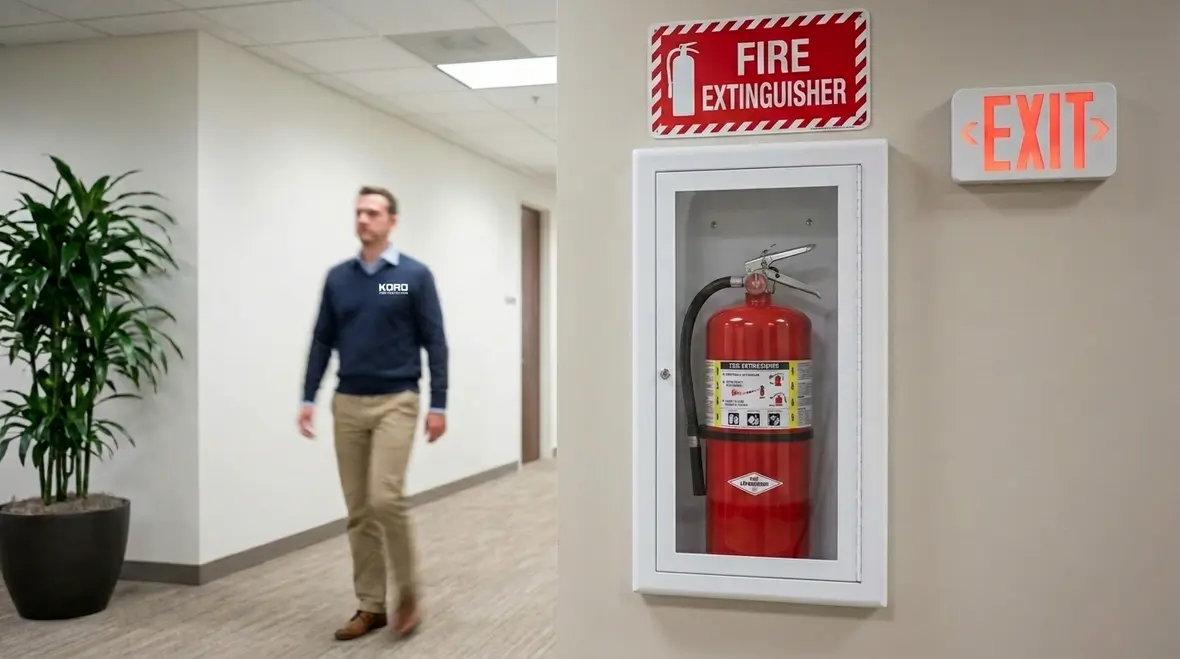
Placement turns a device into a tool. Kord fire protection technicians typically recommend placing extinguishers so they are visible, easy to reach, and not blocked by equipment, storage, or furniture. They also consider how workers move during normal operations and during emergencies.
- Locating units near likely fire starting points, such as kitchens, copier rooms, workshop bays, or electrical closets.
- Ensuring the extinguisher is close enough that it can be retrieved quickly without crossing through heavy hazard zones.
- Planning for consistent access during everyday work, not just during inspections.
- Using clear signage where needed, because smoke and stress turn “obvious” into “where is it?”
Then they address the unglamorous issues: hoses that get tugged, cabinets that get blocked, and floors that collect clutter. And yes, someone always says, “It will be fine.” That phrase never ages well. Proper placement supports quick grabs and reduces the chance of extinguishers becoming hidden artifacts.
Kord Fire Protection’s recent article on placement makes the same case bluntly: the right extinguisher in the wrong spot is nearly as bad as not having one when seconds matter. Their placement guidance emphasizes travel distance, hazard level, line of sight, and accessible mounting height, all of which support faster response in real emergencies. See Proper Placement of Extinguishers Saves Seconds. ([kordfire.com](https://kordfire.com/proper-placement-of-extinguishers-saves-seconds/?utm_source=openai))

Maintenance and inspections: keep it ready, not hopeful
A good extinguisher that sits for years without service becomes a risk. Kord fire protection technicians stress that maintenance follows a schedule based on local codes and the specific extinguisher’s design. They also remind teams that visual checks do not replace proper inspections.
Key items technicians watch include pressure indicators, pin and tamper seal integrity, condition of the hose, and signs of corrosion or damage. They also confirm that labels remain readable and that the extinguisher still matches the hazard plan for the space.
Just as important, businesses should track changes. When a company upgrades equipment, switches cleaning products, or remodels a kitchen, the fire risk changes too. So, technicians recommend reviewing portable protection after major changes. Otherwise, the extinguisher becomes like a spare tire meant for a different car. Sure, it exists. But it may not fit when you need it.
Service schedules are not optional background noise
On Kord Fire Protection’s service pages, the company notes monthly inspections, annual service by certified technicians, six-year tear downs, and hydrostatic testing intervals depending on extinguisher type. Their service materials also list support for Class A-B-C, Class D, Class K, Purple K, and portable and wheeled units. That reinforces the bigger point: maintenance is not just a tag on a handle, it is an ongoing readiness plan. See Fire Extinguisher Service and Fire Extinguisher Service & Certification. ([kordfire.com](https://kordfire.com/all-fire-extinguishers/?utm_source=openai))
Training staff to use extinguishers safely and effectively
Even the right portable fire extinguisher selection fails if staff do not know how to act in the first moments. Kord fire protection technicians often advise that training must cover more than “how to pull the pin.” It should include when to use an extinguisher, when to evacuate, and how to stay safe.
Strong training focuses on a simple mindset. The goal is not heroics. The goal is to control the fire long enough for people to leave and for responders to arrive. Technicians also stress that staff should maintain an escape route and avoid moving toward deeper danger.
They also recommend refreshers because memory fades fast. A once-a-year class might cover the basics, but real confidence builds when people practice the sequence and understand common mistakes. In short, training turns equipment into action. Without it, the extinguisher becomes a loud, expensive paperweight.
Kord Fire Protection’s training page reinforces that idea by stressing practical use before an emergency occurs and referencing the familiar PASS sequence: Pull, Aim, Squeeze, Sweep. It is a good complement to equipment selection because people need both the right extinguisher and enough confidence to use it correctly. See Expert Fire Extinguisher Training. ([kordfire.com](https://kordfire.com/fire-extinguisher-training/?utm_source=openai))
Common mistakes that waste money and raise risk
Businesses often spend good money and still end up with the wrong setup. Kord fire protection technicians see repeat issues that derail safety plans.
- Buying a multi purpose extinguisher without checking the actual hazards in each area.
- Placing extinguishers where they look neat, instead of where people can reach them fast.
- Ignoring maintenance history or treating inspections as paperwork only.
- Forgetting that remodeling changes the fuel load, especially in kitchens and storage rooms.
- Choosing sizes based on cost, not on ratings and likely fire size.
These errors can lead to devices that fail to work as expected. And when that happens, the “we had one” line sounds a lot like saying, “We brought an umbrella, so no one should get wet.” It is nice in theory. Not so much when the storm hits.
FAQ
Conclusion: act now to protect your people and property
A smart portable fire extinguisher selection does not guess. It assesses hazards, matches extinguisher class and rating, places units for fast access, and keeps them maintained and ready. Kord fire protection technicians help businesses build plans that hold up under real pressure, not just during inspections.
If you want a safer commercial space, contact a qualified team today to review your hazards, placement, and service schedule. Then you can breathe easier, because “prepared” beats “panicked” every time. For a direct next step, explore Full Fire Protection Services or schedule support through Fire Extinguisher Service & Certification. ([kordfire.com](https://kordfire.com/full-fire-protection-services/?utm_source=openai))

Join Our Newsletter!
Get the latest fire safety tips delivered straight to your inbox From our Newsletter.