
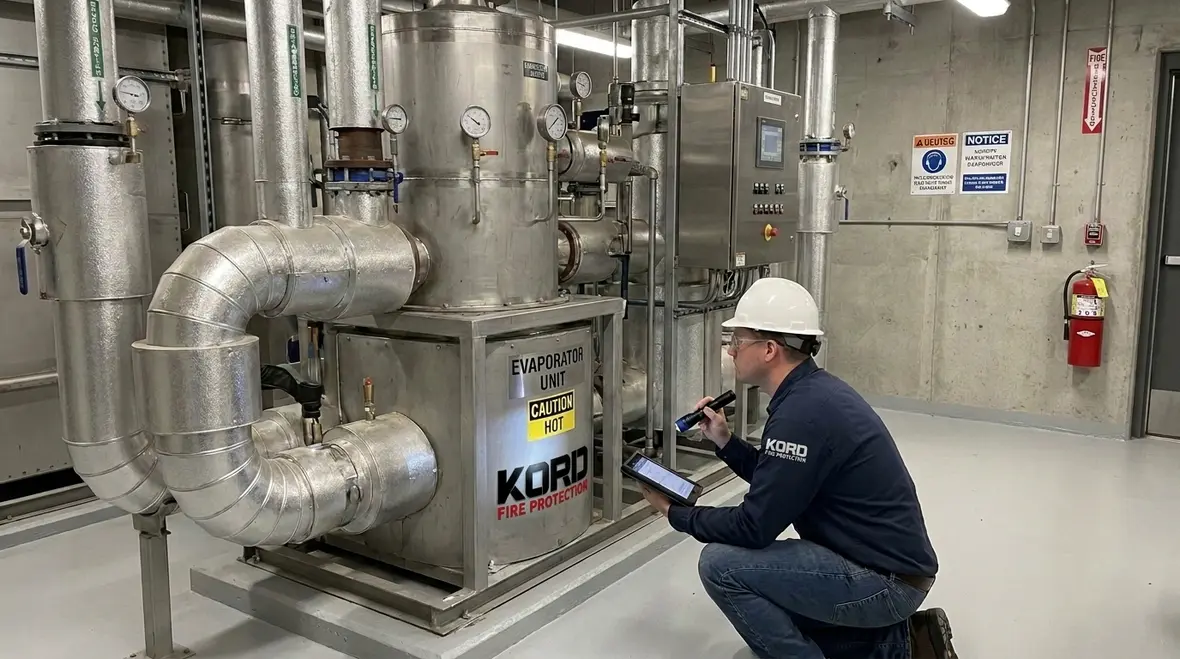
NFPA 36 Section 8.7: Wastewater Evaporation Requirements
Quick Answer
NFPA 36 Section 8.7 establishes fire safety expectations for wastewater evaporation systems used in commercial and industrial occupancies. Compliance focuses on ignition control, proper equipment installation, safe operating practices, and ongoing inspection and maintenance. Facilities must verify system integrity and document performance.
For facilities building a broader inspection program around process fire risk, Kord Fire Protection’s ITM fire protection inspection, testing, and maintenance guidance offers a useful framework for keeping safety systems inspection-ready instead of crossing your fingers and hoping the paperwork looks confident.
What does NFPA 36 wastewater evaporation requirements cover in Section 8.7?
NFPA 36 wastewater evaporation requirements address how wastewater evaporation equipment must be designed, installed, operated, and maintained to reduce the likelihood of fire spread, ignition, or unsafe operating conditions. In practice, Section 8.7 expectations influence burner or heater performance, vapor control, ventilation, ignition source management, and the protection of surrounding combustibles. For facilities, this means aligning equipment specifications with the fire hazard characteristics of the wastewater stream and maintaining the system so it continues to perform as intended over time.
Key compliance elements facilities must treat as operational safety controls
Commercial, industrial, and retail facilities often assume evaporation equipment is “process equipment only.” NFPA 36 treats it as a fire risk control system integrated with the overall fire safety plan. The most common compliance gaps appear when maintenance, housekeeping, or operating procedures drift away from the equipment’s original safety basis.
1) Ignition source and hot surface management
Evaporation systems can include heaters, burners, electrical elements, and associated controls. Compliance depends on preventing unexpected ignition from abnormal conditions such as scale buildup, failed control components, or overheating. Facilities typically need to verify that temperature limiting devices, flame supervision (where applicable), and control interlocks continue to function correctly. Maintenance records should show that these safety components receive inspection and functional testing on a defined schedule.
2) Vapor containment, conveyance, and exhaust reliability
Vapors generated during evaporation must be managed to limit the opportunity for ignition and flame propagation. Operational changes such as altered exhaust routing, damaged ducting, or improperly seated covers can create leakage points. Those leakage points can deposit residues that increase combustible loading and can also shift airflow patterns, which affects how vapors are directed and diluted. Facilities should treat duct condition, gasket integrity, and exhaust fan health as safety items, not convenience items.
3) Separation from combustibles and housekeeping controls
Even when the evaporation unit performs as designed, radiant heat and hot exhaust can expose nearby combustibles. Compliance expectations generally push facilities to maintain appropriate clearances and keep surrounding areas free from waste accumulation, dust, grease, and residue that can accumulate over time. The operational challenge is that residue often spreads during startups, pump cycles, and maintenance activities. Routine housekeeping inspections should specifically include the areas around drains, sumps, observation ports, and exhaust transitions.
Installation and equipment readiness: where inspections usually find problems
Many facilities discover late in the project lifecycle that wastewater evaporation requirements influence more than the evaporation chamber. Inspection readiness depends on how systems interface with utilities, controls, and fire safety features.
Placement, access, and serviceability
Inspectors and fire officials commonly look for practical access to controls, shutoff devices, and safety components. If access panels are removed, restricted, or repeatedly modified, maintenance becomes less reliable and emergency response options become constrained. Access should support safe lockout and inspection routines without forcing technicians to bypass safeguards.
Electrical components and control wiring integrity
Controls for evaporation systems often include electrical relays, sensors, and temperature limit switches. Common failure points include damaged insulation, moisture intrusion, corrosion, and loose terminal connections. When these faults occur, systems may operate outside intended parameters, increasing ignition potential. A robust inspection program should include visual checks, verification of sensor calibration status, and review of fault history in the control panel. Facilities that need stronger control-side oversight may also benefit from a focused industrial electrical safety audit to catch wiring and sensor issues before they turn into shutdowns or surprise troubleshooting marathons.
Condensers, drains, and residue management
Evaporation systems frequently rely on condensers or temperature-controlled segments to manage vapor. Condensate and drain lines can carry residues that accumulate and create combustible deposits. Facilities should inspect drain paths for clogging and ensure that the drainage strategy prevents residue buildup around hot zones. Maintenance that focuses only on the chamber while ignoring condensate routes often misses the ignition drivers that develop downstream.
Ongoing maintenance and testing: how to stay ahead of recurring failure points
NFPA 36 wastewater evaporation requirements work only when the system remains in safe operating condition. Ongoing maintenance should follow written procedures, not informal “as needed” troubleshooting. The goal is to reduce the likelihood of abnormal operation modes, excessive deposits, and compromised vapor control.
Inspection cadence and documentation that matter
Compliance-focused facilities typically establish a documented cadence for:
- Visual inspection for residue, corrosion, and leaks around seals, joints, and access doors
- Verification of temperature control and limiting device function
- Exhaust and duct integrity checks, including fan operation and airflow verification
- Inspection of burners, heaters, or electrical elements for signs of overheating or scale
- Review of alarms, trips, and fault codes to identify patterns before they become failures
Common failure points that drive fire risk
In the field, the same issues recur across many facility types:
- Scale and residue buildup that reduces heat transfer and increases hotspot temperatures
- Exhaust blockages or damaged duct sections that increase pressure or redirect vapors
- Worn gaskets or misaligned covers that allow vapor leakage into surrounding spaces
- Control component drift due to sensor fouling or calibration inaccuracy
- Housekeeping gaps that allow residue accumulation in areas exposed to radiant heat
How Kord Fire Protection supports NFPA 36 compliance for evaporation systems
Commercial facilities often treat NFPA 36 as a periodic checkbox. Kord Fire Protection supports a more reliable approach by aligning inspection and maintenance expectations with the realities of wastewater evaporation equipment, local hazards, and ongoing operational change. The practical focus includes verifying that fire safety controls related to equipment operation, heat exposure, and ignition prevention remain effective over time.
To strengthen your internal compliance program, Kord Fire Protection can also help standardize documentation and readiness practices so inspections do not rely on last minute troubleshooting. For a broader view of best practices across the NFPA 36 framework, see Kord Fire Protection and discuss your facility’s evaporation equipment, operating profile, and maintenance history.
Frequently Asked Questions
Conclusion and call to action
NFPA 36 Section 8.7 requires wastewater evaporation systems to operate with controlled ignition risk, reliable vapor management, and strong housekeeping discipline. To reduce inspection findings and prevent equipment drift from becoming a fire hazard, facilities should validate controls, verify exhaust and duct integrity, and maintain documented testing and corrective actions. Schedule a compliance readiness review with Kord Fire Protection to assess your evaporation setup and strengthen your ongoing inspection and maintenance program.

Join Our Newsletter!
Get the latest fire safety tips delivered straight to your inbox From our Newsletter.



