
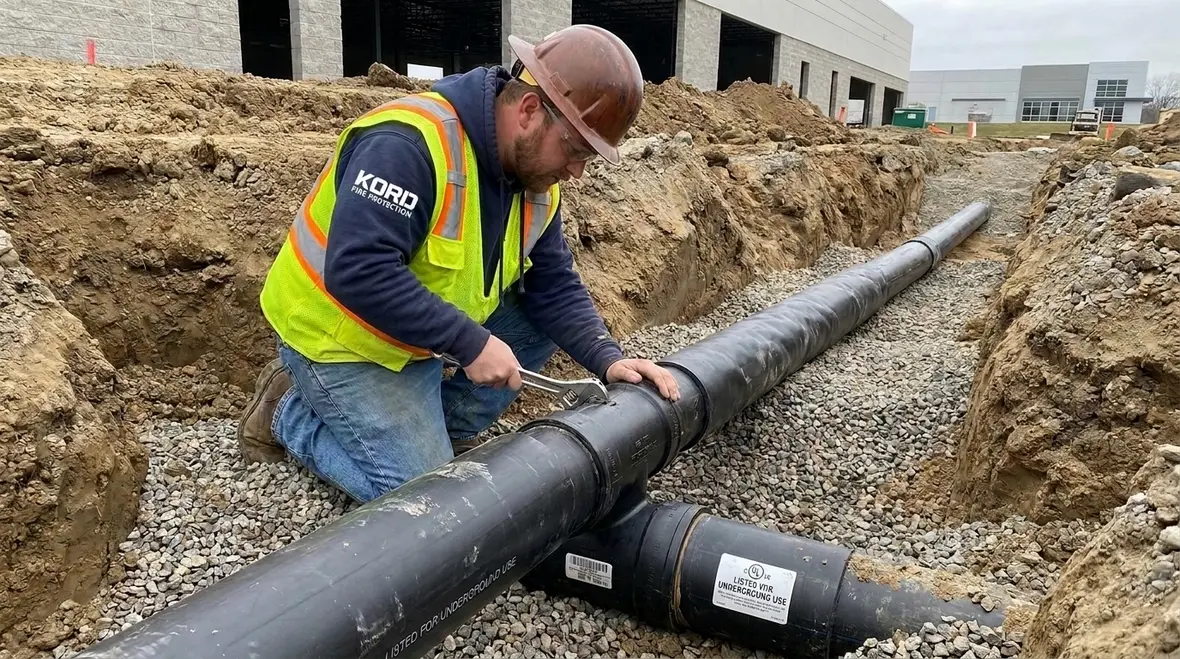
NFPA 13 Section 6.3 — Fittings for Underground Sprinkler Piping
NFPA 13 Section 6.3 Fittings for Underground Sprinkler Piping
NFPA 13 fittings underground sprinkler piping for commercial systems are governed by Section 6.3. The standard requires listed and corrosion resistant fittings, correct burial depth, and accessible inspection. Designers must ensure compatibility with pipe types, protective sleeving, proper backfill, and documented commissioning compliance.
For a broader code foundation, review NFPA 13 automatic fire sprinkler system installation. If you need hands-on support beyond the paperwork and plan review phase, Kord Fire’s fire sprinkler services fit naturally into underground piping compliance, inspection, and ongoing maintenance.
Overview of Scope and Compliance Context
Section 6.3 concentrates on fittings that connect underground sprinkler mains and branches to aboveground risers and spares. It emphasizes compatibility between fittings and pipe materials, corrosion protection, and reliable joints that withstand soil loads and moisture. The guidance also covers identification, accessibility for inspection, and labeling during installation and after commissioning.
Approved Fittings Types and Materials
- Listed underground fittings designed for direct burial, with corrosion protection suitable for the soil environment.
- Elbows, tees, reducers, and couplings that maintain planarity and hydraulics without creating flow disturbances.
- Mechanical tees and saddles used where branch connections are required, provided they are listed for underground use.
- Flanged adapters and gasketed joints when transitioning between pipe materials or reinforcing sleeves.
- Sleeves and protective enclosures to shield fittings from backfill abrasion and impact.
Installation Practices and Protective Measures
Installations must follow a systematic approach that minimizes soil movement and mechanical damage. Installers ensure alignment of joints prior to backfill, place protective sleeves where required, and use appropriate backfill materials to prevent settlement around fittings. Trench walls should be stabilized, and fittings must be protected from aggressive backfill that could compromise seals or coatings.
Field Details That Matter More Than People Expect
Underground work has a sneaky way of looking fine right up until it really, really isn’t. Small alignment issues, rough backfill, or a missing protective sleeve can turn a compliant installation into a future leak investigation. That is why teams should verify trench conditions, joint seating, and coating protection before the line disappears under soil and everyone’s memory gets magically selective.
Inspection, Testing and Commissioning Protocols
- Perform a thorough visual inspection of all underground joints and sleeves during initial installation and after backfilling.
- Document the materials, fittings, and coupling methods used and verify compatibility with the installed pipe.
- Execute a commissioning test per NFPA 13 requirements, ensuring no leaks and that access points remain reachable for future maintenance.
- Record as built information and label buried components so future technicians can locate and inspect them easily.
Common Failure Points and Preventive Strategies
- Corrosion and material incompatibility are mitigated by selecting listed fittings and compatible metals or composites.
- Inadequate backfill or sleeve protection can cause movement, abrasion, or joint failure; protect with sleeves and suitable fill materials.
- Improper installation tolerances lead to misalignment and stress at joints; maintain manufacturer or code required tolerances and verify during pressure tests.
- Damage from nearby construction is prevented by proper routing, marking of underground lines, and coordination with site work.
Why Documentation Saves Headaches Later
A buried fitting that was installed perfectly but never documented becomes tomorrow’s mystery object. Accurate as built drawings, clear labeling, and commissioning records make future repairs, inspections, and expansions far less chaotic. Nobody wants to pay for exploratory digging because a fitting location lived only in somebody’s memory and a pickup truck glove box.
Practical Compliance for Commercial Facilities
Commercial, industrial, and retail facilities face unique challenges when implementing underground piping fittings. Coordination with civil, structural, and design teams is essential to ensure trenching meets code, sleeves are installed correctly, and backfill materials are appropriate for soil conditions. Documentation, as built drawings, and ongoing maintenance plans are critical for long term reliability. Kord Fire Protection positions itself as a vital partner for ongoing compliance, testing, and maintenance across multi site portfolios.
Frequently Asked Questions
Conclusion and Next Steps
Ensuring compliance with NFPA 13 fittings underground sprinkler piping requires careful selection of listed fittings, correct burial practices, and thorough inspection and testing. Thorough documentation and coordinated maintenance reduce risk and extend system life. For a comprehensive assessment, design validation, and ongoing maintenance program, contact Kord Fire Protection to schedule a facility review and create a tailored compliance plan for your buildings.
Call to action: Contact Kord Fire Protection today to schedule a compliance review and a customized maintenance plan for your facility. Our experts coordinate code adherence, testing, and ongoing upkeep across commercial, industrial, and retail properties.

Join Our Newsletter!
Get the latest fire safety tips delivered straight to your inbox From our Newsletter.


