
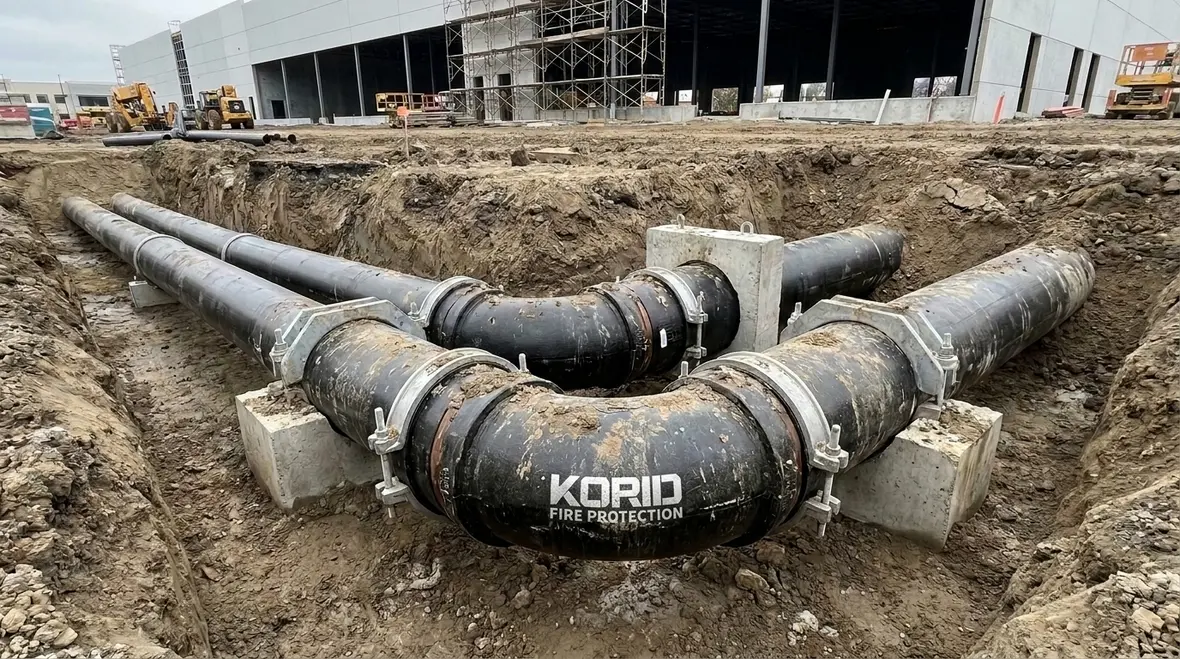
NFPA 13 Section 6.7 — Restraint Requirements for Underground Piping
NFPA 13 Section 6.7 — Restraint Requirements for Underground Piping
NFPA 13 restraint underground piping requirements focus on preventing movement of buried sprinkler lines under soil loads, frost and seismic forces. Section 6.7 requires properly rated restraints, correct spacing, and compatibility with pipe materials. Compliance preserves system integrity and reduces leak risk in commercial facilities.
For a broader code context, review NFPA 13 Overview: Automatic Fire Sprinkler System Installation to see how underground piping and restraints fit into the larger sprinkler system design picture.
Section 6.7 Overview: Purpose and Scope
Section 6.7 governs the restraint of underground sprinkler piping to minimize lateral and vertical movement. It applies to all buried segments where external forces could alter alignment, joint integrity, or water delivery. The section emphasizes compatible restraints, secure connections, and proper installation practices to maintain sprinkler coverage in commercial, industrial and retail facilities.
Key Requirements and Practical Realities for Underground Piping
- Restraints must be rated to withstand anticipated soil loads, backfill compaction and external forces such as vehicle or equipment movement near trenches.
- Provide restraint at transitions, bends and near fittings to prevent thrust and misalignment that could compromise water distribution.
- Ensure material compatibility between restraints and pipe construction to avoid galvanic corrosion or abrasion under backfill conditions.
- Documentation and as built records are essential for ongoing verification during audits and future maintenance.
- Compliance with the NFPA 13 restraint underground piping requirements often hinges on choosing restraints rated for soil loads and ensuring proper spacing.
Installation Design and Best Practices
- Engage a qualified fire protection engineer to confirm restraint layout, anchorage points and allowable movement ranges for the trench topology.
- Use manufacturer approved restraints such as mechanical clamps, straps or anchored joints that match the pipe material and diameter.
- Position restraints to accommodate anticipated thermal expansion and contraction without creating stress at joints or couplings.
- Protect restraints from abrasion and corrosion with sleeves, coatings and compatible backfill materials.
- Coordinate with trench backfilling operations to maintain restraint alignment during consolidation and settlement.
Inspection, Testing and Documentation
- Conduct pre installation reviews and post installation verification to confirm restraint performance and alignment.
- Perform hydrostatic or pressure testing in accordance with NFPA guidelines and project specifications to validate the restraint system integrity.
- Implement routine inspections as part of the facility’s annual maintenance program, with attention to signs of movement, corrosion or backfill degradation.
- Maintain thorough records including restraint type, installation date, location, and any deviations from the original design for future audits.
Maintenance, Common Failure Points and Risk Mitigation
- Common failures include inadequate restraints at elbows and transitions, loosening clamps, and damage from trench work or backfill settlement.
- Risk mitigation involves redundant restraint strategies, periodic alignment checks, and protection of underground piping from heavy equipment and root intrusion.
- Corrosion protection, correct coating, and use of compatible materials reduce long term degradation and leakage risk.
- Keep marked facility maps and as built drawings up to date so maintenance teams can locate restraints quickly during repairs or inspections.
Kord Fire Protection: Your Partner for Compliance, Testing and Maintenance
Kord Fire Protection brings specialized expertise to ensure NFPA 13 restraint underground piping requirements are met across commercial, industrial and retail facilities. From design reviews and installation to ongoing testing and maintenance programs, Kord delivers reliable compliance, timely inspections and responsive service. This support helps minimize downtime and protect sprinkler performance throughout the facility lifecycle.
Frequently Asked Questions
To ensure ongoing compliance and reliable sprinkler performance, engage Kord Fire Protection for a comprehensive site assessment, restraint design validation and a tailored maintenance plan aligned with NFPA 13 restraint underground piping requirements. Contact Kord today to schedule a review and build a durable, code compliant underground piping restraint program.

Join Our Newsletter!
Get the latest fire safety tips delivered straight to your inbox From our Newsletter.


