
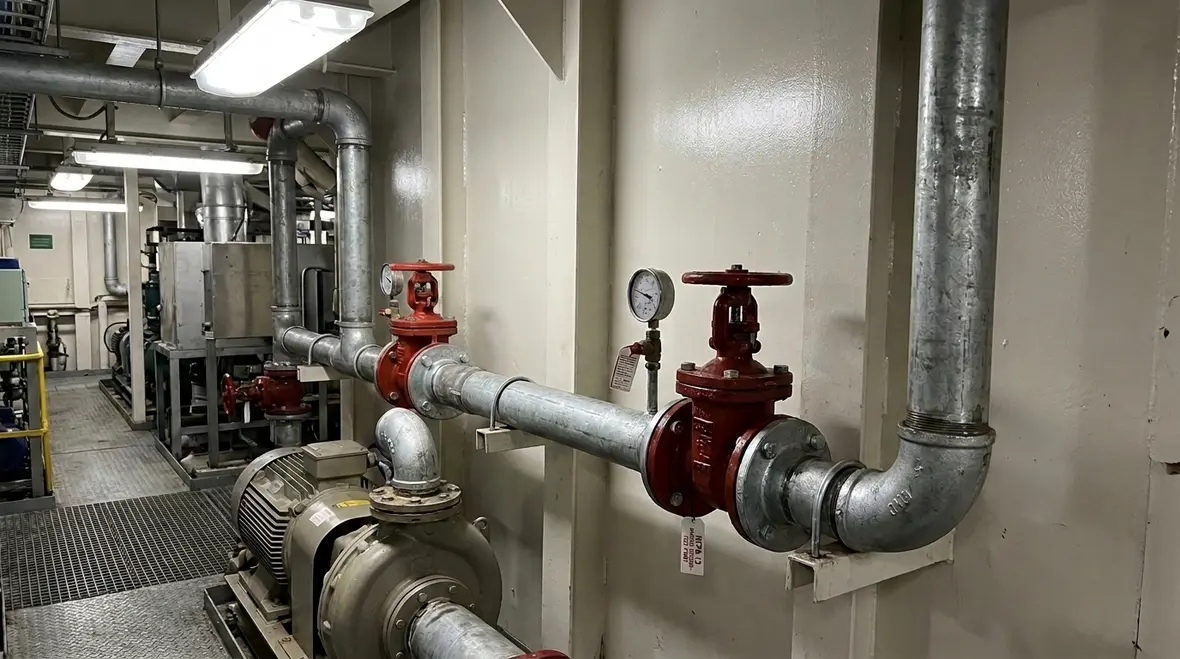
NFPA 13 Section 31.4 — Marine System Installation Requirements
Quick Answer: NFPA 13 Section 31.4 sets detailed installation requirements for marine sprinkler systems, emphasizing corrosion resistance, pump and piping arrangement, bracketing, and maintainable layouts. Compliance also requires realistic inspection, testing, and documentation practices to support continued readiness in a corrosive marine environment.
For teams managing marine or marine-adjacent protection work, it also helps to understand how broader suppression planning fits into specialized environments. A useful related resource near the top of the conversation is fire suppression for port and terminal equipment, especially where vessel support, terminals, and industrial coordination overlap.
What NFPA 13 Section 31.4 covers for marine systems
NFPA 13 Section 31.4 addresses how to install sprinkler systems intended for marine use, including systems on vessels and marine structures where exposure to saltwater, vibration, and motion creates higher reliability demands than typical land based hazards. These NFPA 13 marine system installation requirements focus less on basic sprinkler selection and more on how the system stays functional after years of dynamic loading, humidity, and corrosive atmospheres.
For commercial and industrial facilities that also coordinate offsite marine projects, the practical takeaway remains the same: installation details drive inspection outcomes, pump performance under test, and long term corrosion management. For a broad foundation on system installation and coordination, see NFPA 13 overview for automatic fire sprinkler system installation.
1) Corrosion control and materials: where compliance is won or lost
Marine service creates aggressive corrosion mechanisms that can reduce wall thickness, foul threads, and increase leakage risk at joints. Under the practical intent of NFPA 13 marine system installation requirements, the installation must address both the wet system wetted components and the mechanical interfaces where failures often begin.
Key installation elements that affect corrosion performance
Threaded joint integrity: Improper joint preparation, damaged threads, or incorrect thread sealant can cause microleak paths that accelerate corrosion and weaken the connection over time.
Hose and coupling exposure: Couplings and flexible connections near condensation zones require disciplined placement and protection from salt spray and standing moisture.
Fasteners and hangers: Corrosion resistant bracketing and supports prevent rail or bracket failure that can misalign pipe runs and change sprinkler discharge patterns.
Coating discipline: Protective coatings must not interfere with identification, sprinkler operation, or required clearances at critical components.
In commercial settings, the most common failure point is not the sprinkler itself. It is the system’s mechanical “ecosystem” around the sprinkler that loses alignment or integrity because supports, joints, and protective measures are not installed and documented with maintenance in mind.
2) Pumps, tanks, and hydraulic performance under marine conditions
Marine installations depend on reliable water delivery under motion and vibration. NFPA 13 marine system installation requirements therefore demand a system design that can maintain acceptable pressure and flow during test conditions and realistic operational states.
Operational procedures that determine real world performance
Pump set verification: Installations must support safe access to gauges, drain points, strainer inspection, and control interfaces so testing does not degrade components.
Strainers and suction considerations: Marine sediment or biofouling risk increases the importance of accessible strainer baskets and safe removal procedures.
Pressure measurement locations: Gauge placement affects test validity. Improper locations can misrepresent pressure, leading to late correction after acceptance testing.
For pump and water supply system technical context, facilities often reference firepumps.org during planning and commissioning. Integrating that knowledge with marine specific installation practices reduces the risk of repeated test failures caused by access limits, inaccessible components, or measurement inconsistencies.
3) Piping layout, supports, and vibration resistance
Marine systems experience constant movement. The most defensible compliance position comes from a piping layout that supports predictable thermal expansion, maintains sprinkler spacing accuracy, and keeps joints aligned through vibration cycles.
Common installation challenges
Misaligned pipe runs: Misalignment changes sprinkler orientation and can interfere with unobstructed spray patterns, especially where obstructions are present near decks and bulkheads.
Support spacing and type selection: Overlooked support hardware selection can create localized stress points at joints, increasing leak potential during movement.
Expansion and anchoring strategy: Expansion movement without a disciplined anchoring sequence can “walk” pipe sections, leading to crooked sprinkler rows and difficult re inspection.
Commercial crews frequently underestimate how quickly vibration exposes poor workmanship. For contractors supporting marine or marine adjacent projects, Kord Fire Protection typically coordinates installation review and closeout documentation to ensure the final layout matches hydraulic calculations, inspection access requirements, and maintenance access expectations.
4) Sprinkler installation details that drive inspection and testing
Even when the design intent is correct, poor sprinkler installation details create operational failures that show up during inspection, impairment processing, and flow testing. NFPA 13 marine system installation requirements emphasize a system that can be reliably inspected and kept in service.
Details that typically cause trouble during compliance checks
Obstructions and coverage changes: Improperly installed shields, insulation, or cable trays can create coverage gaps or interference.
Escutcheon fit and leak paths: Poor fit around penetrations can allow moisture intrusion and accelerate corrosion.
Valve and drain access: If drains, test connections, and isolation valves are inaccessible, testing becomes incomplete or unsafe, which undermines ongoing compliance.
Identification and labeling: Marine environments reduce legibility over time. Installation must preserve identification durability for ongoing maintenance cycles.
In practical commercial facility operations, inspection readiness matters as much as initial installation. Kord Fire Protection supports ongoing test plans, impairment handling, and system readiness so marine or marine served facilities do not fall into a compliance gap after acceptance.
5) Inspection, testing, and documentation: the compliance maintenance loop
NFPA 13 compliance is not a one time event. For marine systems, the installation must enable inspection and testing procedures that account for corrosion exposure and access constraints created during construction.
Operational and maintenance expectations
Closeout and record accuracy: As built drawings, valve lists, and component ID matching must be complete so inspectors can verify layout and test points without guesswork.
Routine inspection access: Marine equipment compartments often create physical barriers. Installation must ensure qualified personnel can reach critical components safely.
Test water management: Drains and test connections must support safe, repeatable discharge handling without recontaminating the area or causing corrosion at nearby components.
For many commercial and retail facilities that share contractors with marine project teams, the most reliable approach is to standardize the inspection and maintenance plan during construction. Kord Fire Protection helps commercial owners and operators maintain defensible documentation, coordinate impairment control, and plan recurring testing to preserve readiness through changing operating conditions.
If your organization also evaluates related electrical or life safety integrations that frequently come up during marine builds, Kord Electric at kordelectric.com provides a useful reference point for electrical coordination that can affect fire alarm and related controls.
6) Frequently Asked Questions
Conclusion and call to action
NFPA 13 Section 31.4 marine system installation requirements drive system reliability through corrosion control, vibration resilient piping, validated pump performance, and inspection ready layouts. Owners and operators should confirm installation quality during construction and then lock in an ongoing testing and maintenance plan that supports repeatable compliance.
Contact Kord Fire Protection to review marine installation details, commission test point accessibility, and establish a practical compliance schedule that protects readiness year after year.
Kord Fire Protection Australia is also available for project support and ongoing service planning.

Join Our Newsletter!
Get the latest fire safety tips delivered straight to your inbox From our Newsletter.


