Machinery Space CO2 Suppression Design and Service by Kord
When a fire starts inside a machinery space, seconds matter and smoke travels fast. That is why machinery space CO2 suppression systems draw attention from ship owners, facility managers, and safety teams who want a fast, clean way to protect high hazard equipment. CO2 works by displacing oxygen in the protected area, which helps stop the fire from growing. And while that sounds simple, the real work begins with design, placement, control logic, ventilation strategy, and careful maintenance. Kord Fire Protection can become a vital partner on these jobs, helping teams plan the system correctly, coordinate installation, and keep it ready when it counts. After all, nobody wants their fire suppression to show up like a late action hero with the wrong gear.
For facilities evaluating protection options, Kord also offers dedicated CO2 fire suppression system services built around installation, repairs, testing, and code ready support. That matters because machinery spaces are not forgiving environments. They are packed with mechanical equipment, electrical components, airflow challenges, and operational pressures that punish lazy design.

How CO2 fire suppression protects machinery spaces
Machinery spaces often contain diesel engines, pumps, switchboards, turbines, and cable runs. In other words, they can turn a small fault into a full scene quickly. CO2 systems protect by flooding the space with carbon dioxide and reducing the oxygen level below what combustion needs. Therefore, flames struggle, heat drops, and fire spread slows.
Because these spaces are enclosed and full of obstacles, the design must match the actual layout. For example, supply locations, nozzle direction, and discharge time targets get set based on compartment volume, leakage assumptions, and expected nozzle flow. In addition, the system must integrate with gas detection, alarms, shutdown logic, and ventilation controls so the space behaves the way the hazard analysis predicts.
To keep it practical, teams usually plan for safe egress, signage, audible and visual alerts, and interlocks that prevent discharge when people are in the area. And yes, the system must also behave during testing. Nobody likes a test that disrupts operations more than it needs to. The right plan makes testing smoother, and it keeps stakeholders calmer. If you want a broader look at where different systems fit, Kord’s guide to fire suppression system types helps frame when CO2 makes sense and when another approach may be better.
Why machinery spaces are different from standard rooms
A machinery space is not just a room with equipment sitting politely in corners. It is a dense operating environment with moving air, hot surfaces, electrical hazards, fuel sources, and geometry that can interrupt gas distribution. That means suppression strategy has to think beyond square footage. It has to consider how the space actually behaves under stress, including what stays closed, what shuts down, and what turns into a problem at the worst possible moment.
System design choices that make or break performance
Good machinery space CO2 suppression design does not rely on guesswork. It starts with a proper survey and then follows with calculations tied to the compartment. Next, engineers consider how the space opens and closes, how doors and dampers behave, and how smoke and heat affect detection.
Key design elements
- Compartment integrity: teams estimate leakage and define closure procedures so the CO2 concentration reaches the target level.
- Discharge timing: the system must release fast enough to control growth while avoiding unsafe conditions.
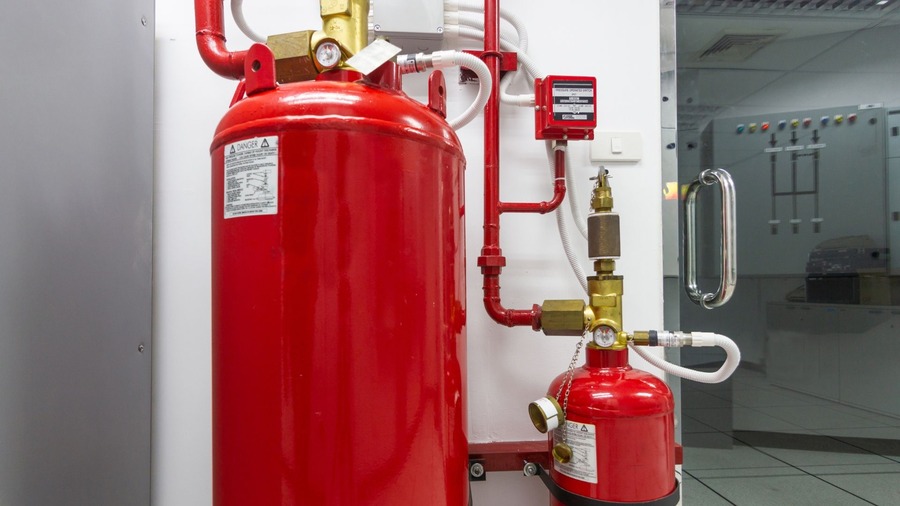
- Nozzle placement: correct placement supports effective distribution, even around machinery and cable trays.
- Ventilation strategy: fans and dampers must shut down or adjust so oxygen does not sneak back in.
- Control logic: detection, delays, pre discharge warnings, and abort conditions must work together.
Furthermore, the design should account for both normal operations and abnormal events. For example, if an engine room ventilation fan runs during an incident, the gas strategy can fail. So the system logic must shut down the right equipment and verify the area status before it releases. That is where Kord Fire Protection often adds value, because it treats the job like a system, not a box on a drawing.
It also helps to think about future service during the design stage. Service access, labeling, cylinder location, releasing controls, and test procedures should not become an afterthought hidden behind equipment like someone’s forgotten gym bag. A system that is hard to inspect tends to become a system people avoid inspecting, and that is not a trend anybody wants.
Installation and commissioning steps for real world operation
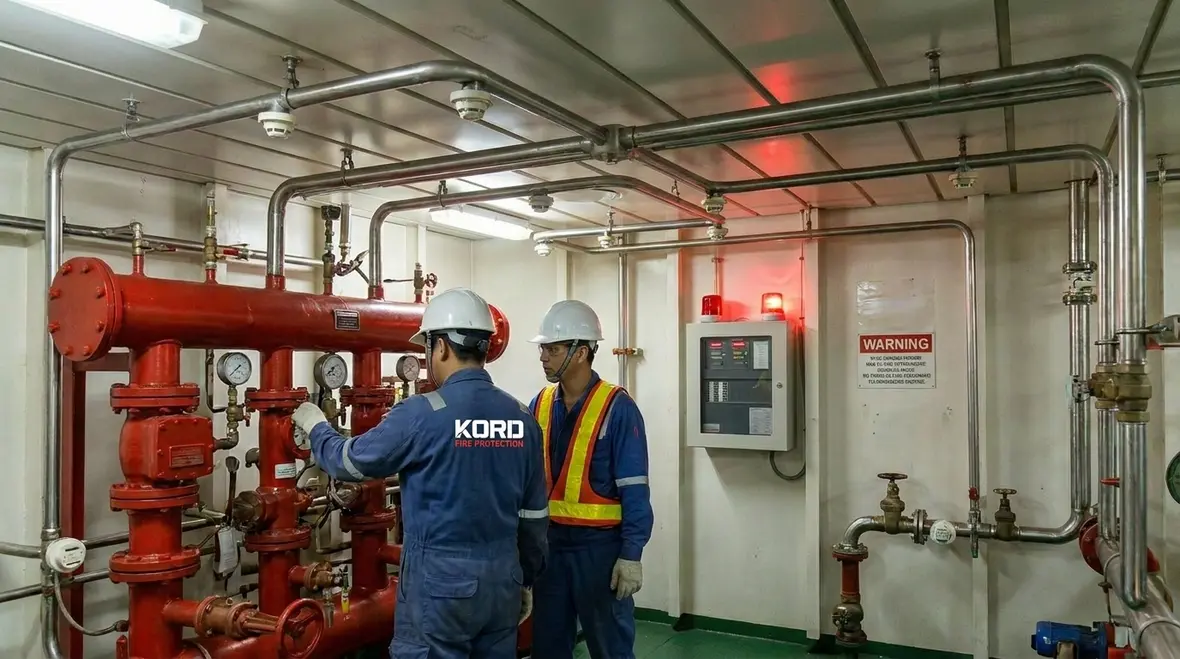
Even a perfect design can underperform if installation cuts corners. During installation, contractors must follow the layout carefully, secure piping correctly, and verify that nozzles aim as intended. Pressure ratings, hangers, supports, and routing all affect performance.
Then commissioning confirms the system works the way it was designed to work. This includes:
- Verification of detection circuits: technicians validate alarm and trip inputs.
- Checking interlocks: they confirm shutdown functions and ventilation controls respond correctly.
- Testing discharge controls: they run logic tests to confirm sequencing without an unintended release.
- Functional acceptance tests: they verify pre alarm, warning times, and safe discharge conditions.
Also, because machinery spaces often run on tight schedules, commissioning needs a plan that reduces downtime. Kord Fire Protection can coordinate testing windows, document results cleanly, and help teams avoid repeat visits. In other words, it turns a “we will test it someday” situation into a controlled process with clear evidence.
Documentation matters more than people think
A successful commissioning process is not just about watching lights blink and checking boxes with a heroic nod. It also requires accurate as builts, device labels, operating instructions, sequence documentation, and test records that future technicians can actually use. Clean documentation shortens troubleshooting time, supports compliance reviews, and helps owners avoid the dreaded phrase, “We think this is how it works.”
Safety planning: people, equipment, and emergency response
CO2 is effective, but safety planning cannot be optional. The system must prevent discharge when occupied or when safe conditions do not exist. Therefore, it relies on alarms, time delays, and strict control logic. Teams also set evacuation procedures and ensure signage explains what to expect.
Emergency response teams need training too. They must understand that the space may remain under suppression while responders operate. Furthermore, they should know how to ventilate the area after discharge so oxygen levels return to safe ranges before re entry. Kord’s article on CO2 fire suppression system safety and alarms is a useful companion for teams tightening procedures around warnings, interlocks, and evacuation.
From an equipment standpoint, CO2 is often considered “clean” compared to other agents because it does not leave residue like dry chemicals. However, technicians still follow procedures to inspect critical components after any discharge event. That keeps the system from becoming the firefighting version of a prank that leaves costly surprises behind.
Transitioning from incident readiness to daily safety, managers should maintain door seals, keep ventilation dampers functional, and ensure detectors stay calibrated. Kord Fire Protection can help build that operating rhythm through clear procedures and consistent field checks.
Maintenance and inspections that keep CO2 ready to act
Fire protection does not run on good intentions. It runs on maintenance. CO2 systems require periodic inspections of cylinders or containers, valves, controls, detectors, and alarms. Technicians also verify that the system documentation matches the installed condition.
During inspections, teams typically confirm:
- Pressure and integrity: cylinders or storage modules meet required conditions.
- Valve and actuator health: components move smoothly when commanded.
- Detection reliability: sensors remain within acceptable response ranges.
- Electrical and wiring checks: they confirm circuits remain secure and labeled.
- Recordkeeping: they keep test reports current for audits and compliance.
Moreover, managers should budget for planned service visits, not surprise emergencies. That is where a partner matters. Kord Fire Protection can help facilities plan inspections around operating cycles, document findings clearly, and address issues before they turn into system downtime. Because the only thing worse than a fire is a system that cannot prove it will work.
Maintenance keeps design intent alive
Even the most thoughtfully engineered system drifts over time if nobody checks it. Labels fade. Doors stop sealing well. Dampers stick. Detection devices age. Wiring gets touched during unrelated work. All of that chips away at performance. Kord’s overview of fire suppression system design, types, and maintenance reinforces the point that readiness is less about luck and more about disciplined follow through.
Why Kord Fire Protection matters on CO2 suppression projects
On machinery space projects, many stakeholders show up with different priorities. The owner wants uptime. Operations wants predictable scheduling. Safety wants compliance. Engineering wants correct calculations. And contractors want clean installs. Kord Fire Protection can become a vital partner because it connects these moving parts and keeps the project aligned with the goal: suppression that performs when it matters most.
In practice, that partnership often shows up as coordinated design support, installation oversight, commissioning assistance, and ongoing service. It also includes clear communication during handover, so teams know how to operate the system and what to expect during tests and inspections.
And if anyone says “It is just CO2,” a professional can respond with a calm smile. The truth is, the method sounds simple, but the engineering and operations details are where reliability lives. Kord Fire Protection supports those details so the system behaves like a trained professional, not like a vending machine that sometimes works.
For organizations comparing service partners, Kord’s broader fire suppression services page is a helpful place to see how CO2 support fits alongside other specialized protection options. Near the end of a project, that kind of full service visibility is useful because facilities rarely have just one hazard forever.
FAQ about machinery space CO2 suppression
Conclusion and call to action
Machinery space fire risk demands a suppression strategy built for the real environment, not a generic template. CO2 can protect by reducing oxygen quickly, but only when the design, installation, interlocks, and maintenance stay tight. From compartment integrity to alarm sequencing to documentation that survives turnover, every detail helps determine whether the system performs like a pro or freezes when the spotlight hits.
To move from paperwork to reliable performance, facilities should bring in a partner who understands the details and can support the full lifecycle. Kord Fire Protection can help teams plan, commission, and service machinery space CO2 suppression with clarity and confidence. Reach out through Kord’s CO2 suppression service page or explore the full fire suppression solutions offering to schedule a review and protect what keeps your operation alive.

Join Our Newsletter!
Get the latest fire safety tips delivered straight to your inbox From our Newsletter.