
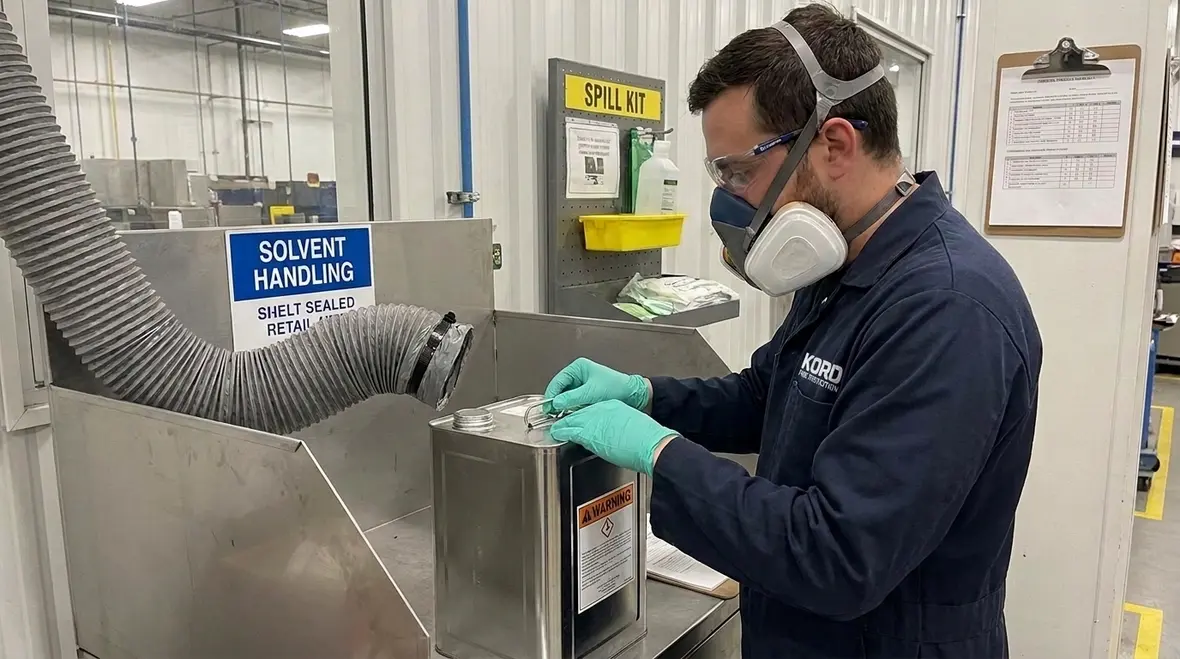
NFPA 33 Section 10.11: Handling Chlorinated Solvents Safely
Quick Answer
NFPA 33 Section 10.11 establishes operational controls for safe handling of chlorinated solvents, including hazard communication, container and system integrity, ventilation and engineering controls, spill and leak response, and inspection and maintenance. Facility managers should build documented procedures and verification checks to prevent toxic exposure and ignition-related incidents.
What does NFPA 33 Section 10.11 require for chlorinated solvents?
NFPA 33 chlorinated solvent handling requirements focus on preventing harmful releases and unsafe operating conditions in spray application, solvent handling, and associated processing areas. In commercial and industrial environments, compliance depends on more than having a chemical safety data sheet. It depends on maintaining closed systems where feasible, controlling vapors, protecting workers, and verifying that equipment remains leak free through routine inspection and corrective maintenance.
For facilities that handle chlorinated solvents in production or finishing operations, the most common compliance failure points include degraded hoses, improperly rated fittings, blocked local exhaust ventilation, and incomplete maintenance records that do not reflect real-world operating conditions.
If your team is tightening inspection schedules and documentation across multiple systems, fire protection services in Southern California can help support a more organized compliance path.
How Section 10.11 controls exposure and release risks
Section 10.11 concentrates on operational controls that reduce the likelihood of toxic exposure and unintended releases. In practice, safe handling starts with how solvents move through the facility and how the process area maintains negative pressure or sufficient capture to limit vapor escape.
1) System integrity and container management
- Use compatible containers and connections: Components must be rated for the solvent and compatible with seals and gaskets. Unknown seal materials often swell, crack, or harden and then begin to weep.
- Prevent pressure and temperature stress: Overpressure events and thermal cycling increase leak probability at couplings and quick-disconnects.
- Keep containers closed when not in use: Open handling increases vapor release and makes ventilation performance harder to maintain.
- Label and segregate properly: Chlorinated solvents must align with the site chemical inventory and SDS documentation to avoid wrong-chemical transfer and unsafe mixing.
2) Ventilation and vapor control
- Local exhaust ventilation (LEV) performance: Capture effectiveness must match the operating method, including periods of loading, spraying, and cleaning.
- Maintain airflow and ducting: Blocked filters, crushed ducts, and incorrectly balanced dampers can reduce capture and cause vapor accumulation.
- Protect against cross drafts: Door traffic and HVAC supply patterns can pull vapors away from the capture zone.
3) Worker protection and operational discipline
- Training tied to task risk: Operators must understand transfer hazards, cleaning hazards, and how to recognize abnormal odors or visible leakage without improvising.
- Respiratory protection alignment: If respiratory protection is required by the hazard assessment, the program must include fit testing, maintenance, and change-out schedules.
- Housekeeping procedures: Residues on floors, sumps, and drip trays become vapor sources and complicate spill control.
What inspections and maintenance protect compliance?
Section 10.11 expectations typically translate into a facility program that verifies equipment condition and correct operation over time. Documentation matters because inspectors evaluate how the facility prevents issues, not just how it responds after a failure.
Common inspection points during compliance walkthroughs
- Hoses and flexible connections: Look for abrasion, swelling, cracking, and loose clamps. Replace at defined intervals, not only after a failure.
- Valves, regulators, and pump seals: Mechanical seal wear and packing degradation often show early signs as micro-leaks.
- Drip trays, containment, and secondary barriers: Confirm they are present, sized correctly, and routinely cleaned.
- Ventilation status indicators: Confirm gauges, alarms, or monitoring devices are functioning and used.
Maintenance practices that reduce leak frequency
- Update maintenance plans after process changes: Changes to transfer methods, dwell time, or operating temperatures require reassessment of component compatibility and ventilation loads.
- Use torque and assembly standards: Incorrect torque on fittings can lead to slow leaks that become severe after thermal cycles.
- Verify cleaning and drying methods: Aggressive cleaning can damage seals; incomplete drying can trap solvents and later release vapors.
For guidance on establishing inspection discipline across life safety systems and hazard controls, Kord Fire Protection supports commercial facilities with ongoing compliance services, documentation support, and maintenance planning that aligns with real operational conditions. Learn more about Kord Fire Protection’s approach here: fire safety system documentation for compliance.
Spill and leak response: operational details that matter
Even with strong engineering controls, chlorinated solvent spills and leaks still occur due to hose damage, operator error, or component fatigue. Section 10.11 drives an expectation of prepared response capabilities, controlled cleanup methods, and documented follow-up actions.
Practical spill response requirements in the field
- Stop the release safely: Shut valves or isolate pumps only if it does not increase vapor spread or expose responders unnecessarily.
- Control the area: Use appropriate isolation to keep ignition sources and foot traffic away from the spill zone while maintaining ventilation.
- Use compatible absorbents and containers: Absorbents must not react with the solvent or become a long-term vapor source.
- Prevent secondary contamination: Avoid spreading solvent into drains, porous surfaces, or HVAC intakes.
Failure modes to avoid after incidents
- Cleaning without root cause correction: A “clean and close” response repeats the same event because the damaged hose, fitting, or seal remains.
- Incomplete waste handling: Improper containerization of contaminated cleanup materials can create continued vapor hazards.
- Missing documentation: Without incident reports, the facility cannot prove that it improved equipment reliability.
Designing a compliance-ready program for commercial and industrial facilities
For retail, light industrial, and manufacturing spaces, compliance succeeds when the handling program connects engineering controls, written procedures, and inspection frequency. Management should not treat NFPA 33 compliance as a one-time checklist. Instead, the program should function like a living system.
Recommended program elements
- Written procedures by task: Transfer, container changeout, spraying, cleaning, and waste handling each require task specific controls.
- Equipment and component compatibility matrix: Map each solvent to hoses, seals, gaskets, pumps, and fittings that have been verified for compatibility.
- Ventilation verification routine: Define what operators check daily or before shifts, and define what maintenance verifies on a scheduled basis.
- Training and sign-off: Use training records that reflect the specific equipment and the actual work environment.
- Corrective action workflow: Assign responsibility, define response times, and confirm that repairs are verified before returning equipment to service.
When commercial facilities need a disciplined approach to testing, inspection, and documentation across life safety and hazard control systems, partnering with Kord Fire Protection helps reduce administrative burden and improves consistency. For more on how Kord Fire Protection can support your site, visit: Kord Fire Protection.
Frequently Asked Questions
Conclusion and next step
NFPA 33 Section 10.11 safety outcomes depend on proven equipment integrity, reliable vapor control, and documented spill and maintenance discipline. If your facility handles chlorinated solvents in a production, finishing, or cleaning environment, conduct a structured compliance review that verifies ventilation performance, component compatibility, and inspection records. Then partner with Kord Fire Protection to keep your program audit-ready through ongoing testing, maintenance coordination, and documentation support. Contact Kord Fire Protection today to schedule a compliance assessment.

Join Our Newsletter!
Get the latest fire safety tips delivered straight to your inbox From our Newsletter.



