
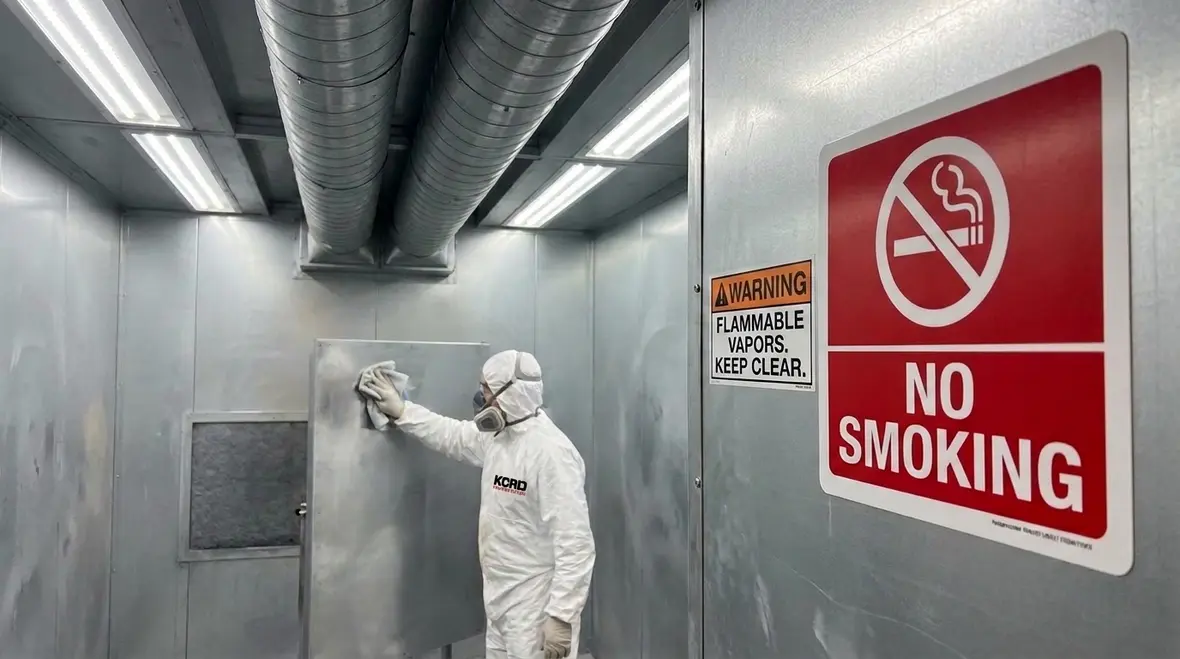
NFPA 33 Section 10.12: Smoking Restrictions in Spray Operations
Quick Answer
NFPA 33 Section 10.12 requires strict control of ignition sources during spraying and related operations. Smoking is prohibited in designated spray areas and must be managed through written procedures, signage, employee training, and verified housekeeping. Facilities must align enforcement with their operating design and hazard assessment.
Facilities reviewing spray area safety controls can also explore spray booth fire suppression for safer paint operations for related protection planning and operational context.
What NFPA 33 smoking restrictions spray operations actually require
NFPA 33 Section 10.12 focuses on eliminating ignition sources in and around spray operations, where flammable liquids, vapors, and combustible residues can accumulate. In practice, the rule means the facility must treat smoking, open flames, and spark producing activities as incompatible with spraying activities and their immediate processes.
For compliance teams, the key is that NFPA 33 smoking restrictions spray operations is not just a policy statement. It requires active implementation: controlled access to spray areas, clear prohibition signage, employee training, and verification that procedures prevent ignition sources from entering hazardous locations.
Where smoking is restricted in a spray process area
Section 10.12 enforcement depends on how the facility defines “spray operations” and adjacent conditions. Most commercial and industrial facilities apply the restriction to the following zones:
- Inside spray booths or spray rooms, including pre spray and post spray dwell periods where vapors can remain.
- Near spray preparation, mixing, thinning, and transfer points where vapors can be generated.
- During application and cleanup, including wiping, solvent handling, and waste handling before vapors dissipate.
- In storage or staging areas when containers are opened, handled, or when residual vapors may accumulate.
In retail and light industrial settings, the most common failure is treating smoking restrictions as limited to “the booth.” Auditors typically consider the entire operational pathway, including material handling routes and work areas where vapors may migrate.
How to implement NFPA 33 smoking controls day to day
1) Written procedures and clear site boundaries
Facilities should document procedures that define:
- Where smoking and other ignition sources are prohibited.
- Where smoking is allowed, if permitted at all, including the location and safe routing that avoids hazardous zones.
- Who has authority to stop work and remove ignition sources.
- How contractors and visitors are briefed.
2) Signage and access control that actually works
Effective signage includes more than posting “No Smoking.” It should align with the physical boundaries of spray areas and include consistent labeling at entrances, transfer doors, and workstations. Access control should prevent employees from bypassing boundaries during operations.
Common commercial facility challenge: spray areas operate through doors that are propped open for workflow convenience. That practice increases ignition source risk and undermines the intent of Section 10.12.
3) Training for employees, supervisors, and contractors
NFPA 33 compliance depends on people understanding the “when” and “where.” Training should cover:
- Why smoking is prohibited during spraying and related operations.
- What counts as an ignition source beyond smoking, including lighters, open flames, and some portable equipment use.
- What to do if someone violates the rule, including stopping spray work and securing ignition sources.
Maintenance and supervisor training matters because many violations occur during shift changes, cleanup cycles, or when a task shifts to solvent handling. Supervisors must know the correct hold points.
Equipment, ventilation, and housekeeping considerations that affect ignition risk
Even when a facility prohibits smoking, the ignition risk can remain high if ventilation and housekeeping do not support safe vapor control. NFPA 33 compliance practices typically pair administrative controls with engineered controls.
Ventilation performance and downtime
Spray operations rely on ventilation to control vapor concentrations. If ventilation is down, degraded, or incorrectly configured, the hazard level increases. Facilities should ensure:
- Fans and exhaust systems operate correctly during spray activities.
- Interlocks and controls prevent spraying when required ventilation is not available.
- Inspection and verification routines confirm performance and document results.
Housekeeping, residue control, and waste containers
Residue and waste can generate flammable conditions even after active spraying stops. Housekeeping procedures should address:
- Removal of waste and rags containing coatings and solvents.
- Proper containerization and closure of waste during and after operations.
- Cleaning practices that do not introduce ignition sources or sparks.
One frequent inspection finding involves delayed waste removal after shifts. Vapors can dissipate while residues remain, creating conditions where ignition control must continue for the appropriate operational timeline.
Inspections, documentation, and common compliance failure points
Audits and insurance reviews often focus on evidence that the restriction system operates in real conditions, not only on paper. Facilities should maintain:
- Current written smoking control procedures tied to spray operations.
- Training records for employees and contractor onboarding.
- Inspection logs for ventilation and spray area safety systems, where applicable.
- Corrective action documentation for violations and near misses.
Common failure points
- Inconsistent boundaries: smoking controls apply to one room, but routing through adjacent areas is unrestricted.
- Missing enforcement: signage exists, but supervisors do not consistently stop work for ignition source violations.
- Ventilation or housekeeping gaps: controls rely on ventilation and cleanup that are not verified.
- Contractor noncompliance: temporary crews are not trained on spray area boundaries before starting work.
To strengthen ongoing compliance, many commercial sites use a structured inspection and maintenance program for spray safety systems and related fire protection components. Kord Fire Protection supports facilities with practical testing, documentation support, and service planning to help maintain the integrity of spray area safety controls.
For additional guidance on commercial fire protection planning and service resources, see Kord Fire Protection’s full fire protection services.
Frequently Asked Questions
Next step: verify your spray area controls now
Review your spray area boundaries, signage placement, visitor and contractor briefing process, and enforcement practices for smoking and ignition sources. Then confirm that ventilation and housekeeping routines support safe operations during spray and cleanup. If you need a structured maintenance and compliance approach, contact Kord Fire Protection to schedule a targeted review and ongoing service planning for your commercial spray safety program.

Join Our Newsletter!
Get the latest fire safety tips delivered straight to your inbox From our Newsletter.



