Emergency Lighting Service Testing and Repairs
Emergency Lighting Service: Testing, Battery Failures, and Repair Timing Explained
When the lights go out, calm leadership matters. That is precisely where a dependable emergency lighting service steps into the spotlight. Within the first few seconds of a power failure, backup lights guide people toward exits, prevent panic, and protect businesses from liability. Kord Fire Protection technicians often explain it simply. Emergency lighting is not about convenience. It is about control when everything else feels uncertain.
Throughout this article, the focus turns to testing schedules, battery failures, repair timing, and why proactive care saves both money and stress. Because while emergency lighting fixtures may sit quietly above doorways, they carry enormous responsibility. And like any silent hero, they require attention long before trouble arrives.
Why Emergency Lighting Service Matters More Than People Realize
Power failures rarely send a calendar invite. They happen during storms, equipment malfunctions, or construction mishaps. Therefore, buildings rely on illuminated exit paths and backup lights to keep occupants safe. A professional emergency lighting service ensures that those systems perform exactly as designed.
Kord Fire Protection technicians frequently remind property managers that emergency lighting is part of a larger life safety ecosystem. It connects with fire alarms, exit signage, and building codes. If one element fails, the entire safety strategy weakens. Moreover, inspectors do not accept good intentions as proof of compliance. They look for documented testing, verified battery capacity, and clear maintenance records. For emergency exit light testing details, see Kord’s Emergency Exit Light Services page.
However, many facility owners underestimate how quickly batteries degrade. They assume that because a light turns on during a quick glance, everything works. Unfortunately, that is like judging a marathon runner by a five step jog. Real reliability requires structured testing and informed evaluation.
How Often Should Emergency Lights Be Tested
This is the one question building managers type into search bars at midnight before an inspection. The answer is straightforward.
According to widely adopted fire safety codes, emergency lighting systems require:
Monthly functional tests
A short activation, usually 30 seconds, confirms that fixtures switch to battery power.
Annual duration tests
A full 90 minute test verifies that batteries sustain illumination for the required time. These intervals align with NFPA 101 life safety expectations and match how Kord outlines emergency light testing on their service page.
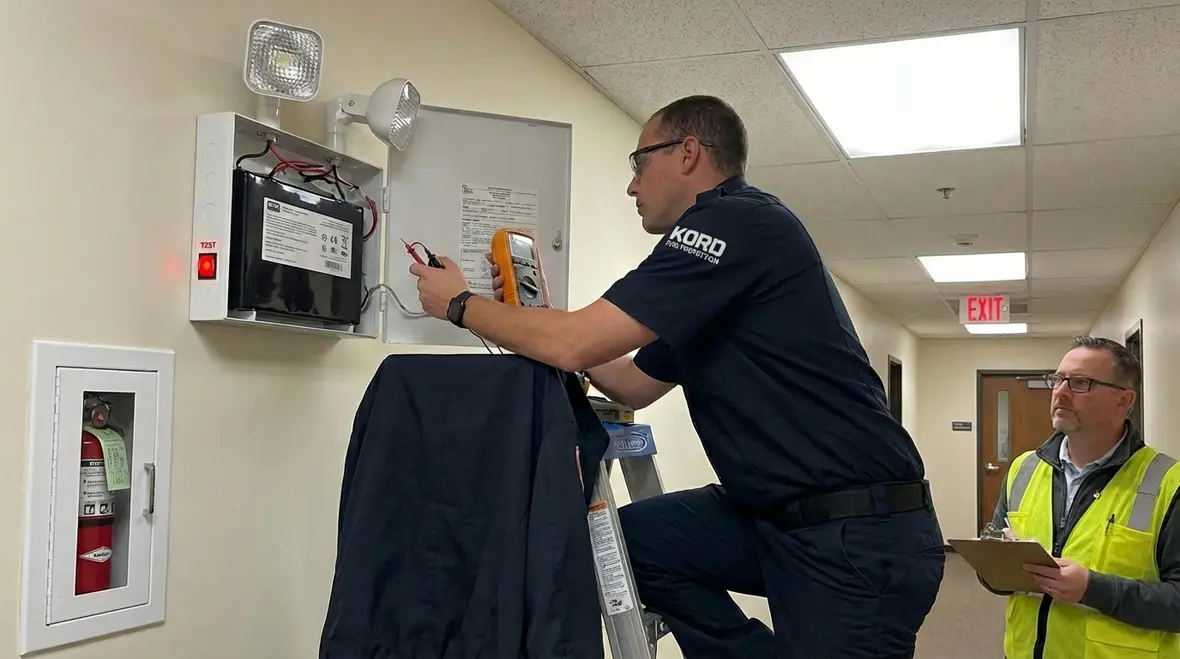
During these checks, technicians observe brightness, flickering, charging indicators, and physical condition. Furthermore, they document results for compliance records.
Kord Fire Protection technicians explain that monthly tests catch surface level issues. Meanwhile, annual tests reveal deeper battery weaknesses. Both matter. Skipping either invites risk. And inspectors rarely appreciate improvisation.
Although some facility teams attempt in house testing, professional oversight adds consistency. Specialists understand how voltage drops signal future failure. They also recognize when fixtures appear operational but fall below legal brightness levels.
After all, emergency lighting should not perform like a phone battery stuck at ten percent. It must deliver full power when demanded.

Understanding Battery Failures Before They Surprise You
Battery failure remains the most common cause of emergency lighting breakdown. Yet batteries rarely fail without warning. They whisper before they quit.
Over time, internal chemical reactions reduce capacity. Heat accelerates deterioration. Poor charging circuits also shorten lifespan. As a result, a battery that once sustained ninety minutes may barely last twenty.
Kord Fire Protection technicians often encounter three primary battery issues:
- Capacity loss
The battery charges but cannot hold sufficient energy. - Charging failure
The fixture fails to replenish power due to faulty components. - Corrosion or swelling
Physical damage indicates imminent replacement.
Consequently, proactive inspection prevents sudden darkness. Technicians measure output under load conditions rather than relying on indicator lights alone. Because a glowing green light can be misleading. It tells you the charger works. It does not guarantee endurance.
Additionally, environmental conditions matter. Storage rooms with high heat shorten battery life. Likewise, dusty environments affect internal circuitry. Therefore, maintenance plans must reflect building realities.
In simple terms, batteries age whether or not anyone pays attention. A structured lighting maintenance program simply acknowledges that truth and manages it wisely.

Repair Timing Explained by Kord Fire Protection Technicians
When should a repair occur immediately, and when can it wait? According to Kord Fire Protection technicians, timing depends on risk exposure.
If a fixture fails a monthly or annual test, immediate corrective action is recommended. Delays increase liability and compromise safety. Moreover, insurance providers may question unresolved deficiencies after an incident.
However, minor cosmetic damage without performance impact may fall into scheduled maintenance windows. The key lies in accurate diagnosis.
Technicians evaluate:
- Illumination levels
Do lights meet minimum brightness standards during battery mode? - Transfer response time
Does the fixture switch to battery power instantly? - Physical integrity
Are lenses clear and housings secure?
Because emergency systems exist for critical moments, experts recommend erring on the side of caution. Waiting rarely reduces repair costs. In fact, small issues often escalate. A weak battery can strain charging circuits. A loose connection can damage internal boards.
Think of it like ignoring a dashboard warning light. The car may run for a while. Yet eventually, the tow truck joins the story. Buildings deserve better endings.
Comparing Proactive Maintenance vs Reactive Repairs
| Proactive Lighting Maintenance | Reactive Repairs |
|
Scheduled monthly and annual testing Documented compliance records Planned battery replacement cycles Lower long term costs Reduced inspection stress |
Repairs after failure Limited documentation Unexpected battery collapse Higher emergency service fees Increased liability risk |
Although reactive repairs may seem cheaper in the short term, they often create cascading expenses. For example, emergency call outs during business hours disrupt operations. Furthermore, failed inspections may lead to fines or reinspection fees.
On the other hand, a structured emergency lighting service reduces uncertainty. Facility managers gain predictable maintenance schedules. Budget planning improves. Most importantly, occupant safety remains uncompromised.
Kord Fire Protection technicians emphasize that preparedness costs less than panic. And frankly, panic rarely fits into annual budgets.
Choosing the Right Emergency Lighting Service Provider
Selecting a qualified provider requires more than comparing price tags. Instead, decision makers should evaluate experience, documentation practices, and response times.
A reliable emergency lighting service offers:
- Comprehensive testing protocols
Clear procedures aligned with recognized codes and local standards. - Detailed reporting
Written documentation for every inspection and repair. - Certified technicians
Professionals trained in life safety systems. - Transparent repair recommendations
Clear explanations without unnecessary upselling.
Kord Fire Protection technicians take time to explain findings in plain language. They avoid technical jargon unless requested. Because building managers need clarity, not a physics lecture. Moreover, transparent communication builds trust.
Additionally, response capability matters. When a system fails, waiting days is rarely acceptable. Providers should demonstrate timely repair scheduling and readily available replacement parts.
Ultimately, the right partner treats emergency lighting not as a side task, but as a critical safety function woven into every building operation. If you manage properties in Southern California, Kord’s dedicated Emergency Exit Light Services are built around exactly that philosophy.
How Emergency Lighting Service Supports Code Compliance and Peace of Mind
Compliance may sound like paperwork. Yet behind every regulation stands a history of lessons learned the hard way. Emergency lighting requirements exist because past tragedies exposed the need for visible exit paths.
Therefore, a professional emergency lighting service supports both legal compliance and moral responsibility. Testing logs, maintenance records, and documented repairs provide proof that safety measures function properly.
Kord Fire Protection technicians often explain that inspectors appreciate clarity. When documentation shows consistent testing and prompt repairs, inspections move smoothly. Conversely, missing records raise questions.
In addition, insurance carriers frequently request maintenance documentation after incidents. Organized records simplify that process. Consequently, proactive management protects reputations as well as occupants.
There is also a psychological benefit. When building owners know systems are maintained correctly, they sleep better. And restful sleep, unlike emergency batteries, should not require monthly testing.
FAQ About Emergency Lighting Testing and Repairs
Conclusion: Keep the Lights Ready Before the Storm
When darkness arrives, preparation speaks louder than promises. A dependable emergency lighting service ensures batteries hold charge, fixtures respond instantly, and inspections proceed without stress. Kord Fire Protection technicians stand ready to test, repair, and document every detail with precision. Do not wait for an outage to reveal weaknesses. Schedule professional evaluation today and keep every exit clearly lit when it matters most.
If you are responsible for a building in Southern California and want one partner to oversee fire protection beyond just lighting, explore Kord’s Full Fire Protection Services. From emergency exit light testing to sprinklers, alarms, and suppression, their team designs maintenance plans that keep you inspection-ready year-round.
Ready to take the next step?
Schedule your emergency exit light service or contact Kord Fire Protection to build a complete, code-compliant emergency lighting and fire protection plan for your facility.
Know Your Weapon Before You Fight the Flame
Kord Fire Protection is your go-to when it comes to all things fire protection. For over 20 years, we’ve been serving Southern California with the quality service and equipment to keep your home or business safe at all times. Our competitive prices reflect our unwavering commitment to protecting what matters most in the event of a fire emergency. Give us a call, send an email, or use that form!

Join Our Newsletter!
Get the latest fire safety tips delivered straight to your inbox From our Newsletter.