Dry Chemical Fire Suppression System Guide
Fire does not knock before it enters. It arrives loud, fast, and hungry. That is precisely why our dry chemical fire suppression system stands ready long before smoke ever curls toward the ceiling. Within the first seconds of ignition, it reacts with speed and precision, cutting off the fire at its chemical core. However, understanding how it works makes all the difference between blind trust and informed confidence. In the sections ahead, Kord Fire Protection technicians step into the spotlight, calmly explaining agent types, nozzle design, and real world applications in a way that feels less like a lecture and more like a masterclass delivered in a smooth, reassuring baritone.
Because when it comes to fire safety, knowledge is not just power. It is prevention.
Understanding a Dry Chemical Fire Suppression System
A dry chemical fire suppression system uses powdered extinguishing agents to interrupt the chemical reaction that fuels a fire. Rather than cooling flames like water or removing oxygen like carbon dioxide, this system attacks the molecular chain reaction itself. As a result, combustion simply cannot continue.
Kord Fire Protection technicians often explain it this way. Imagine a campfire story that gets interrupted mid sentence. No ending. No dramatic finale. Just silence. That is what a dry powder extinguishing system does to fire.
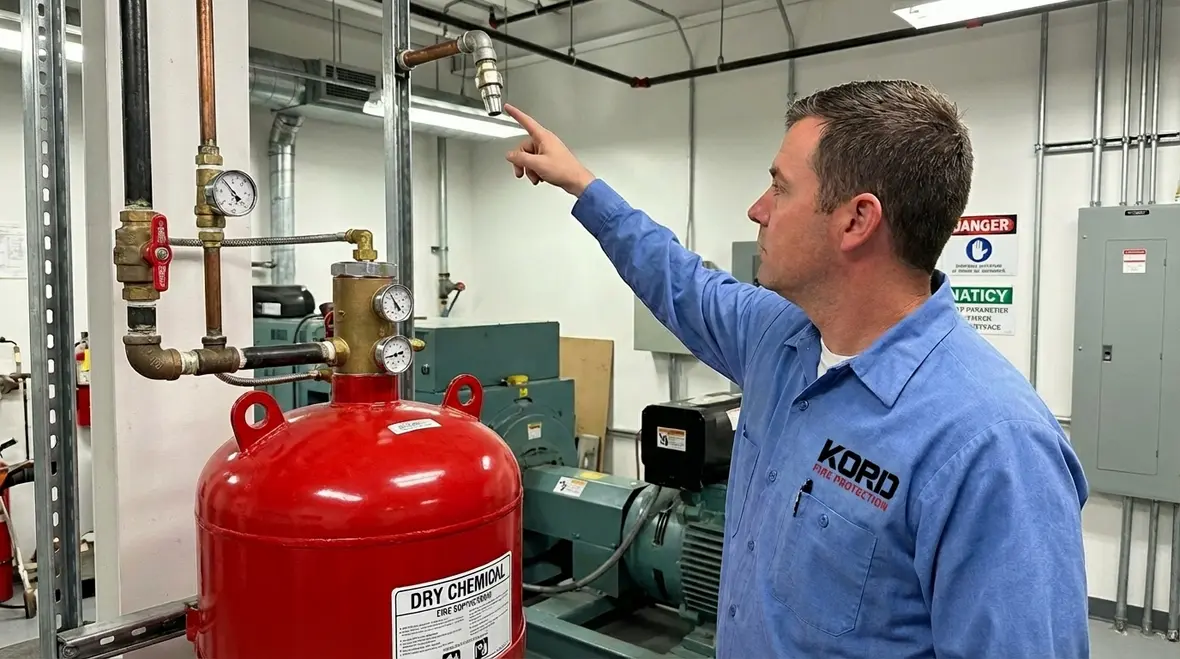
Typically, the system stores the agent in a pressurized cylinder. When heat sensors or manual controls activate it, the agent travels through piping and exits through strategically placed nozzles. Consequently, the powder blankets the hazard area and disrupts the fire triangle with remarkable speed.
Moreover, these systems prove especially effective for Class A, B, and C fires. That includes ordinary combustibles, flammable liquids, and electrical equipment. Therefore, industries that cannot risk water damage often rely on this solution. For a broader look at how suppression fits into a complete protection strategy, many facility managers also review Kord Fire’s fire suppression services overview to compare options across different hazards.
What Types of Dry Chemical Agents Are Used?
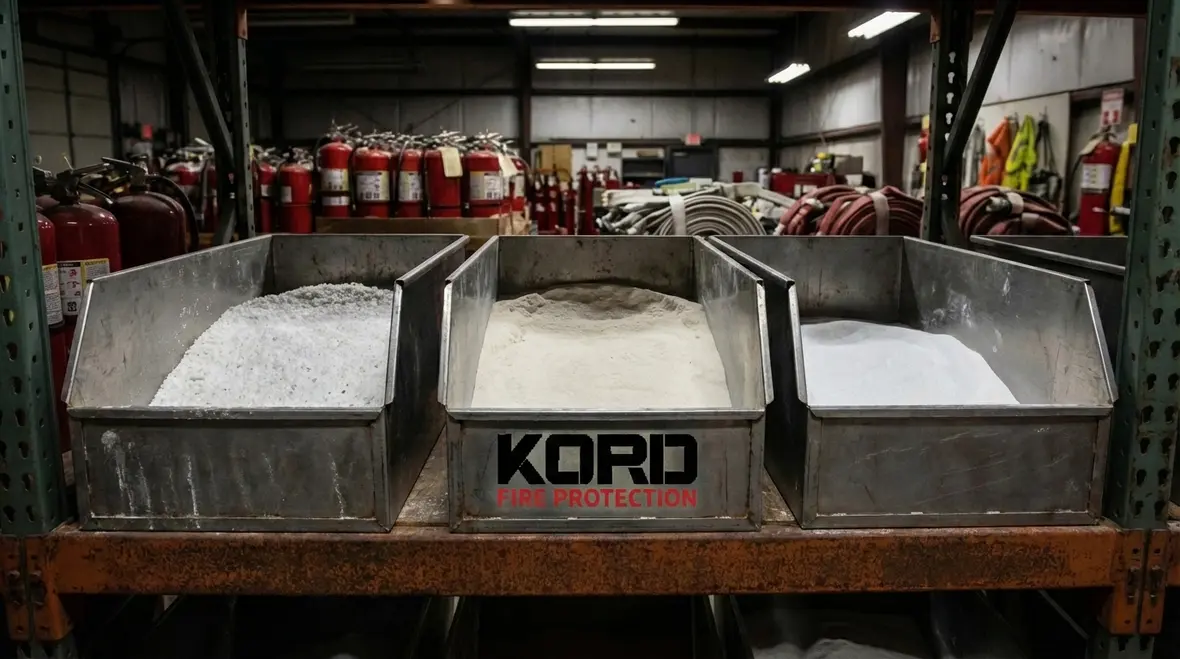
Not all fires behave the same way. Likewise, not all suppression powders serve the same purpose. Kord Fire Protection technicians frequently break down the main agent categories so facility managers can choose wisely.
Multipurpose Monoammonium Phosphate
This agent handles Class A, B, and C fires. It melts slightly when exposed to heat, creating a coating that seals surfaces from oxygen. Because of that versatility, it remains one of the most widely used options in commercial settings.
Sodium Bicarbonate
Common in industrial kitchens and fuel storage areas, sodium bicarbonate excels on Class B and C fires. It interrupts the flame reaction almost instantly. However, it does not create the same surface sealing effect as monoammonium phosphate.
Potassium Bicarbonate (Purple K)
Often referred to as Purple K, this agent delivers rapid knockdown for high hazard flammable liquid fires. Consequently, it appears frequently in aviation and petrochemical facilities where seconds truly matter.
Each agent serves a purpose. Therefore, selecting the correct one is less about preference and more about environment. Kord technicians often say choosing the wrong agent is like bringing a garden hose to a volcano. Technically water. Practically useless.
Agent Type and Primary Use Overview
| Agent Type | Primary Use and Strength |
| Monoammonium Phosphate | Works on Class A, B, C fires and forms protective residue |
| Sodium Bicarbonate | Fast suppression for flammable liquids and electrical hazards |
| Potassium Bicarbonate | High speed knockdown for industrial fuel risks |
This comparison helps decision makers quickly align fire hazards with the right chemical defense.
How Nozzles and Distribution Design Make or Break Performance
A dry chemical fire suppression system relies heavily on its discharge pattern. After all, an agent sitting inside a cylinder is about as helpful as a superhero who refuses to leave the couch.
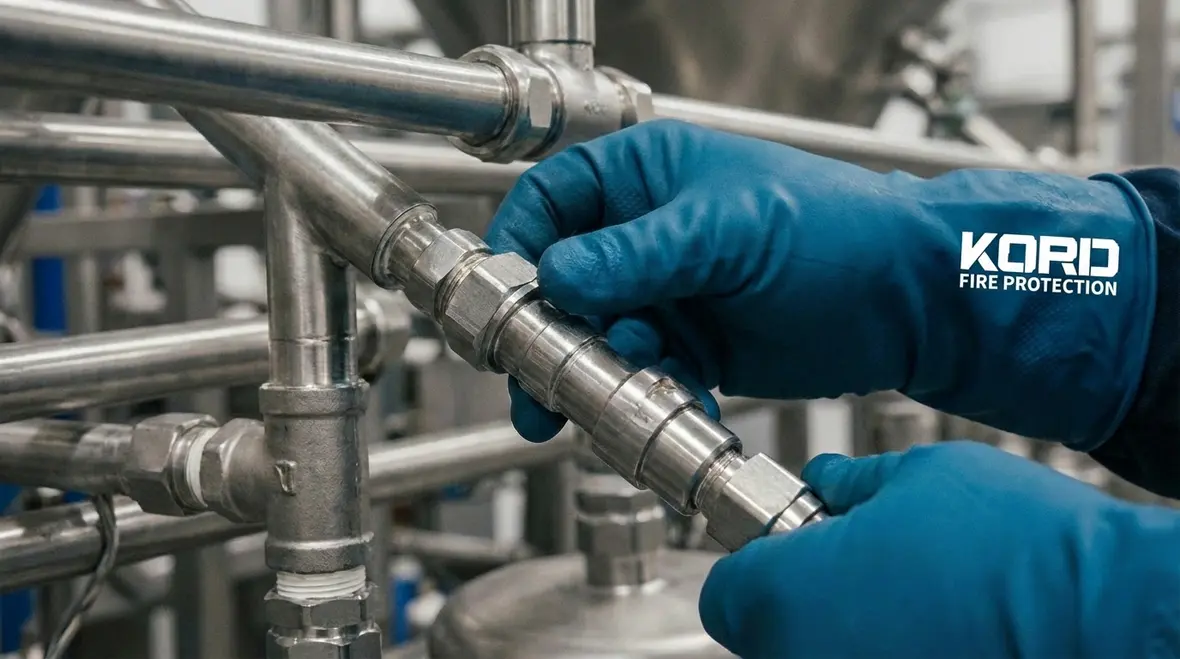
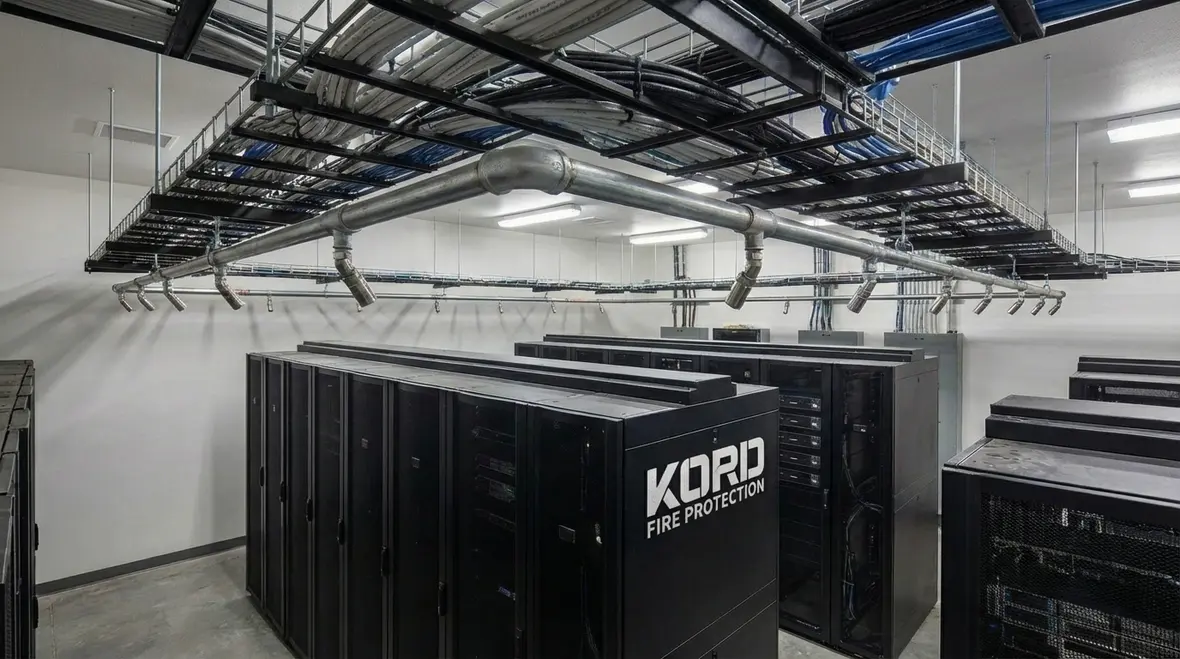
Nozzles control flow rate, spray angle, and distribution density. Therefore, engineers calculate placement based on enclosure size, airflow patterns, and hazard location. Kord Fire Protection technicians evaluate these variables carefully during installation.
For example, a total flooding design fills an enclosed space with powder. In contrast, a local application system targets a specific piece of equipment such as a paint booth or fuel pump. Because of this difference, nozzle positioning must align with the hazard footprint.
Additionally, pipe diameter and pressure ratings influence discharge speed. If pressure drops too quickly, the agent may not reach distant nozzles. Consequently, proper hydraulic calculations ensure uniform coverage.
Kord technicians often remind clients that placement is not guesswork. It is physics, airflow science, and experience working together. Or as they like to joke, it is less Hollywood explosion and more quiet precision.
Where Dry Chemical Systems Perform Best
Every fire suppression method shines in specific settings. The dry chemical fire suppression system stands out where water damage would cause equal or greater loss than fire itself.
Industrial Facilities
Manufacturing plants frequently contain flammable liquids, mechanical processes, and electrical panels. Therefore, a powder based approach offers rapid interruption without conductive risk.
Commercial Kitchens
Although wet chemical systems dominate cooking appliance protection, dry agents still appear in certain exhaust ducts and auxiliary hazards. In addition, facilities that store cooking fuels benefit from their rapid action.
Fuel Storage and Aviation
Flammable liquid fires spread quickly across surfaces. Because dry chemicals interrupt the chain reaction at a molecular level, they suppress these fires with exceptional speed.
Electrical Rooms
Water and electricity remain a famously bad combination. Consequently, many data centers and utility spaces rely on non conductive suppression powders.
Across these use cases, Kord Fire Protection technicians tailor systems to match risk levels. They assess airflow, occupancy, and fuel load before recommending a configuration. Therefore, each installation reflects real world hazard analysis rather than a one size fits all approach. For deeper code-specific guidance, many safety teams also reference Kord Fire’s article on NFPA 17 dry chemical extinguishing systems to understand design and approval requirements.
Installation and Compliance Considerations
Designing a system is only part of the journey. Codes and standards guide installation, inspection, and maintenance. Because safety depends on reliability, compliance is not optional.
National fire codes specify cylinder sizing, nozzle spacing, detection integration, and alarm connection. Moreover, routine inspections verify pressure levels, mechanical integrity, and unobstructed discharge paths.
Kord Fire Protection technicians walk clients through these requirements step by step. First, they perform a hazard analysis. Next, they calculate agent volume. Then, they coordinate with building management and local authorities for approval.
Importantly, maintenance includes regular cylinder weighing, hose checks, and functional testing. Over time, even the most robust equipment can degrade. However, scheduled service prevents unpleasant surprises.
As technicians often explain, a suppression system is like a parachute. One hopes never to use it. Nevertheless, when the moment arrives, it must work flawlessly.
Advantages and Limitations You Should Know
Advantages
- Rapid fire knockdown across multiple classes
- Non conductive properties for electrical hazards
- Cost effective compared to some gaseous systems
- Proven reliability in industrial settings
Limitations
- Residue cleanup required after discharge
- Reduced visibility during activation
- Not ideal for delicate electronics without protective measures
Because the agent leaves powder behind, post incident cleanup becomes part of the recovery plan. However, most facility managers agree that sweeping up residue beats rebuilding a structure.
Kord Fire Protection technicians approach these conversations with transparency. They outline trade offs clearly so clients understand both the power and the practical realities of a dry chemical fire suppression system.
How Kord Fire Protection Technicians Explain It Simply
Technical manuals can feel overwhelming. Therefore, technicians translate complex mechanics into plain language.
They often describe the suppression process in three steps. First, detection senses abnormal heat. Second, the control panel triggers release. Third, the powder interrupts combustion instantly. Simple. Direct. Effective.
Additionally, they emphasize that prevention works alongside suppression. Good housekeeping, safe storage, and staff training reduce the likelihood of activation. Because even the best system works best when it rarely needs to act.
Clients frequently note the calm confidence technicians bring to consultations. Perhaps it is experience. Perhaps it is preparation. Or perhaps it is the reassuring knowledge that someone has already calculated the outcome before sparks ever fly.
Dry Chemical Fire Suppression FAQs
Conclusion: Turn Knowledge Into Protection
Fire moves fast. However, preparation moves faster. A professionally designed dry chemical fire suppression system delivers immediate, decisive protection when hazards ignite. With expert guidance from Kord Fire Protection technicians, facilities gain more than equipment. They gain clarity, compliance, and confidence.
If safeguarding assets, staff, and operations matters, now is the time to act. Connect with Kord Fire Protection today and build a safer tomorrow before sparks ever have a chance. For a side by side look at other options, you can also review their full suite of fire suppression system services and choose the right fit for each area of your facility.
Prefer to talk it through? Call the Kord Fire team to walk through your hazards, NFPA 17 requirements, and inspection schedule in plain language so you can move forward with confidence.
Know Your Weapon Before You Fight the Flame
Kord Fire Protection is your go-to when it comes to all things fire protection. For over 20 years, we’ve been serving Southern California with the quality service and equipment to keep your home or business safe at all times. Our competitive prices reflect our unwavering commitment to protecting what matters most in the event of a fire emergency. Give us a call, send an email, or use that form!

Join Our Newsletter!
Get the latest fire safety tips delivered straight to your inbox From our Newsletter.