
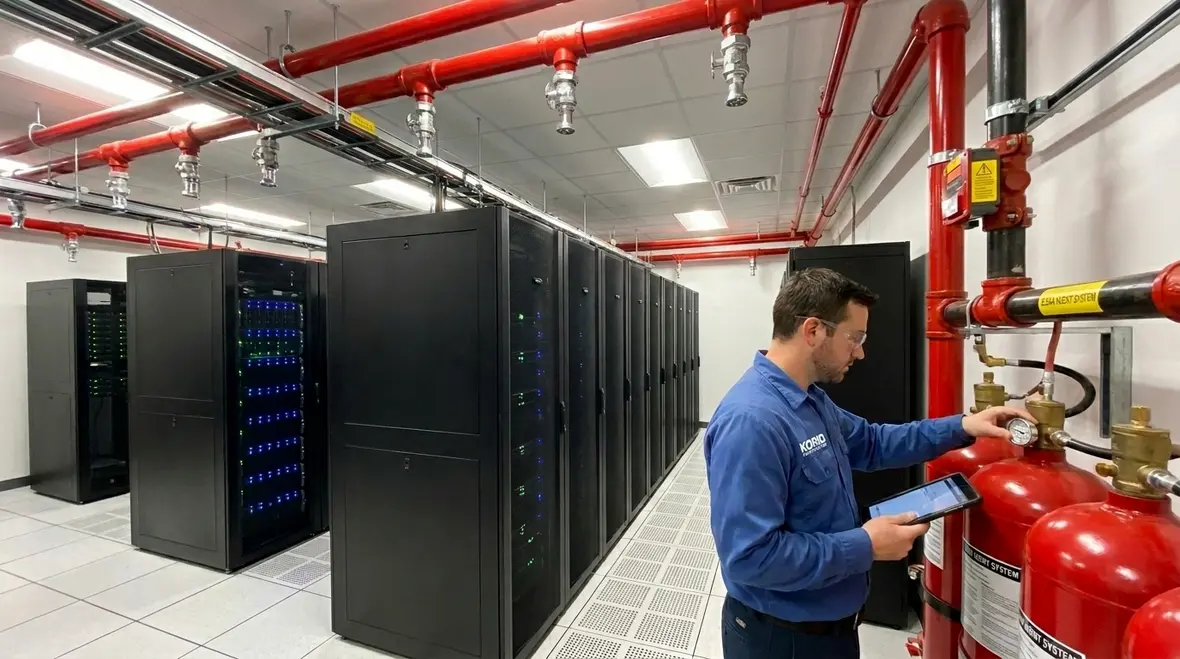
Best Clean Agent for Data Center Fire Protection
When a data center needs clean agent fire suppression, the best clean agent for data center protection is the one that matches the facility size, hazard type, and operational goals. In other words, it must put out the fire while keeping downtime low and safeguarding the equipment that runs everything from cloud services to critical healthcare systems. And yes, the right choice also matters because a wrong choice can turn a “quick response” into a long cleanup project. That is where planning meets reality, and where Kord Fire Protection can become a vital partner, not just a vendor, for jobs that demand both technical accuracy and calm execution.
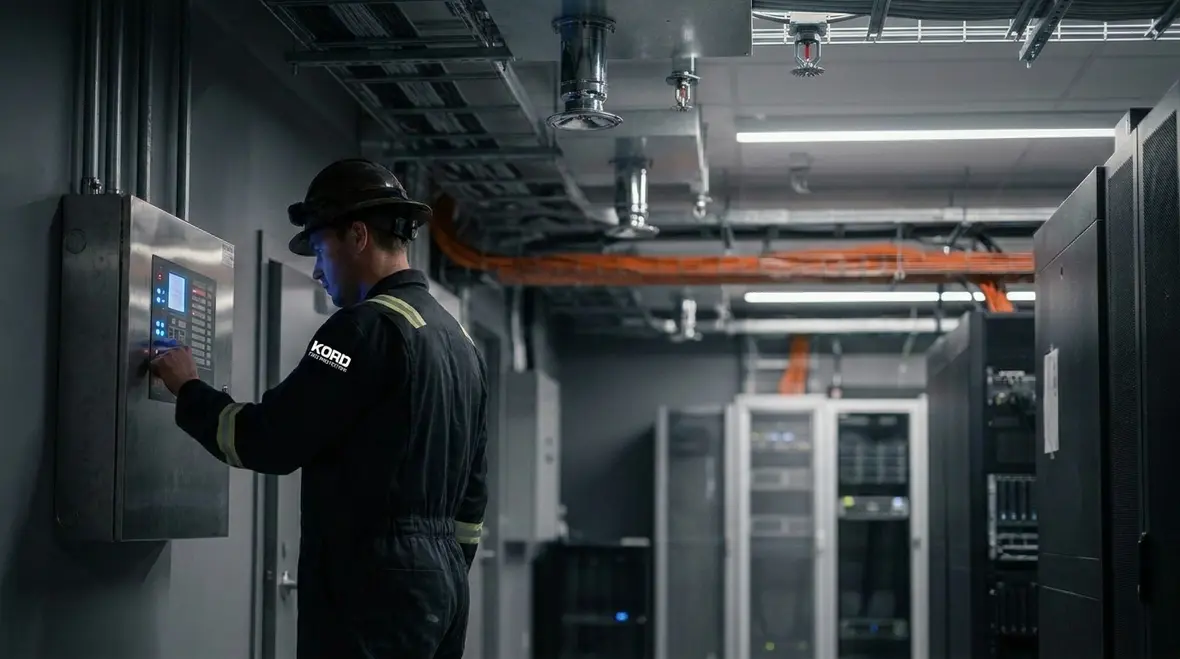
Which clean agent fits modern data centers best?
Most data centers choose clean agents because they control fire with minimal residue. However, the “best” option is not a single product name for every building. Instead, it depends on how the agent works, how it affects enclosure design, and what the facility can tolerate during discharge and reentry.
Clean agents generally fall into two buckets: inert gas systems and halocarbon-based systems. Inert gas systems use naturally occurring gases to reduce oxygen, while halocarbons interrupt the fire chemical process. So, when selecting a clean agent, the team should weigh hazard class, occupant exposure limits, and the facility’s ability to maintain airtight conditions during flooding.
Additionally, many data centers operate with tight airflow and sophisticated cooling layouts. Therefore, the suppression design must account for airflow patterns, aisle containment, cable trays, and equipment room zoning. Without that, the agent might do the job on paper and underperform in the real world, which is like wearing a suit to the beach and hoping the ocean files a request for refunds.
For teams comparing approaches, Kord Fire has related resources on data center clean agent fire suppression and a broader look at the clean agent standard for fire suppression systems, both of which help frame how design choices affect real rooms and real outcomes.
Common clean agent types and where they perform well
A facility manager can improve decision speed by understanding how agent types behave in the field. Below is a practical look at common clean agent approaches.
Inert gas systems
Inert gas systems, such as nitrogen or argon blends, work by lowering oxygen concentration. They often suit rooms where halocarbon use needs careful review. However, these systems require larger storage capacity and strict enclosure performance, because oxygen levels must drop reliably and remain where the design expects them to stay.
Halocarbon agents
Halocarbon agents include several generations of formulations, each designed to balance fire control with safety and cleanup. Many modern halocarbons aim to leave little residue and support faster recovery for operations. Still, the system design must meet discharge rate targets and ensure exposure limits for any potential occupant presence.
Key design reality
No agent replaces good engineering. Therefore, the right agent with poor nozzle placement, weak detection, or inaccurate room modeling will still lead to wasted time and risk. A well built plan aligns hazard mapping, detection spacing, and distribution calculations. If you want a useful companion read, Kord Fire’s comparison of clean agent vs traditional fire suppression systems helps explain why clean agent design has to be exact, especially when expensive electronics are involved.
What matters most when choosing a best clean agent for data center
Even though teams often focus on the agent first, the deeper driver is the system outcome: reliable detection, effective distribution, safe exposure, and predictable recovery. To move beyond guesswork, a data center should evaluate these items in order.
- Hazard and expected fire scenario
Different ignition sources behave differently. For instance, electrical cabinets, cable bundles, and transformer or power rooms can present varied risks. The system should target the likely fuel load and fire growth pace. - Enclosure quality and leakage
Clean agent systems rely on maintaining concentration in the protected volume. Therefore, even minor air leaks can reduce effectiveness. Before any discharge calculation gets finalized, a team should review penetrations, door seals, cable cutouts, and HVAC interactions. - Occupant safety and exposure management
A data center may run lights out, yet staff can still be present during maintenance. So the plan should define pre discharge alarms, evacuation timing, and signage. It should also verify that exposure limits match the agent choice and local code requirements. - Recovery plan and downtime tolerance
Equipment recovery often depends on concentration control and residue control. Therefore, the organization should define what happens after discharge: inspection, downtime windows, and how quickly operations can resume.
How Kord Fire Protection supports clean agent installation
Choosing the agent is only half the story. The other half is execution. Kord Fire Protection can become a vital partner by bringing jobsite discipline to the steps that make or break clean agent performance.
In many facilities, the biggest friction shows up during site coordination: scheduling shutdowns, verifying room boundaries, confirming detection and zoning, and coordinating with electrical and mechanical teams. Meanwhile, the contractor must also document system configuration, verify tank and control equipment setup, and ensure that all interlocks perform correctly.
Kord Fire Protection can support this work by aligning engineering assumptions with real room conditions. They can also help the facility verify that detection, alarm, and release sequences match the operational rules of the building. And because data center staff do not want “surprises” any more than fans want surprise rain in a summer tournament, the partner should confirm commissioning tests before final handoff.
Just as importantly, Kord Fire Protection can help plan ongoing maintenance. Clean agent systems still need testing, inspections, and cylinder or cartridge management based on manufacturer guidance and local code. Maintenance done right keeps the system ready, even when nobody wants to think about fire on a Tuesday. For readers who want more technical context, Kord Fire’s clean agent suppression for data centers article pairs well with their NFPA 2001 guidelines overview.
Dual column guide to clean agent selection and project steps
Below is a dual column planning guide to help teams align decisions with field readiness.
Selection factor
- Hazard mapping
- Room boundary checks
- Detection strategy
- Agent distribution design
- Release sequencing
- Commissioning and proof
What the facility should do
- Identify equipment types, cable density, and likely ignition sources for each room.
- Review ceiling heights, doors, penetrations, and HVAC airflow paths that affect agent retention.
- Confirm smoke, heat, or aspirating choices match smoke development and airflow conditions.
- Verify nozzle locations, discharge pressures, and calculation assumptions in the final design.
- Set alarm timing, abort logic, and interlocks so operations can evacuate safely.
- Perform functional testing, confirm control panels, and document results for compliance.
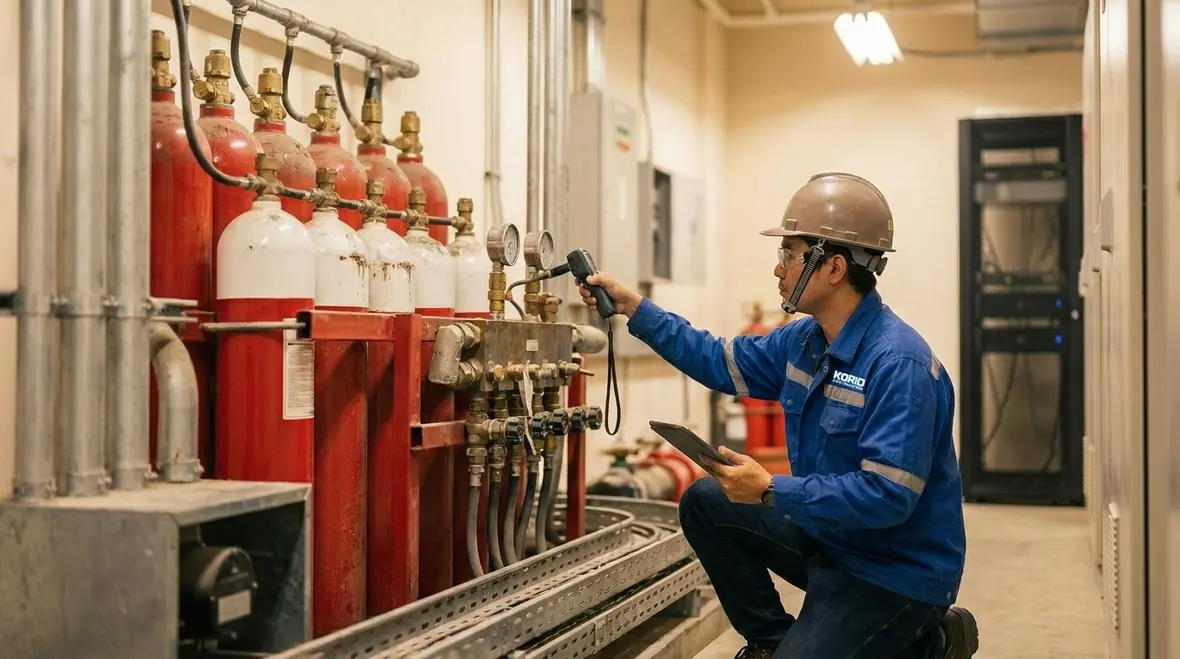
Design pitfalls that cause underperformance
Most failures do not happen because the agent is “bad.” Instead, they occur due to avoidable design and coordination issues. Therefore, teams should watch for these common pitfalls.
- Overlooking enclosure integrity
A room that looks sealed can still leak through cable trays, service corridors, or under door gaps. If the design assumes tighter conditions than the building can deliver, the system can miss the required concentration. - Ignoring airflow during cooling cycles
Data centers often run variable air volume and high velocity cooling. If the airflow model does not reflect real operation, the agent may not mix as predicted. As a result, concentration can become uneven across racks. - Weak coordination between detection and release
If detection reaches the control panel late, or alarm timing does not match evacuation needs, the system might discharge after conditions change. In that case, it can reduce effectiveness or increase risk. - Not planning for maintenance access
Clean agent rooms still require inspection access for nozzles, detectors, and controls. When teams skip maintenance planning, they often end up with access issues that delay service and reduce reliability.
When these pitfalls get addressed early, the facility avoids costly rework. And that is a win for the budget, the schedule, and the humans who keep the lights on. It also makes the path to long term service simpler, especially when the project team already has a maintenance partner lined up instead of scrambling later like somebody who just realized the “easy assembly” instructions came in six languages and zero mercy.
FAQ: Clean agent decisions for data centers
Conclusion and next step
The best clean agent for data center protection comes from matching the agent type to the real room, the actual fire risk, and the operational limits of the site. When a team plans hazard mapping, enclosure integrity, detection strategy, and release sequencing with discipline, the system performs when it must. That is the difference between a system that simply exists on drawings and one that actually protects uptime.
If the facility wants reliable results and a calmer project experience, Kord Fire Protection can act as a vital partner from design support to commissioning and ongoing maintenance. For the next step, explore Kord Fire’s clean agent fire suppression service page and the dedicated clean agent fire suppression offering to start a plan built for your facility’s needs.


Join Our Newsletter!
Get the latest fire safety tips delivered straight to your inbox From our Newsletter.



