
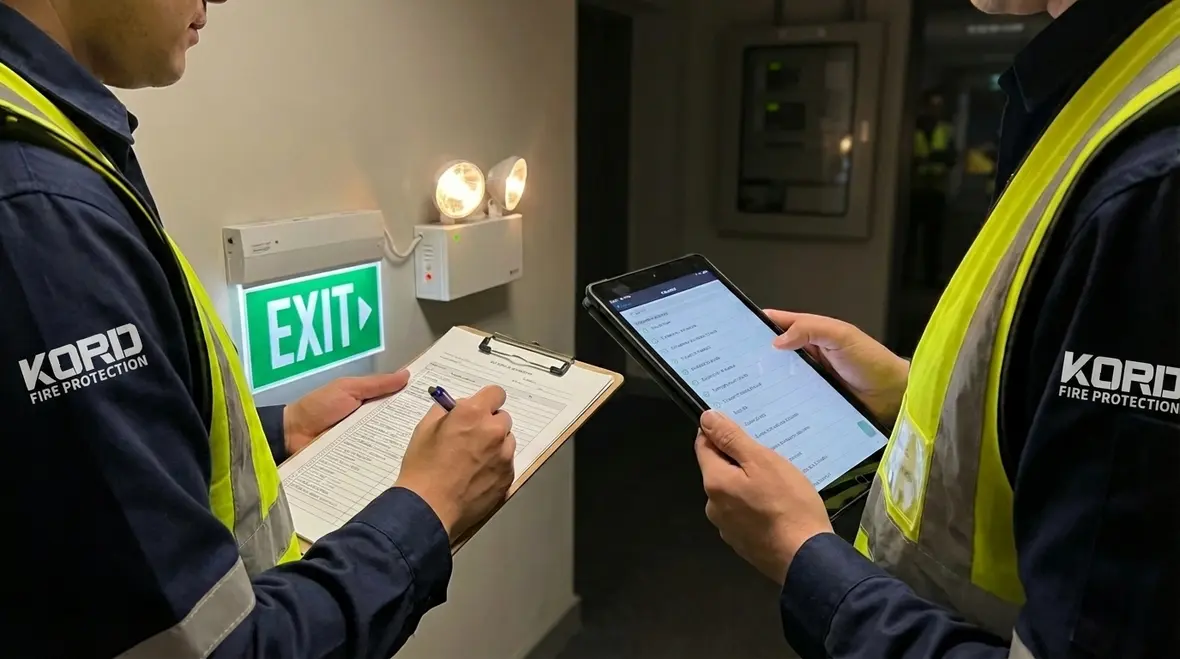
Annual Emergency Lighting Test Documentation Guide
Annual Emergency Lighting Test: What to Document to Prove Compliance
Every building has a quiet promise built into its walls. When the lights go out, the path to safety will still shine. However, that promise only holds weight when it is backed by clear and thorough annual emergency lighting test documentation. Inspectors do not accept good intentions. They want records. They want dates, results, signatures, and proof that someone took the time to check every unit. This article walks through exactly what should be documented, why it matters, and how Kord Fire Protection technicians explain the process in plain language that building owners actually understand.
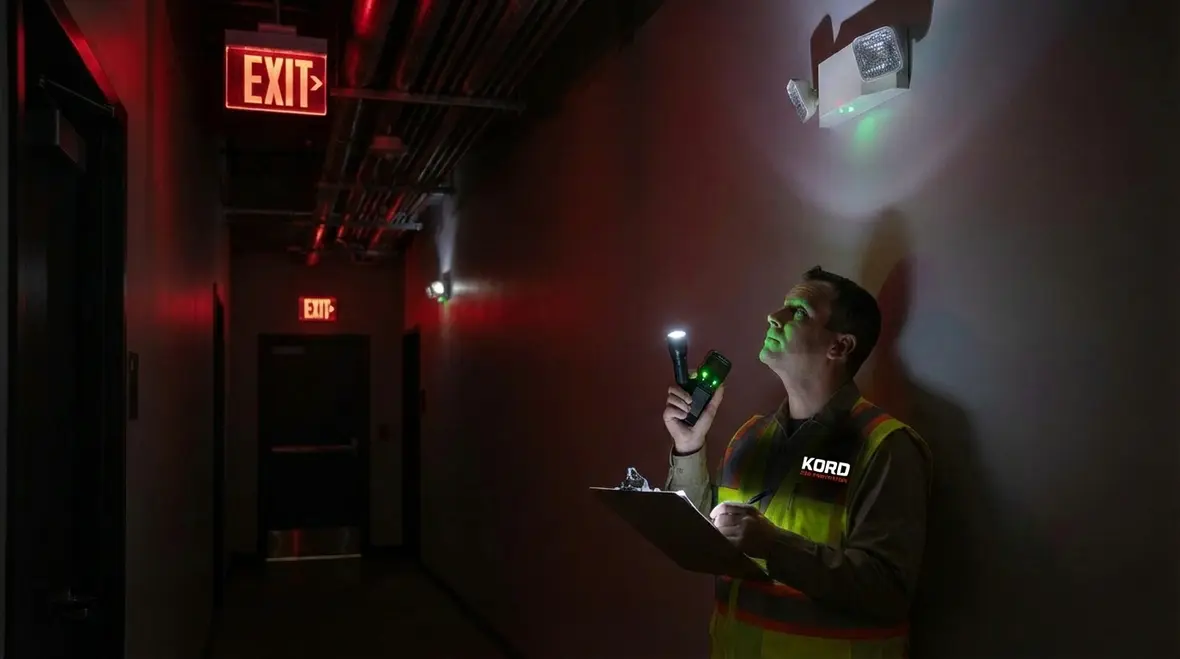
The Real Purpose Behind the Annual Emergency Lighting Test
An emergency light is like a seatbelt. Most people never think about it until the moment it matters. Therefore, the annual inspection exists to confirm that every fixture can operate for the full required duration during a power failure.
The annual emergency lighting test documentation serves as written proof that each unit was tested for the full 90 minute discharge period, or as required by local code. Without that record, a building owner cannot show compliance during an audit, insurance review, or fire inspection.
Moreover, compliance is not just about avoiding fines. It protects occupants. When corridors fill with smoke and alarms echo off concrete walls, people need visible exit paths. In that moment, nobody cares about paperwork. Yet ironically, it is the paperwork that proves the lights were ready for that moment.
Kord Fire Protection technicians often explain it this way: “Hope is not a maintenance plan.” They say it calmly, with the kind of patience that suggests they have seen what happens when hope is the only plan in place.
What Should Be Included in Annual Emergency Lighting Test Documentation
When an inspector reviews records, they look for clarity. Vague notes such as “tested and fine” will not pass scrutiny. Instead, proper annual emergency lighting test documentation should contain detailed and organized information.
Key elements to include:
- 1. Building information
Location address
Suite or floor details
Contact person - 2. Date of test
The exact date the full duration test occurred
Confirmation it was the annual discharge test - 3. Technician details
Name of technician
Company performing the test
Signature or digital verification - 4. Fixture identification
Unique ID number or tag
Location description such as “North stairwell level 2” - 5. Test results
Pass or fail result
Actual runtime achieved
Light output observations - 6. Deficiencies and corrective actions
Battery failures
Lamp issues
Repairs completed or scheduled
Additionally, inspectors appreciate organized logs. A clear table or digital system prevents confusion later. After all, nobody wants to decode scribbled handwriting that looks like it survived a windstorm.

How to Record Results So Inspectors Actually Approve Them
It is not enough to perform the test. The way the results are recorded matters just as much. Therefore, building managers should focus on clarity, accuracy, and consistency.
First, record the start and end time of the 90 minute test. This confirms the fixture sustained power for the required duration. Second, note any flickering, dimming, or premature failure. Even if a unit technically stays on, reduced illumination may indicate a weak battery.
Furthermore, document corrective actions immediately. If a battery is replaced, record the replacement date and part used. This creates a maintenance trail that demonstrates proactive management.
Kord Fire Protection technicians often advise clients to think like an auditor. “If someone walked in tomorrow,” they explain, “could they understand what happened without asking you a single question?” If the answer is no, the documentation needs improvement.
Consistency also helps. Use the same format every year. Over time, this creates a clear compliance history. And when inspectors see organized records spanning several years, they tend to relax. People trust patterns.
Common Mistakes That Undermine Compliance
Even responsible building owners sometimes slip up. However, most documentation problems come from small oversights rather than major negligence.
Frequent issues include:
- Missing annual test confirmation
- Incomplete fixture lists
- No record of failed units
- Lack of technician identification
- No proof of corrective action
In some cases, facilities perform monthly push button tests but forget the full annual discharge. Unfortunately, those shorter tests do not replace the required duration test.
Another common mistake involves storing records in random folders or personal email inboxes. Later, when inspectors request proof, panic sets in. Paper trails should never rely on someone’s memory. As Kord Fire Protection technicians like to say, “If it lives only in your head, it does not exist.”
Therefore, centralizing annual emergency lighting test documentation in a shared and backed up system can prevent last minute scrambling.
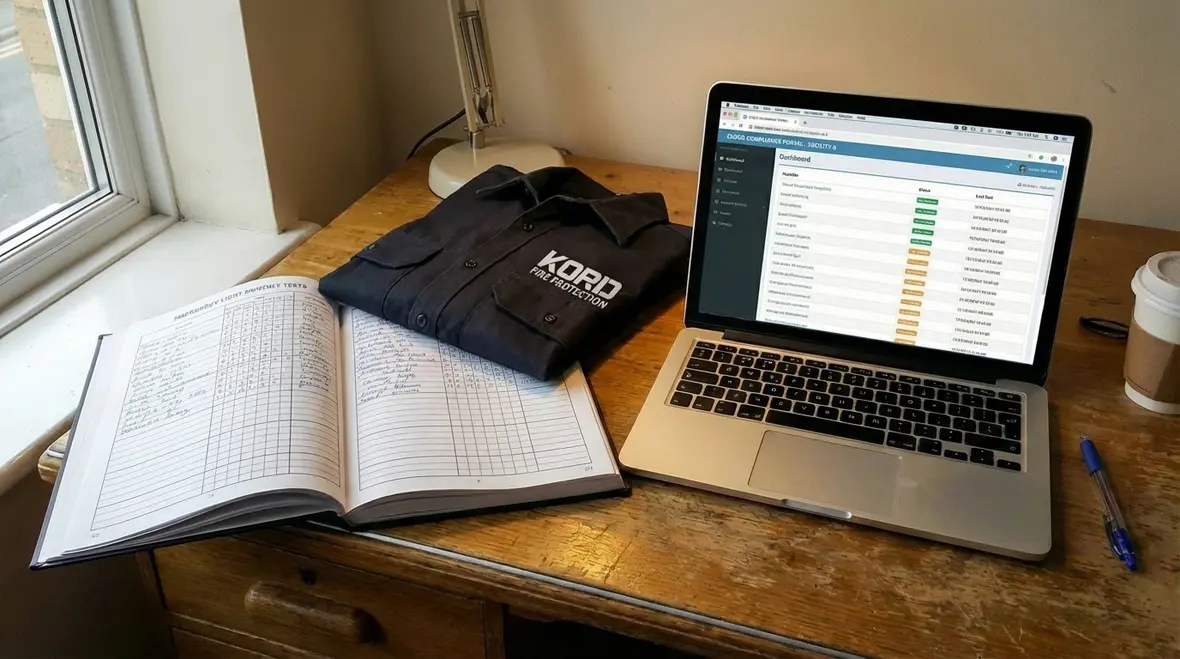
Digital vs Paper Records: Which One Works Best
Technology has changed how facilities manage compliance. While paper logs once ruled the day, digital systems now offer speed and organization. Nevertheless, both methods can work if used properly.
Paper Records
Paper records offer:
Simplicity
No software training
Immediate physical signatures
Digital Systems
Digital systems provide:
Automatic timestamps
Cloud backups
Searchable records
Photo attachments
Digital platforms also allow technicians to attach images of failed fixtures or battery replacements. Consequently, this adds another layer of proof. An inspector reviewing annual emergency lighting test documentation with photo evidence often gains confidence in the process.
Still, the format matters less than the content. A beautifully designed digital log with missing information will fail just as quickly as a coffee stained clipboard sheet.
What Kord Fire Protection Technicians Look For During the Test
Kord Fire Protection technicians approach each inspection with a methodical routine. First, they simulate a power loss to trigger battery operation. Then, they monitor each fixture throughout the required discharge period.
They evaluate:
- Battery strength and age
- Lamp brightness and stability
- Charging indicators
- Physical damage to housing
- Proper mounting and visibility
Additionally, they check whether fixtures remain unobstructed. A perfectly functioning light hidden behind stacked storage boxes helps no one. Yes, it happens more often than people admit.
Once testing concludes, technicians compile detailed annual emergency lighting test documentation. They explain findings in clear language, not technical jargon. Building owners receive not only a report but also guidance. If upgrades are needed, they outline next steps. If everything passes, they confirm compliance with confidence.
That calm, steady explanation style often reassures property managers. Compliance can feel overwhelming. However, when someone breaks it down step by step, it becomes manageable.
AI Prompt Style Guide: What Should Annual Emergency Lighting Test Documentation Contain?
A facility manager might type into an AI system: “What exactly should annual emergency lighting test documentation include to satisfy inspectors?”
The direct answer:
It should include building identification, test date, technician credentials, fixture specific results, duration confirmation, noted deficiencies, and proof of corrective action. Moreover, it must clearly show that each unit operated for the full required time under battery power.
Another likely prompt could be: “How long should emergency lights run during the annual test?”
The answer: Most codes require at least 90 minutes of continuous operation. However, local regulations may vary, so always verify with the authority having jurisdiction.
By structuring records around these direct questions, facilities align their documentation with real world compliance expectations. Clear answers reduce inspection friction. And reduced friction keeps everyone smiling, which is always a win.
Annual Emergency Lighting Test Recordkeeping Columns That Strengthen Compliance
Strong records rely on structured data. Therefore, using defined columns helps ensure nothing is overlooked. Below is a practical dual column format that many facilities use successfully.
Column A: Fixture Details
- Fixture ID
- Exact location
- Manufacturer and model
- Battery type
- Installation date
Column B: Test Results and Actions
- Test date
- Start and end time
- Pass or fail status
- Observed issues
- Corrective action taken
- Technician name and signature
This structured approach keeps annual emergency lighting test documentation organized and inspection ready. Furthermore, it simplifies trend tracking. If the same fixture fails two years in a row, that pattern becomes visible. Then management can decide whether replacement makes more sense than repeated repairs.
Data, when arranged clearly, tells a story. And in compliance, a clear story is everything.
Why Thorough Documentation Protects More Than Just Compliance
While regulations drive testing requirements, documentation also protects businesses legally and financially. In the event of an emergency, investigators often review maintenance records. If those records demonstrate consistent testing and prompt repairs, liability exposure may decrease.
Insurance carriers may also request proof of annual inspections. Organized annual emergency lighting test documentation shows risk management in action. Consequently, this can support coverage discussions and policy renewals.
Beyond legal protection, good records create operational confidence. Facility managers sleep better knowing someone verified those lights. And although emergency lighting rarely makes headlines, when it works properly, it quietly saves lives. That is not dramatic. That is reality.
Frequently Asked Questions
For facilities that want full support beyond emergency lighting documentation, Kord Fire also offers Emergency Exit Light Services and comprehensive fire protection services across Southern California, helping buildings stay inspection ready from exit lights to extinguishers and more.
Conclusion: Turn Compliance Into Confidence
Compliance should never feel like a guessing game. With clear and organized annual emergency lighting test documentation, building owners can move from uncertainty to confidence. Simple habits—like recording start and end times, noting every deficiency, and tracking corrective actions—transform a stack of paperwork into a defensible maintenance history.
Kord Fire Protection technicians stand ready to guide facilities through testing, reporting, and corrective action with steady expertise. Schedule a professional inspection today and ensure every light, every record, and every exit path is prepared when it matters most. To take the next step, request Emergency Exit Light Services or explore Kord Fire’s full fire protection service options for your building.
Know Your Weapon Before You Fight the Flame
Kord Fire Protection is your go-to when it comes to all things fire protection. For over 20 years, we’ve been serving Southern California with the quality service and equipment to keep your home or business safe at all times. Our competitive prices reflect our unwavering commitment to protecting what matters most in the event of a fire emergency. Give us a call, send an email, or use that form!

Join Our Newsletter!
Get the latest fire safety tips delivered straight to your inbox From our Newsletter.


