
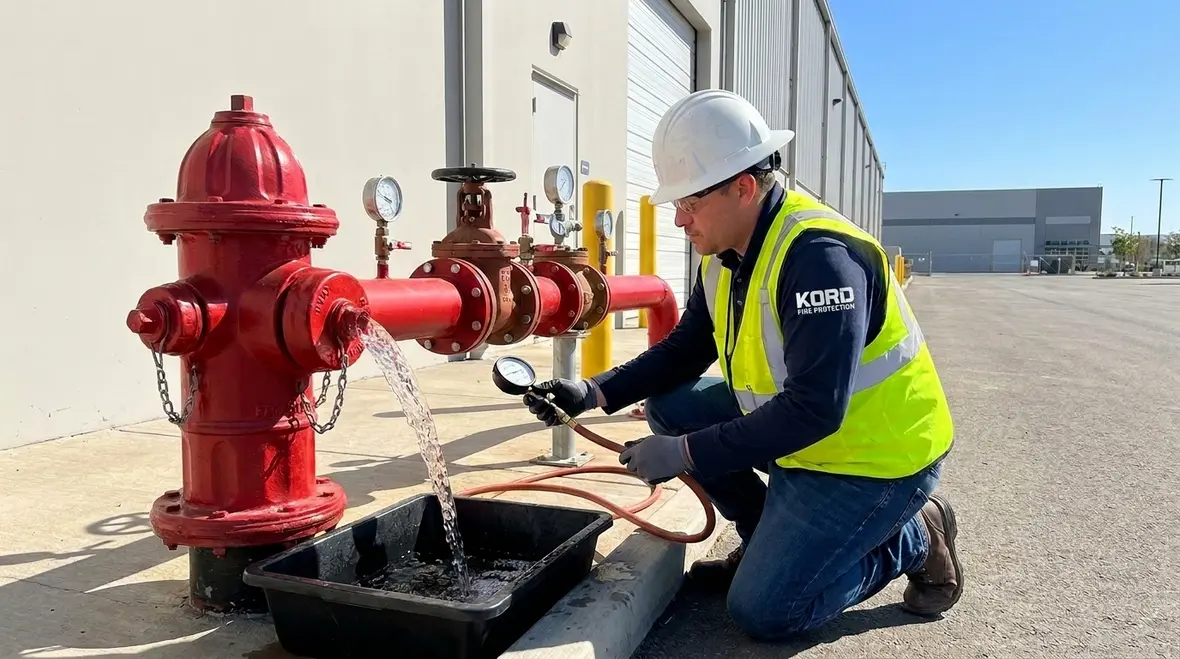
NFPA 25C Section 7.3: Private Fire Service Main Testing Requirements
Quick Answer
NFPA 25C Section 7.3 sets the inspection and testing expectations for private fire service mains to confirm reliable water supply. It focuses on verifying valves, check devices, pressure sources, flow conditions, and documenting results so deficiencies are corrected before loss of fire protection performance.
What Section 7.3 covers for private fire service mains
Private fire service mains supply water from a fire pump system, water storage, or other private source to fire protection system connections. NFPA 25C Section 7.3 private fire service main testing requirements address how facilities verify that the installed system performs as intended during an emergency. In commercial environments, the practical value of Section 7.3 comes from reducing uncertainty: confirming that water will reach the sprinkler, standpipe, and other connected systems at the required pressures and flows.
For many facilities, the compliance gap is not the presence of a fire pump or mains. The gap typically appears in valve alignment, air and debris accumulation in hydrants and drains, check device performance, control interface issues, and test data that does not reflect current operating conditions. Kord Fire Protection supports recurring compliance by aligning testing with facility operations, documenting changes, and correcting failure points before they become system outages.
Near the top of the program, it also helps to connect private main verification with a broader fire protection services program so water supply, distribution, and corrective action are not managed like separate departments that refuse to make eye contact.
Why NFPA 25C Section 7.3 testing matters in the real world
Section 7.3 testing is designed to validate the private water delivery path. That includes the distribution piping, supervisory components, and the ability of connected systems to draw water when demanded. In commercial, industrial, and retail settings, water delivery reliability often deteriorates due to routine maintenance, renovations, seasonal operations, and changes to access or drainage conditions.
Primary outcomes facilities must demonstrate
Hydraulic reliability: The main and connected components provide the expected pressure and flow characteristics during testing and, by extension, during fire demand.
Mechanical operability: Valves, check devices, and control interfaces move and respond correctly without binding or leaking.
Water system cleanliness: Drains, strainers, and internal piping do not accumulate debris or air pockets that reduce effective flow.
Documented traceability: Test results are recorded so that trends and corrective actions can be tracked through the maintenance cycle.
What technicians verify during private fire service main tests
Although facility configurations vary, the testing workflow for NFPA 25C Section 7.3 private fire service main testing requirements typically centers on confirming that water can be delivered and that supervisory status remains accurate. Technicians generally verify components that can fail quietly while still showing normal appearance.
1) Condition and readiness of valves and access points
Private mains include a network of valves that must remain in correct positions and respond predictably. Common challenges include valves that were partially closed during adjacent work, valves that leak and lose tight shutoff, and valves that cannot be fully operated due to corrosion or seizing.
Technicians typically confirm:
Valves are correctly positioned for fire service use.
Supervisory tamper switches, indicators, and wiring interfaces reflect actual valve position.
Valve stems and operating mechanisms move freely and safely under test.
2) Check devices and backflow prevention behavior
Check devices protect against unwanted backflow and help maintain correct flow direction. Over time, check valves can stick, become inefficient, or fail to reseat properly. Even minor leakage can reduce effective pressure and complicate flow tests.
During NFPA 25C Section 7.3 private fire service main testing requirements, technicians focus on verifying that check devices allow intended flow while preventing reverse flow under abnormal conditions.
3) Water supply connection and pressure stability
Testing validates that the main is supplied and that pressure does not collapse due to supply constraints or internal restrictions. Pressure readings provide the early warning signals for issues like partially obstructed piping, failing strainers, or abnormal suction conditions affecting the fire pump water delivery path.
Facilities should ensure that test points are accessible, instrumentation is calibrated, and pressure readings correspond to the expected system response rather than transient spikes.
4) Drains, air release points, and internal cleanliness
Air and debris create a disproportionate loss of performance. Air can compress and delay water delivery. Debris can block flow paths and elevate friction losses. Drains and low points help remove contaminants, but they only work if they are maintained and exercised correctly.
Kord Fire Protection frequently sees issues where drains are present but not effectively used during maintenance, which leads to recurring system underperformance. The solution is not only exercising drains. It is verifying that drainage removes obstructions and that follow up testing confirms improvement.
Common compliance pitfalls and how facilities avoid them
Commercial facilities often succeed on the first inspection and then drift out of compliance due to change management issues. NFPA 25C Section 7.3 private fire service main testing requirements depend on consistent execution, accurate documentation, and timely corrective action.
1) Outdated test baselines
Test results lose value when they no longer represent current conditions. Renovations, new tenant fit outs, and changes to hydrant locations or pipe routing can alter system performance. A facility should treat major work as a trigger to reestablish test baselines.
2) Incomplete deficiency closure
A test may identify a leaking valve or a check device concern, but the facility can still pass a documentation review if correction timelines are not tracked. Strong programs include tagging, repair verification, and retesting to confirm that the deficiency is actually resolved.
3) Instrumentation and procedure mismatch
If gauges are not calibrated, or test points are read incorrectly, the resulting data will not support engineering decisions. Technicians must follow a repeatable procedure and use calibrated instruments to ensure comparable results across maintenance cycles.
4) Poor coordination with other water based fire protection systems
Private mains connect to water based fire protection systems. When sprinkler and fire pump maintenance is handled without alignment to main testing, defects can recur. For broader context on how installation quality affects maintenance performance, see NFPA 13 overview and automatic fire sprinkler system installation. For maintenance program planning across water based systems, refer to NFPA 25 overview: complete water based fire protection systems maintenance breakdown.
How Section 7.3 aligns with the full fire protection maintenance ecosystem
Private fire service mains do not operate alone. They interface with fire pumps, controllers, sprinkler systems, and other connected equipment. Facilities that treat private main testing as a stand alone task often miss interdependencies that influence performance.
Related system coordination that improves outcomes
Fire pump and controller assurance: A stable water supply requires both mechanical reliability and accurate control logic. When pump testing and main testing are coordinated, technicians can more quickly distinguish supply issues from distribution issues.
Sprinkler system performance: Flow and pressure outcomes depend on the available supply from the mains. For facilities managing sprinkler compliance in California, see fire sprinkler code California explained.
Documentation consistency: Using uniform test records across related NFPA references helps trend performance and supports better corrective action decisions.
For industry benchmarks and technical background on fire pump and water supply systems, facilities can also reference Fire Pumps Association resources. Kord Fire Protection applies these concepts in the field through maintenance and compliance execution for commercial and industrial facilities.
Frequently Asked Questions
Next step: align your testing program with Section 7.3
NFPA 25C Section 7.3 private fire service main testing requirements work best when they are executed as a repeatable maintenance program with clean documentation and rapid deficiency closure. Kord Fire Protection helps commercial facilities plan intervals, perform accurate tests, and restore reliable water delivery when issues arise. Request a compliance review and maintenance plan to confirm your private main testing matches current operating conditions and protects the rest of the water based system.

Join Our Newsletter!
Get the latest fire safety tips delivered straight to your inbox From our Newsletter.


