
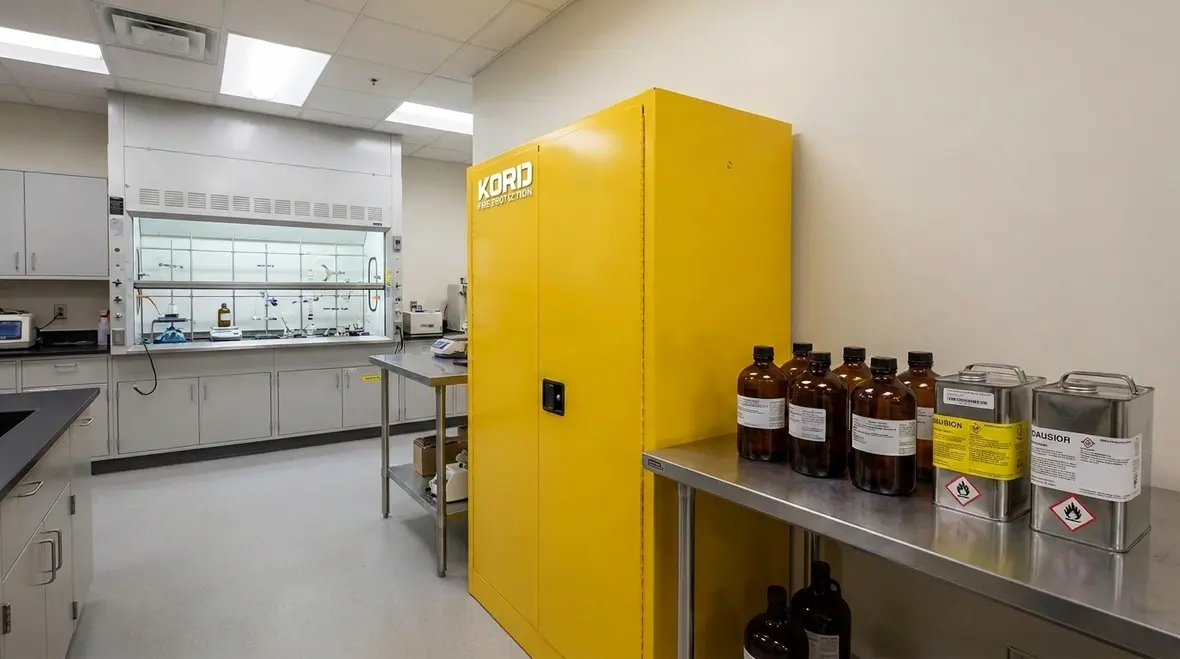
NFPA 45 Section 9.1: Quantity Limitations for Lab Flammable Liquids
Quick Answer
NFPA 45 Section 9.1 sets how much lab flammable liquid may be stored and used at one location, based on controlled limits and proper containment. These NFPA 45 flammable liquid quantity limitations reduce fire load while maintaining safe operations through segregation, labeling, and inspection-ready storage.
Facilities that want a broader laboratory protection strategy should also review clean agent fire suppression for labs, especially when flammable liquid controls need to work alongside suppression planning.
What does NFPA 45 Section 9.1 control in the real world?
NFPA 45 Section 9.1 focuses on reducing the hazard from flammable liquids in laboratories. In practical terms, it drives how facilities stage, store, and manage liquid inventories so that a single area does not accumulate excessive flammable fuel. For commercial, industrial, and retail environments that operate labs, satellite workrooms, or reagent spaces, the section becomes a day to day compliance requirement, not a one time documentation exercise.
Facilities typically run into the same issues during walkthroughs: cabinets packed beyond approved limits, containers not controlled as “in use,” inadequate segregation from ignition sources, and storage locations that do not match the assumptions used when the lab safety plan was written. Kord Fire Protection routinely helps organizations translate NFPA 45 requirements into operational controls that can survive inspections and management of change.
How quantity limits are applied: location, category, and control
Section 9.1 quantity limitations operate by tying the allowed inventory to the physical location and the facility’s method of control. Compliance depends on being able to answer three questions quickly during an inspection:
- Where is the liquid? The measured area must match the permitted storage concept (room, cabinet, bench area, or other defined location).
- What is the actual quantity present? Auditors expect a realistic inventory, not just approved purchase orders.
- How is the inventory controlled? Storage containers, cabinet types, and procedures must reliably limit access and accumulation.
Even when a facility has a policy, failures often occur when containers are moved between benches, hoods, and storage without updating the “on hand” total. A compliant program treats quantity as a living control: it changes when work changes, and it must be verified.
Where compliance breaks most often during inspections
Commercial labs and lab like spaces commonly experience these recurring failure points related to NFPA 45 flammable liquid quantity limitations:
1) Mismanaged “in use” versus “stored” distinctions
Containers on a bench, inside a fume hood, or in a temporary staging area can be interpreted as stored inventory depending on how they are maintained. If the workflow causes repeat accumulation, inspectors may treat it as storage at that location. Facilities that use standardized labeling and time based controls reduce this risk.
2) Cabinet overfill and inconsistent container practices
Fire rated storage cabinets and flammable storage cabinets often lose compliance when organizations add secondary bottles, larger drums, or additional containers that exceed the designed holding capacity. Maintenance teams should confirm the cabinet’s intended configuration, including tray or rack arrangement, free venting clearance, and door closure verification. For related cabinet considerations, see NFPA 30 storage cabinets in mercantile occupancies.
3) No effective inventory audit cadence
NFPA 45 Section 9.1 quantity limitations work only when inventory is continuously tracked. When organizations rely on annual counts, day to day operations drift. A short, frequent audit cycle aligned with ordering and lab schedules is typically more effective than a single end of year audit.
4) Segregation and ignition source proximity issues
Even with correct quantities, flammable liquids must be managed to avoid introducing ignition hazards. Hot plates, ovens, electrical panels, and energized equipment near storage locations can create unsafe conditions. Compliance improves when facilities enforce a consistent “no ignition nearby” layout and maintain clear access paths.
Operational controls that support ongoing compliance
Effective NFPA 45 flammable liquid quantity limitations compliance is procedural as much as it is physical. Facilities typically implement the following controls to keep quantities within allowed ranges and maintain inspection readiness.
Inventory verification and labeling
Implement container labeling that includes content, hazard classification, and date received or placed. Use standardized containers to reduce the time inspectors spend reconciling inventory. Where possible, use centralized receiving and controlled distribution to minimize “unknown inventory” in work areas.
Staging controls and time limits
Where work requires temporary staging, define maximum allowed staging durations and the responsible role. Tie staging limits to a verification checklist that is completed at shift turnover or during scheduled rounds. This reduces the risk that “temporary” becomes “stored.”
Cabinet management and maintenance checks
Qualified personnel should verify that cabinet doors close properly, latching mechanisms remain functional, and internal arrangements do not block vents or impede safe access. Cabinets that are kept open for convenience tend to accumulate inventory, and that behavior can push quantities beyond acceptable limits.
Training and accountability
Train lab users on the practical meaning of quantity control and location based limitations. Assign accountability for deviations, including when a container is added, moved, or disposed. A compliant program makes deviations reportable and correctable fast.
Coordinate with detection, fire suppression, and egress
Quantity limits work alongside the broader fire protection strategy. Ensure that detection, suppression, and clear egress routes remain unobstructed. If stored liquids reduce clearance or block access to firefighting equipment, the facility can face both code and practical safety concerns.
For a deeper look at how ongoing maintenance and inspection planning strengthens fire safety performance, see streamlined maintenance schedules for compliance and commercial fire pump maintenance schedule optimization.
How facilities should document and maintain compliance
Documentation supports both inspection outcomes and internal management of change. Facilities that succeed typically maintain a clear compliance file that connects the lab safety plan to actual conditions.
- Current inventory records with dates, locations, and quantities.
- Storage maps showing where flammable liquids are permitted to reside.
- Cabinet and container inspection logs including corrective actions.
- Operating procedures defining how “in use” containers remain controlled.
- Training records and periodic refresher schedules.
Commercial environments also benefit from audit checklists that include quick measurements or count methods. Auditors look for consistency: the facility’s stated limits should match what is found in the field.
Frequently Asked Questions
Conclusion and next step
NFPA 45 Section 9.1 quantity limitations are only effective when day to day inventory control matches the written fire safety plan. Facilities should tighten staging procedures, verify cabinet management, and schedule frequent quantity audits aligned to operations. Kord Fire Protection can support compliance through practical review, inspection readiness planning, and maintenance aligned with the realities of commercial lab environments. Contact Kord Fire Protection to assess your current storage controls and documentation approach.

Join Our Newsletter!
Get the latest fire safety tips delivered straight to your inbox From our Newsletter.



