
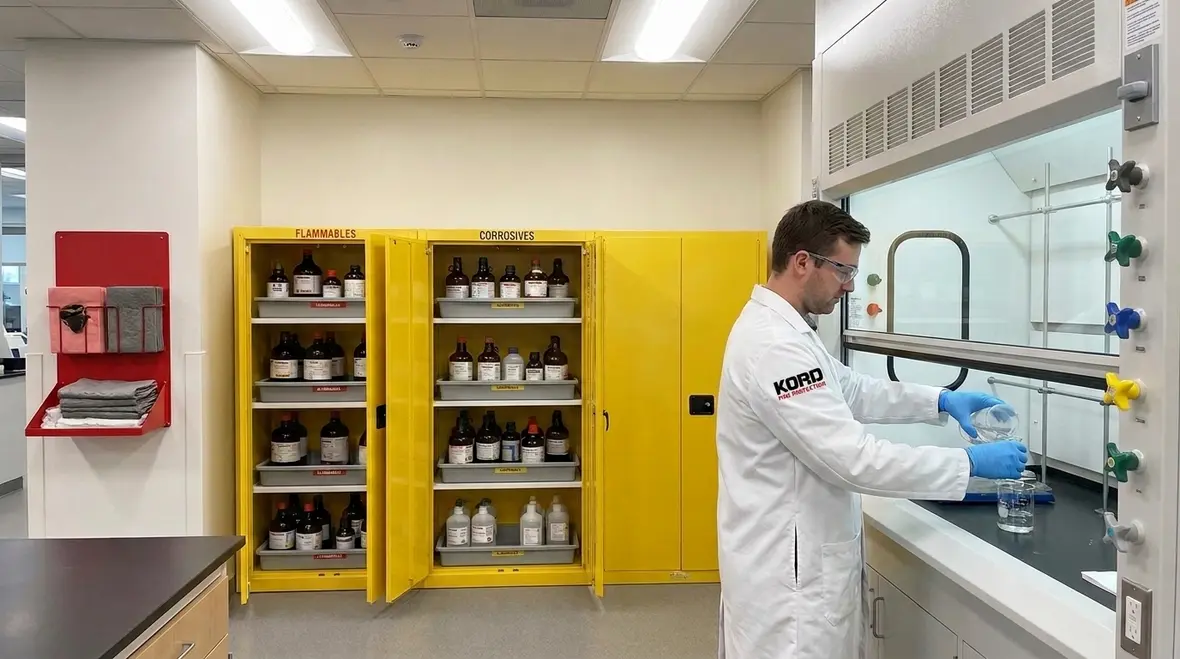
NFPA 45 Section 8.3: Chemical Handling and Storage in Laboratories
Quick Answer
NFPA 45 Section 8.3 sets the expectations for controlling how laboratories handle and store chemicals to reduce fire, explosion, and exposure risks. Effective compliance depends on correct segregation, approved containers, ventilation, compatible storage practices, and documented maintenance of safety systems.
NFPA 45 laboratory chemical handling storage requirements in Section 8.3 focus on preventing incidents during routine use, storage, and transfer of hazardous materials. For commercial, industrial, and retail facilities that operate laboratories, compliance becomes a systems problem, not a checklist exercise. Facilities must align procedures, physical controls, equipment performance, and inspection records so that “safe storage” remains safe throughout daily operations.
For facilities building a stronger maintenance framework around these risks, the full lifecycle of fire protection servicing offers a useful look at how inspection records, maintenance logs, and service planning support long-term compliance.
What NFPA 45 Section 8.3 Requires for Laboratory Chemical Handling
Section 8.3 addresses the operational side of hazard control. It expects labs to manage chemicals in ways that prevent ignition sources, minimize spill and release potential, and maintain safe conditions for storage and handling. In practice, this means the facility must define how chemicals are received, staged, used, capped, transferred, and returned to storage.
Common compliance challenges in occupied commercial buildings include:
- Uncontrolled staging: Chemicals waiting for use are placed in work areas without regard to segregation and container integrity.
- Inconsistent transfer practices: Pouring and decanting occur without secondary containment, spill kits sized to chemical hazards, or defined shutdown steps.
- Expired or unlabeled containers: Abandoned containers remain in cabinets or rooms, creating unknown hazard profiles.
- Ventilation shortfalls: Local exhaust and room ventilation do not match chemical volatility or operational workflow.
Commercial laboratories often share HVAC and egress infrastructure with other building occupants. That increases the need for disciplined procedures and validated engineering controls to keep NFPA 45 outcomes consistent even when staffing and workflows change.
Storage Controls That Matter: Segregation, Containers, and Limits
NFPA 45 laboratory chemical handling storage compliance begins with how chemicals are stored, not how they are written down. Section 8.3 requires storage arrangements that reduce the likelihood of a reacting incident, fire spread, or hazardous release.
Segregation and compatibility
Facilities must store chemicals so incompatible materials are separated. This includes acids from bases, oxidizers from fuels, and reactive chemicals from sources of contamination. Compatibility is not a general concept; it must translate into physical layout decisions such as cabinet zoning, segregation racks, and separation distances within storage rooms.
Container integrity and labeling
Containers must be suitable for the chemical and kept closed when not actively in use. Labels must remain legible so hazard identification supports safe handling and emergency response. Failure points typically include decanted liquids in unapproved bottles, damaged caps, and containers transferred into containers that do not provide equivalent performance to the original packaging.
Quantity and location controls
Even when a lab stores compatible materials, excessive quantities increase consequence severity during fire, release, or spill. Section 8.3-driven controls therefore include limiting how much material stays in the laboratory and ensuring that the most hazardous materials are stored in designated areas with appropriate containment.
How Ventilation and Engineering Controls Support Safe Handling
Handling and storage safety depends heavily on controlling vapor and gas hazards. For laboratories, ventilation strategies must align with the chemical hazard profile and the way tasks are performed. When ventilation underperforms, the lab can accumulate flammable vapors, toxic atmospheres, or oxygen displacement conditions.
Fume hoods and local exhaust performance
Many commercial labs rely on fume hoods for safe chemical handling. For compliance readiness, facilities should treat hood performance verification as a scheduled maintenance and inspection item, not an as-needed activity. Common failure points include:
- Damper or sash position management that does not match operating procedures
- Blocked duct runs or deteriorated duct seals
- Face velocity drifting below target performance
Spill control and secondary containment
Section 8.3-aligned storage and handling practices include preventing released chemicals from spreading across floors, into drains, or into ignition-adjacent areas. Secondary containment should be sized for the credible spill scenario for the stored chemical volumes and container geometry.
Inspection, Maintenance, and Documentation for Ongoing Compliance
NFPA 45 safety outcomes degrade when inspections and maintenance remain informal. For Section 8.3, commercial facilities should build a maintenance system that ties performance verification to documented records and operational accountability.
What to inspect routinely
Commercial laboratory walkdowns typically focus on:
- Condition and labeling of chemical containers and storage cabinets
- Segregation effectiveness and physical barriers
- Exhaust system status indicators, alarm functions, and inspection tags
- Condition of spill containment materials and availability of chemical appropriate kits
- Housekeeping around storage areas, including clear access to exits and equipment
Maintenance verification
Maintenance should include periodic testing and performance checks of critical systems that support chemical handling. This often includes controls that reduce ignition sources, contain or isolate fire scenarios, or maintain engineered ventilation. Where facilities use fire protection systems designed for hazardous occupancies, maintenance must follow manufacturer requirements and applicable code expectations.
To streamline ongoing compliance work across multiple sites, Kord Fire Protection supports commercial facilities with inspection support, testing coordination, and maintenance planning. This helps organizations maintain defensible records and reduce operational disruption during audits and enforcement visits.
Common Failure Points in Commercial Laboratories (and How to Correct Them)
In real-world facility operations, Section 8.3 failures usually emerge from inconsistent practices across shifts, labs, and vendors. The following issues frequently trigger findings during internal audits or external reviews.
1) Storage practices drift from the written plan
When new chemicals enter the facility, staff sometimes store them “temporarily” in existing spaces. Over time, temporary arrangements become permanent, and segregation requirements are no longer met.
Correction: Implement a controlled chemical receiving and staging process that assigns storage locations at the point of receipt, with compatibility verification and labeling requirements.
2) Ventilation controls are present but not verified
Hoods or local exhaust may exist without confirmed performance. This undermines the operational basis for safe handling.
Correction: Use a verification schedule aligned to operating intensity and chemical volatility, and maintain records of performance checks.
3) Cabinets and storage rooms lack functional protection
Improper cabinet loading, blocked exhaust interfaces, or damaged seals reduce protection effectiveness.
Correction: Conduct targeted inspections that verify cabinet arrangement, closure performance, and unobstructed pathways for safety controls.
4) Training and procedure gaps
Procedures fail when they are not practical for day-to-day workflow, especially under time pressure.
Correction: Provide job-task specific training, update SOPs after workflow changes, and require documentation of competency for high hazard handling steps.
Links to Strengthen Your Fire and Life Safety Program
Because chemical handling safety connects to fire protection readiness, facilities often benefit from aligning laboratory hazard controls with broader inspection and life safety expectations.
- Commercial fire protection services for ongoing compliance can support maintenance planning, testing coordination, and readiness efforts across commercial laboratory environments.
Frequently Asked Questions
Conclusion and Call to Action
NFPA 45 Section 8.3 compliance depends on more than storage cabinets and posters. Commercial laboratories must operationalize chemical segregation, container control, ventilation effectiveness, spill readiness, and maintenance documentation so safety stays consistent through daily workflow changes. Kord Fire Protection can help facility teams maintain inspection readiness with a practical, service-focused approach. Contact Kord Fire Protection to review your laboratory chemical handling storage practices and develop an ongoing compliance and maintenance plan.

Join Our Newsletter!
Get the latest fire safety tips delivered straight to your inbox From our Newsletter.



