
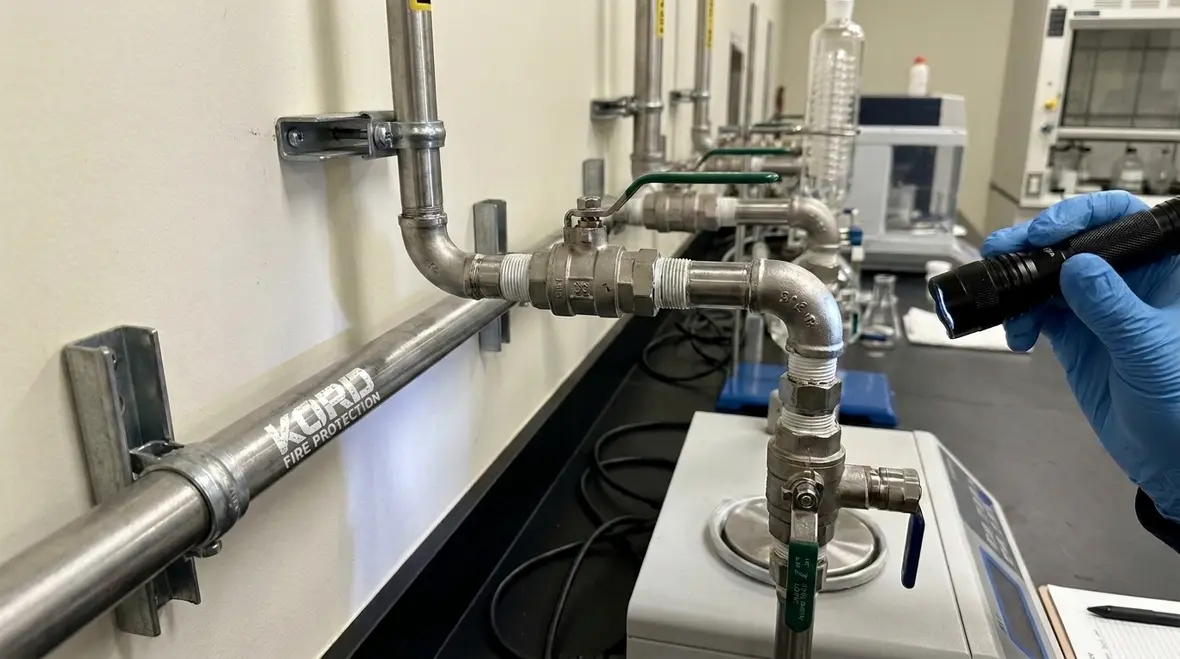
NFPA 45 Section 9.2: Supply Piping for Lab Ignitible Liquids
Quick Answer
NFPA 45 Section 9.2 establishes design, installation, and maintenance expectations for laboratory liquid supply piping where ignitible liquids are handled. It focuses on preventing ignition hazards through appropriate piping materials, protection of joints and connections, routing practices, and inspection-ready installation details.
Why NFPA 45 Section 9.2 Matters in Real Labs
NFPA 45 laboratory liquid supply piping requirements exist because small system failures can create ignition sources in an environment designed for controlled experiments. For commercial facilities, this section drives practical decisions: how lines are routed, how equipment interfaces are connected, and what evidence of integrity must remain available during routine inspections.
In practice, the largest compliance gaps often show up where piping systems transition between lab benches, equipment manifolds, and bulk storage or distribution points. When commercial operations scale, maintenance teams change, and lab layouts evolve, the original intent of safe piping design can get diluted unless a facility maintains a documented inspection and repair program aligned with NFPA 45 expectations.
For a broader look at keeping research and commercial spaces inspection-ready, see fire protection compliance for Irvine tech campuses.
Scope and Intent: What Section 9.2 Covers
NFPA 45 Section 9.2 addresses supply piping for ignitible liquids used in laboratory settings. The intent is to reduce the likelihood of a leak, control the consequences if a release occurs, and limit ignition potential by ensuring the piping system remains serviceable, protected, and properly installed.
For facilities, this includes a need to treat “piping” as a complete system rather than just the pipe runs. Section 9.2 expectations typically influence how the facility manages:
- Connections and joints between piping and lab equipment
- Protective measures where piping could be impacted or exposed
- Routing that avoids unnecessary damage exposure and ignition risk
- Installation quality that supports later inspection and maintenance
Design and Installation Practices That Drive Compliance
Materials and Compatibility Control
Even when the correct piping material is selected, compatibility failures can occur at the point of use. Chemical attack, swelling, or degradation commonly initiates at fittings, valves, and short flexible connections. That is why compliance programs must connect engineering design to field verification and ongoing condition monitoring.
For commercial, industrial, and retail facility environments with shared lab infrastructure, the facility should manage change control. A simple label swap or a substitute chemical can require a material reassessment and a re-evaluation of the laboratory liquid supply piping integrity risks.
Connections, Valves, and Fittings: The Failure Points
Most piping issues encountered during commercial maintenance involve transitions: threaded joints loosening, gasket compression loss, worn valve packing, or compromised coupling interfaces. Section 9.2 compliance work typically emphasizes that the system must remain tight, serviceable, and protected against mechanical damage.
Maintenance teams should implement visual inspection standards for joints and fittings. They should also require documented corrective actions whenever any condition suggests loss of integrity, such as staining, odor complaints tied to the system, wetness at connection points, or abnormal valve behavior during operation.
Routing, Support, and Protection Against Impact
Routing affects both physical durability and hazard control. Piping sections can be damaged by routine lab activity, cleaning procedures, equipment movement, or maintenance traffic. Support placement, securing methods, and protective barriers influence whether the system can withstand expected use without compromising joints.
Facilities should align support and protection practices with operational realities. For example, if a bench frequently receives equipment changes, the piping interface and surrounding protection should be designed for that workflow. Without that, the system can develop stress on couplings that leads to slow seepage, especially at threaded or flanged interfaces.
Teams building a stronger documentation trail may also find it helpful to review fire safety compliance management with automated documentation.
Inspection, Testing, and Maintenance Requirements
NFPA 45 Section 9.2 is not a “set it and forget it” requirement. Commercial laboratories need a maintenance plan that verifies integrity over time and provides documented evidence for ongoing compliance.
If your facility needs broader support with inspections, repairs, or compliance planning, explore fire protection services in Southern California.
What Inspections Should Look For
Effective inspections typically include:
- Visual verification of piping runs, supports, and protective measures
- Condition checks at valves, unions, threaded joints, and quick connect areas
- Identification of corrosion, abrasion, cracking, or degraded coatings
- Verification that modifications have not introduced unsafe routing or unapproved components
Operational staff should understand that leak indicators can appear first at the mechanical interfaces, not in the straight runs. When labs use multiple ignitible liquids, each one can leave different residue patterns, which helps inspection staff identify early issues if the program includes training and standardized reporting.
Common Commercial Failure Scenarios
In multi-tenant or corporate lab settings, the following problems frequently undermine Section 9.2 objectives:
- Untracked piping modifications after equipment swaps
- Use of incompatible sealants or gaskets during “quick fixes”
- Support spacing changes from renovations that stress the piping system
- Failure to restore protective covers or guards after maintenance access
- Delayed reporting of minor seepage that later becomes a larger release
How Kord Fire Protection Supports Ongoing NFPA 45 Compliance
Compliance programs for NFPA 45 laboratory liquid supply piping succeed when maintenance teams have clear inspection routines, correct documentation, and rapid corrective action pathways. Kord Fire Protection helps commercial facilities sustain compliance through practical field support, documentation discipline, and verification-focused service that aligns fire protection requirements with real operational conditions.
For facilities managing mixed lab functions across multiple floors or units, Kord Fire Protection can also help standardize how teams identify, track, and close piping system issues so that changes do not erode the baseline safety posture intended by NFPA 45.
To strengthen your facility’s overall approach to ignition hazard reduction, Kord Fire Protection also supports broader safety planning and maintenance workflows. Explore related guidance at Kord Fire Protection.
Frequently Asked Questions
Next Step: Validate Your Piping Program Against Section 9.2
Facilities should review how NFPA 45 laboratory liquid supply piping is installed, protected, and inspected, then confirm that maintenance practices match the real lab workflow. Kord Fire Protection can help commercial teams establish a sustainable inspection and corrective action process so piping integrity remains verifiable over time. Schedule a compliance-focused review to identify risks early and close gaps before they become operational disruptions.

Join Our Newsletter!
Get the latest fire safety tips delivered straight to your inbox From our Newsletter.



