
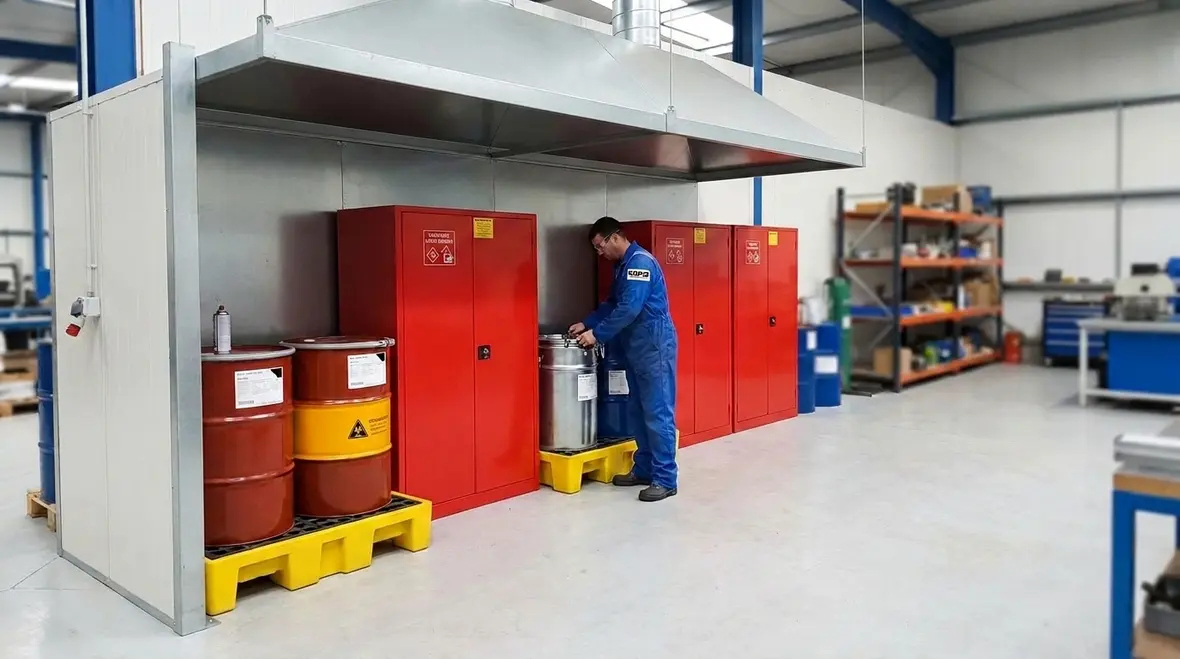
NFPA 33 Section 8.2: Storing Flammable Liquids in Process Areas
Quick Answer: NFPA 33 Section 8.2 sets practical controls for how flammable liquids are stored within process areas, focusing on container integrity, limits, segregation from ignition sources, and safe ventilation and handling. Facilities must document procedures and maintain equipment so storage conditions do not degrade over time.
For a broader look at which spray operations fall under this standard in the first place, see NFPA 33 Section 1.1 scope for spray operations.
What NFPA 33 Section 8.2 is trying to prevent
NFPA 33 governs spray application using flammable and combustible materials, but Section 8.2 directly targets a common commercial failure mode: flammable liquid storage drifting into unsafe process-area conditions. The risk is not only the presence of liquid, but also how quickly an upset can turn into a vapor cloud, ignition, and fire spread around operating equipment.
In practice, NFPA 33 process area flammable liquid storage requirements focus on controlling the amount stored, containing it effectively, preventing ignition exposure, and ensuring the work area remains compatible with the chemical hazards in use. For industrial, commercial, and retail facilities, compliance typically depends on repeatable storage procedures, inspection readiness, and maintenance that keeps containment and ventilation performance stable.
Where Section 8.2 applies inside a commercial facility
Section 8.2 addresses flammable liquid storage located within process areas rather than remote storage warehouses. This includes tanks, drums, pails, totes, and other containers used near spray operations or other processes involving flammable liquids. Facilities frequently misclassify areas because day to day operations shift the “effective process zone” through carts, staging, and routine refilling.
To avoid that gap, facility owners and safety teams should define and enforce the boundary of the process area, including:
- Staging zones for replenishment containers
- Areas where containers remain between use cycles
- Spill response staging or secondary containment locations
- Any location near spray equipment where vapors could accumulate
Operationally, the most common audit finding is not a missing piece of equipment, but an uncontrolled pattern of “temporary” storage that becomes permanent. Tight definitions and container controls reduce that drift.
Core operational controls required for storage in process areas
Section 8.2 drives a set of controls that, when implemented, reduce the probability of ignition and limit the consequences if a release occurs. The following topics typically require the most attention during inspections, walkthroughs, and operational reviews.
1) Container integrity and closure discipline
NFPA 33 expectations for process-area storage commonly translate into strict container handling rules: lids must remain closed except when dispensing, containers must be in serviceable condition, and incompatible materials must not contaminate each other.
Common failure points include:
- Worn drum bungs, degraded gaskets, or damaged pails that still “seem to work”
- Pour spouts and hoses left uncapped after use
- Labels removed or illegibility that results in incorrect handling during refills
From an operational standpoint, container checks should be part of the dispensing routine, not only part of the monthly inspection. That cadence reduces the odds that a degraded container remains in service long enough to leak.
2) Quantity and limits tied to safe operation
Process areas typically require limiting stored quantity to what is necessary for operations. NFPA 33 process-area storage requirements generally align to the principle of “keep it as small as practical.” A facility that stores full day supply in the process bay increases the consequences of a container failure or hose rupture.
Compliance programs usually succeed when they:
- Use replenishment planning to reduce staging quantities
- Track container inventory by shift and by location
- Define maximum container counts for each process line
- Remove empty containers promptly to prevent residue and vapor generation
3) Segregation from ignition sources and heat
Flammable liquid vapors can ignite from many sources beyond obvious flames. Section 8.2 supports safe placement by requiring storage conditions compatible with the process environment. This includes controlling ignition sources through good housekeeping, correct equipment selection, and preventing storage near abnormal heat or sparking conditions.
Teams should verify:
- Electrical equipment is appropriate for the area classification strategy used by the facility
- Motors, heaters, and transformers are not located where vapors can accumulate
- No smoking, hot work, or equipment modifications occur without hazard controls
Even when equipment is properly installed, operational changes can create exposure. A thorough compliance approach includes change control when production layouts shift.
4) Ventilation and vapor control in and around storage
Vapor hazards often develop in corners, cabinets, pits, and under-work benches where airflow does not reliably move vapors away. NFPA 33 process-area storage requirements are generally not satisfied by “there is ventilation somewhere.” The facility should maintain ventilation performance so it does what the design assumed.
Maintenance that matters includes:
- Cleaning and inspection of ventilation intakes and ducting
- Verification of exhaust flow before high use periods
- Repair of damaged hood systems or exhausted enclosures
- Monitoring controls and alarms where the system supports safe operation
5) Spill control and secondary containment readiness
Process-area storage should include spill control expectations that prevent released liquid from spreading into pathways. Secondary containment and appropriate spill response materials must be positioned so staff can respond quickly without moving containers through the hazard zone.
Practical items auditors look for include:
- Secondary containment sized and maintained to capture credible releases
- Drainage controls so containment does not become a transfer pathway
- Spill kits compatible with the chemicals stored
- Training that confirms staff know where kits are located and how to use them
Inspection and documentation that stand up to audits
NFPA 33 compliance in process areas requires more than installing containers correctly. It depends on documentation that proves conditions are monitored and maintained. For commercial facilities, this is where many programs fall short because the compliance tasks are distributed across operations, maintenance, and safety without a single ownership model.
What to verify during routine walkdowns
- All containers are closed when not dispensing
- Container condition is acceptable and leaks are not present
- Stored quantities match the documented operational limits
- Ventilation is unobstructed and access to hoods is maintained
- Spill control equipment is in place, within date where applicable, and ready
- Labels and safety information remain readable and consistent
Maintenance and testing routines that prevent drift
Ventilation and related controls can degrade without obvious signs. A robust maintenance plan should include periodic checks aligned to your facility’s risk profile and manufacturer requirements. When facilities treat these systems as “set it and forget it,” they increase the chance that storage conditions no longer meet the intent of NFPA 33 process-area controls.
For ongoing compliance support, Kord Fire Protection helps commercial clients implement practical inspection readiness programs, including documentation support, testing coordination, and maintenance guidance for fire protection and life safety systems. If your operation involves frequent chemical changes or process layout changes, partnering with a service provider reduces the time between modifications and compliance updates.
If your documentation gaps are making audits messier than they need to be, a related read is missing process safety information for PHA reconstruction, which fits naturally into the same evidence-and-readiness conversation.
Common commercial compliance pitfalls in process-area storage
Experience from commercial and industrial environments shows a predictable set of issues that create risk under NFPA 33 process area controls.
- Staging creep: containers remain in the process zone longer than planned
- Inconsistent labeling: labels fade, secondary containers appear without identification
- Improper container compatibility: incorrect coatings or residual incompatibilities lead to container degradation
- Ventilation obstruction: carts, pallets, and new equipment block airflow paths
- Spill response mismatch: kits are missing or not chemically compatible
- Weak change control: production or layout changes happen without updating storage boundaries
Correcting these issues often requires a combination of training, standard work, and clear physical boundaries. The goal is to make safe behavior the easiest option for the workforce.
Plan a compliance program that works day to day
Facilities improve compliance when they treat Section 8.2 controls as operational systems, not one time checklist items. A practical program typically includes:
- Define process area boundaries and document staging locations
- Set and enforce storage limits based on real consumption rates
- Standardize container handling with closing discipline and labeling requirements
- Maintain vapor control by keeping ventilation unobstructed and verified
- Strengthen spill readiness with secondary containment and chemical compatible kits
- Audit and document on a routine schedule with corrective action tracking
For additional guidance on managing fire protection risk in commercial environments, many clients also review related resources on fire safety planning and protection system readiness. As an example, see Kord Fire Protection resources for practical, facility focused information that supports compliance documentation and operational consistency.
Frequently Asked Questions
Get compliance support before the next inspection
NFPA 33 Section 8.2 compliance depends on day to day controls: container discipline, quantity management, vapor control, and spill readiness. Kord Fire Protection can help commercial facilities build inspection ready documentation, coordinate testing and maintenance activities, and identify drift before it becomes a finding. Contact Kord Fire Protection to schedule a process area compliance review and develop a sustainable maintenance plan.

Join Our Newsletter!
Get the latest fire safety tips delivered straight to your inbox From our Newsletter.



