
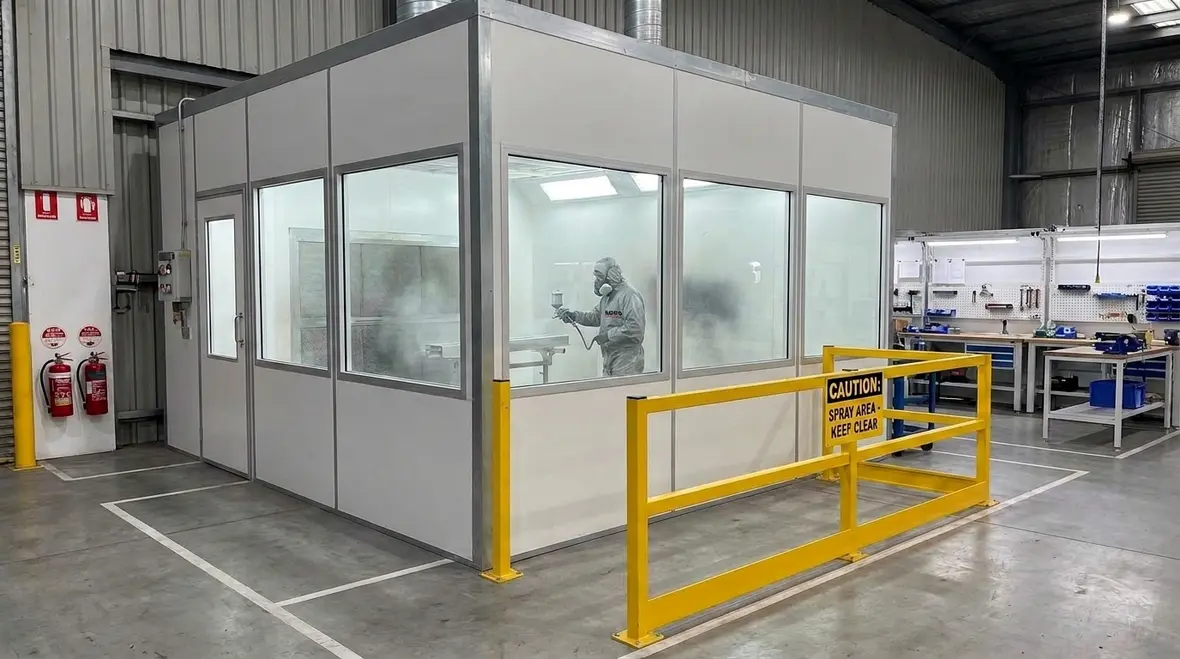
NFPA 33 Section 4.2: Separating Spray Operations From Other Activities
Quick Answer: NFPA 33 Section 4.2 requires separating spray operations from other activities to reduce ignition, exposure, and contamination risks. Facilities must control where spraying occurs, how adjacent work is managed, and how boundaries are maintained through construction, ventilation, and operational controls.
NFPA 33 separation requirements spray operations focus on preventing incompatible activities, ignition sources, and unintended exposure to spray hazards. In practice, compliance depends on site layout, ongoing operational discipline, and the integrity of physical and procedural controls. This section becomes especially critical in commercial, industrial, and retail environments where maintenance work, cleaning, refueling, and general traffic occur near spray areas.
Facilities dealing with booth protection, overspray hazards, and inspection planning often also benefit from reviewing spray booth fire suppression for safer paint operations, especially where suppression strategy and operational separation need to work together.
What NFPA 33 Section 4.2 Actually Requires
Section 4.2 addresses the need to keep spray operations isolated from other activities that could increase fire, health, or contamination hazards. The intent centers on two outcomes: prevent ignition of flammable or combustible materials and limit the movement of hazardous vapors, overspray, and residues beyond the spray area.
Compliance typically involves a combination of:
- Spatial separation through layout and defined boundaries.
- Control of ignition sources in adjacent areas.
- Management of activities that produce heat, sparks, or high-risk processes.
- Maintenance of containment and ventilation assumptions so boundaries stay effective over time.
Facilities that treat separation as a one-time design decision often experience drift during day to day operations. Trades add equipment, change workflow, or reassign rooms. Those shifts can turn a compliant plan into a nonconforming condition without obvious visual cues.
Common Commercial Compliance Scenarios (Where Separation Breaks Down)
In real facilities, separation requirements spray operations are most frequently challenged by operational overlap. The following scenarios commonly produce gaps during inspections, walkthroughs, and post incident reviews:
1) Hot work and spray work happening in the same zone
Grinding, cutting, welding, or torch use near a spray area increases ignition risk, especially where residues accumulate. Separation requires coordination, but more importantly it requires verifying that adjacent work does not undermine the risk controls assumed by the spray system design.
2) Maintenance and repair activity entering “controlled” spaces
Spray enclosures, booths, and adjacent corridors often get used for storage or staging. When carts, pallets, rags, or aerosol containers appear, separation effectiveness decreases because fuels and ignition opportunities grow.
3) Overspray and ventilation imbalance affecting other rooms
Even where spray is confined, overspray and vapor travel can extend into neighboring areas when airflow performance declines or when doors remain open. Separation is not just walls and distance; it is also the continued reliability of ventilation and containment.
4) Retail and light industrial layouts with shared traffic paths
Retail back rooms and light industrial shops often use open plans. Separation can still be achieved, but it must be intentional: defined spray zones, controlled access, and procedural controls that prevent routine activities from creeping into spray space.
How Facilities Commonly Build Separation: Physical and Procedural Controls
NFPA 33 separation requirements spray operations generally rely on layered defenses. The goal is to reduce the probability that ignition sources, incompatible work, or hazardous materials migrate into the spray environment.
Physical separation strategies
- Dedicated spray rooms or enclosed booths with controlled access.
- Walls, barriers, and closures that maintain intended isolation during spraying and cleanup.
- Proper door management and sealing where doors open into adjacent workspaces.
- Controlled layouts that prevent overspray travel into offices, warehouses, or utility spaces.
Procedural separation strategies
- Work planning and permit coordination for hot work and maintenance tasks near spray operations.
- Traffic control for personnel movements, especially during active spraying and immediate post spray periods.
- Housekeeping requirements to remove residues that can become ignition fuels.
- Equipment readiness checks to confirm spray controls, ventilation, and monitoring functions remain in service.
From a field perspective, the most reliable programs treat separation like an operating system. They document who can do what, when they can do it, and how the facility verifies that boundaries remain effective.
Inspection, Testing, and Maintenance That Keep Separation Effective
Separation failures often appear slowly. Walls remain, but airflow performance changes, access control weakens, or maintenance schedules slip. Kord Fire Protection supports commercial facilities by aligning inspection and maintenance practices with the operational realities of spray areas.
Key maintenance focus areas
- Ventilation performance verification for spray enclosures and related exhaust systems.
- Condition of barriers and closures, including doors, curtains, and seals where used.
- Control hardware and interlocks, ensuring that systems respond correctly during spraying operations.
- Cleaning and residue management to prevent build up on surfaces outside the spray zone.
- Storage discipline for flammable and combustible materials in adjacent spaces.
Common failure points auditors look for
- Doors left open during spraying or cleanup.
- Adjacent workstations placed too close to the boundary due to operational convenience.
- Ventilation reduced, bypassed, or rebalanced after construction changes.
- Improper waste handling, including rags and spent materials.
- Unauthorized ignition sources in adjacent areas, especially during peak spraying.
To strengthen your compliance program, it helps to align engineering controls with a maintenance schedule that is enforced. Kord Fire Protection can assist with ongoing verification and service planning so separation controls remain credible over time. For additional guidance on related fire protection planning and hazard control fundamentals, see fire suppression system services.
Implementation Playbook: Meeting Separation Requirements in Day to Day Operations
This playbook helps facilities convert NFPA 33 separation requirements spray operations from a code section into practical routine control.
Step 1: Define the spray boundary and the “no overlap” zone
Use floor plans to identify the spray area, the boundary, and the adjacent spaces that cannot host incompatible work. Document access points, staging locations, and traffic routes that remain active during spraying.
Step 2: Create a workflow separation matrix
List common activities that occur near the spray area and assign rules for scheduling. Hot work, cleaning, electrical tasks, refueling, and storage changes should have explicit restrictions and approval paths.
Step 3: Train operators and maintenance teams on what changes separation
Operators should understand how door positions, airflow behavior, and cleanup practices affect isolation. Maintenance teams should understand that changing ventilation settings, relocating equipment, or modifying layouts can invalidate assumptions.
Step 4: Verify controls before each spray campaign
Short pre use checks reduce risk drift. Confirm that boundaries are established, ventilation systems are operating as intended, and adjacent incompatible work has been cleared.
Step 5: Audit separation weekly and after any change
Perform brief audits for housekeeping, storage, door status, and adjacent activity overlap. Trigger a reassessment after repairs, renovations, or changes in product formulation or spray method.
Frequently Asked Questions
Conclusion and Call to Action
NFPA 33 Section 4.2 separation requirements spray operations depend on layered controls that stay effective through maintenance, training, and daily discipline. If your spray areas share space with other work, Kord Fire Protection can help you validate separation practices, strengthen inspection and testing routines, and address common failure points before they become enforcement issues or safety incidents. Contact Kord Fire Protection today to discuss your spray area layout, operational workflow, and compliance verification needs.

Join Our Newsletter!
Get the latest fire safety tips delivered straight to your inbox From our Newsletter.



