
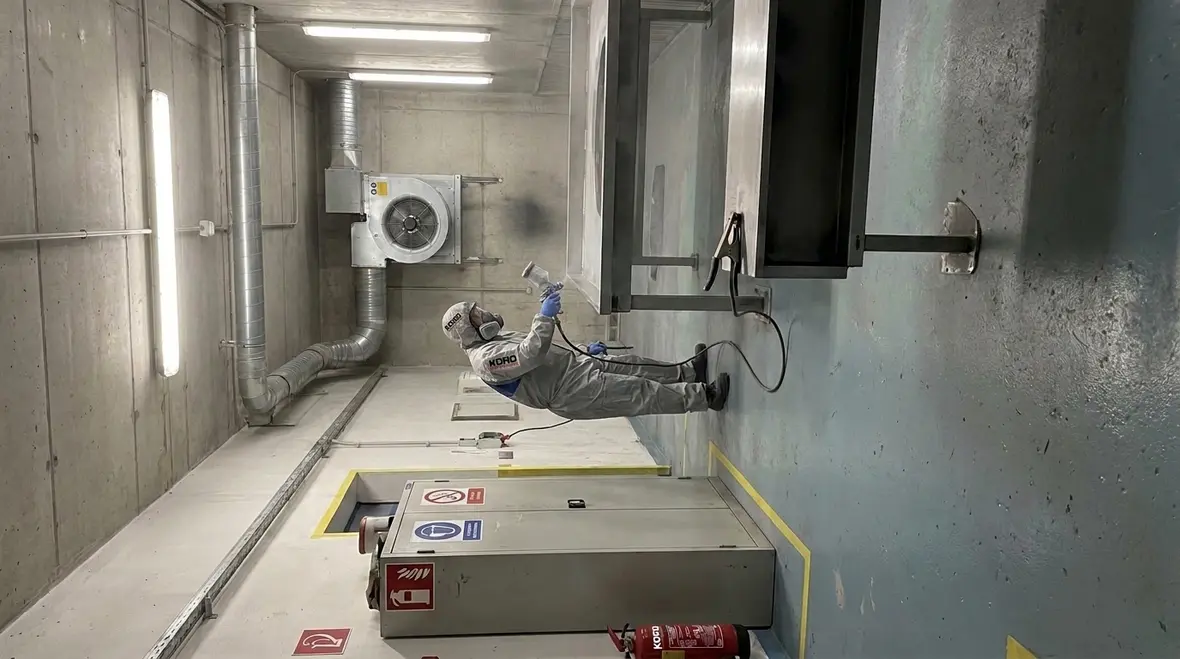
NFPA 33 Section 4.3: Spray Operations in Basements — What’s Allowed
Quick Answer: NFPA 33 Section 4.3 addresses when spraying in basements is permissible and what must be in place to control ignition hazards. Compliance hinges on ventilation, approved equipment, spray area controls, and maintaining conditions so solvents and residues do not accumulate.
Spray booth fire suppression for safer paint operations is a smart companion read if you’re comparing basement spray risks with how enclosed spray environments are typically managed in the field.
Why NFPA 33 Basement Spray Rules Matter in Real Facilities
Commercial, industrial, and retail facilities often assume basement spray work is “contained” because it is out of sight. NFPA 33 Section 4.3 challenges that assumption. Spray operations produce flammable atmospheres, overspray particulates, and residue deposits that can create ignition sources long after the spray stops. The result is a compliance problem that shows up during inspections as missing engineering controls, ineffective ventilation verification, and poor housekeeping practices.
For facilities seeking NFPA 33 basement spray operation requirements, the governing idea is simple: the basement environment must not become an unprotected ignition and accumulation zone. The code approach typically requires meeting specific conditions for the spray space, controlling ignition sources, and verifying that ventilation and monitoring perform as designed.
What Section 4.3 Focuses On: Basement Spray Risk Controls
Section 4.3 addresses spray operations conducted in basements and elevates the hazard because basements can trap vapors and contaminants. In practice, compliance centers on three technical outcomes:
- Prevent flammable vapor accumulation by using ventilation systems that maintain safe atmospheric conditions.
- Control ignition sources by ensuring equipment and installations follow the applicable hazardous location and ignition control principles.
- Limit combustible and residue hazards through spray area integrity, housekeeping, and waste handling.
Even when an operation is allowed, it must be managed under documented procedures. Inspectors generally look for evidence that controls remain effective throughout normal operations, startup, shutdown, maintenance, and cleaning.
What Is Typically Allowed: Conditions You Must Be Able to Demonstrate
NFPA 33 allows basement spray operations only when the facility can demonstrate that the spray process and space meet the code intent for hazard control. Facilities should expect compliance to be tied to the following practical elements.
1) Ventilation performance that matches the process
Basements require verified ventilation effectiveness because vapors can migrate to low points. A compliant approach typically includes a designed air movement strategy, adequate air changes for the spray scenario, and controls that prevent operation if ventilation performance cannot be maintained.
Common failure points include:
- Exhaust systems that exist but are not balanced or verified for the actual operating conditions.
- Inadequate capture at the spray position, allowing vapors to escape into the basement.
- Ventilation that stops or degrades during doors opening, duct balancing changes, or equipment downtime.
2) Proper spray area containment and separation
Where a facility uses enclosures, partitions, or spray rooms, the intent is to keep flammable atmospheres localized and to reduce uncontrolled migration. Compliance evidence often includes room integrity checks, door operation controls, and documentation showing that the spray area configuration during work matches the approved condition.
Where containment is not practical, the facility must rely more heavily on ventilation and ignition control, which increases the burden of proof during inspections.
3) Ignition control for equipment and electrical systems
Basements create a higher risk profile for ignition control because vapor accumulation can be more persistent. Equipment used in the spray area typically needs to meet the ignition control requirements applicable to the hazardous conditions created by spraying.
Inspectors commonly scrutinize:
- Fans, heaters, and motors located within or affecting the spray area air stream
- Switching devices and wiring routes that can introduce ignition
- Grounding and bonding practices for transfer operations and spray equipment
4) Housekeeping and residue management
Spray operations generate overspray and residue. In basements, residue can settle on surfaces, collect in hidden areas, and become a renewed hazard if disturbed or heated. NFPA 33 compliance generally expects a documented cleaning and waste handling program that prevents accumulation and does not introduce ignition hazards during cleanup.
Operations and Maintenance: How NFPA 33 Basement Spray Operation Requirements Are Enforced
NFPA 33 compliance does not stop at equipment purchase or initial installation. Basement spraying is enforced through ongoing operational readiness. That is where many commercial facilities struggle.
Pre job readiness checks (what should be verified)
Before spraying begins, responsible parties should verify that key controls are operating as intended. Typical checks include:
- Ventilation system operation and airflow status indicators
- Spray area boundaries, doors, dampers, and airflow control devices
- Condition and operation of spray equipment, including fluid handling and atomization components
- Grounding and bonding connections, verified for continuity and correct placement
During operation: preventing control drift
During spraying, conditions can change quickly. Compliance programs commonly require:
- Continuous or procedural confirmation that ventilation remains stable
- Controls to prevent ignition sources from entering the space
- Work practices that reduce overspray dispersion and limit uncontrolled airflow paths
After operation: cleaning, waste control, and reset
After spraying, residues and contaminated materials must be handled in a way that reduces fire risk. This includes proper containerization, storage location control, and cleaning methods that do not generate ignition. Many facilities fail here because cleaning schedules drift or because vacuum and brush practices are not aligned with flammable residue behavior.
To maintain credible compliance in audits and inspections, Kord Fire Protection supports facilities with code-aligned inspection documentation, hazard review workflows, and maintenance verification planning. For additional context on how fire protection professionals support code compliance programs, see Kord Fire Protection’s fire protection services in Southern California.
Inspection Readiness: Common Noncompliance Patterns in Basements
Basement spray operations often fail not because the facility “does not have controls,” but because controls are not maintained, not verified, or not consistent with actual work practices.
Noncompliance pattern 1: Ventilation exists but is not proven
Exhaust fans and ductwork may be installed, yet airflow performance may not reflect the spray scenario. Inspectors may look for evidence that the system has been evaluated and maintained. A credible compliance file usually includes inspection records, performance checks, and a maintenance history tied to the spray scope.
Noncompliance pattern 2: Equipment compatibility gaps
Misalignment between spray process and equipment rated capabilities is a common root cause. Even when equipment is “rated,” installation details and changes over time can introduce gaps. Maintenance records should show corrective action when issues are identified.
Noncompliance pattern 3: Waste and residue accumulation
Basements are prone to unnoticed residue buildup behind columns, along walls, and inside housekeeping “dead zones.” Effective compliance requires a realistic cleaning plan that matches the facility layout and the actual spray output.
Noncompliance pattern 4: Weak documentation and training
Facilities frequently cannot show who performs checks, what is verified, and what triggers corrective actions. Training records, written procedures, and job-start documentation usually determine whether a facility can demonstrate “safe operation” rather than “intended safe operation.”
Getting to Compliance: A Practical Checklist for Basement Spray Work
The following checklist supports compliance planning for NFPA 33 basement spray operation requirements. It is designed for use by safety managers, facilities teams, and operations supervisors.
| Area | What to Implement | Evidence to Keep |
|---|---|---|
| Ventilation | Ventilation strategy that controls flammable vapor hazards during spraying | Ventilation performance records, maintenance logs, commissioning or verification documentation |
| Spray area integrity | Controlled spray space with defined boundaries and operation practices | Facility layout drawings, operating procedures, room condition inspection records |
| Ignition control | Equipment and electrical components compatible with the hazard environment | Equipment documentation, inspection results, corrective action records |
| Grounding and bonding | Verified connections for spray and transfer operations | Test records, procedure references, maintenance verification |
| Housekeeping | Cleaning schedule and residue waste handling that prevents accumulation | Cleaning logs, waste handling procedures, container location and labeling records |
| Training and procedures | Operator training aligned to spray startup, operation, shutdown, and cleanup | Training rosters, SOPs, job-start checklists, incident review records |
For facilities that need an ongoing compliance partner, Kord Fire Protection helps commercial teams coordinate inspections, maintenance alignment, and documentation so basement spray operations remain supportable during audits. Visit Kord Fire Protection for service information.
Frequently Asked Questions
Next Step: Get Basement Spray Operations Audited Before Work Starts
Basement spray work fails compliance when ventilation, ignition control, or cleanup procedures drift from the approved condition. Kord Fire Protection can help commercial facilities validate controls, organize inspection-ready documentation, and build a maintenance plan that supports NFPA 33 basement spray operation requirements. Contact Kord Fire Protection to schedule a practical compliance review tailored to your spray process, equipment, and basement layout.

Join Our Newsletter!
Get the latest fire safety tips delivered straight to your inbox From our Newsletter.



