NFPA 25 Owner Responsibility and Inspection Records
Quick Answer: NFPA 25 §§ 4.1-4.3 places clear duties on owners for fire protection inspection, testing, and maintenance. It requires the owner to keep records, make sure work gets done, and verify that systems stay ready. Kord Fire Protection can act as a steady, compliant partner that helps facilities stay audit ready.
In many Australian commercial and industrial sites, NFPA 25 owner responsibility and inspection records become the difference between “we thought it was fine” and “we can prove it was fine.” Sections 4.1 through 4.3 place specific expectations on the owner, including how they manage fire protection ITM and how they maintain evidence. At first glance, recordkeeping sounds like paperwork for paperwork’s sake. Yet, when an auditor arrives, those NFPA 25 owner responsibility and inspection records help confirm systems were inspected and maintained on time. And when something goes wrong, they help trace the “what, when, and who” with calm clarity.
Near the top of that workflow, many facilities also benefit from aligning documentation with a broader full fire protection services program so inspections, maintenance, repairs, and records do not drift into separate lanes. When the field work and the paperwork stay connected, compliance gets a lot less dramatic and a lot more dependable.
Understanding NFPA 25 §§ 4.1-4.3 at a practical level
NFPA 25 covers inspection, testing, and maintenance for water based and other fire protection systems. In §§ 4.1-4.3, the core message is straightforward. The owner does not get to treat fire protection like a once a year chore. Instead, the owner ensures the required inspections and tests occur and that the facility can demonstrate compliance. Furthermore, the owner must handle recordkeeping so results remain available when needed.
In other words, the system can’t just exist. It must be actively managed. And yes, that includes documentation. Even the most reliable fire system cannot “witness” for itself during an inspection. Without records, teams often waste time rebuilding history from memory. That is never a good business day.
That practical reading lines up neatly with Kord Fire Protection’s NFPA 25 overview and complete water based fire protection systems maintenance breakdown, which explains how the standard is built around routine attention rather than heroic last minute cleanups. Owners who understand that rhythm usually build better systems for both maintenance and proof.
Why the owner’s role matters more than people think
A lot of confusion starts when teams assume hiring a contractor transfers the responsibility entirely. It does not. A provider can perform the inspections, tests, and repairs, but the owner still owns the obligation to ensure those things actually happen and that records remain available. That distinction matters because it changes how facilities schedule work, review reports, and chase deficiencies to completion.
Owner responsibility: what the law expects the facility to do
Under NFPA 25 §§ 4.1-4.3, the owner retains responsibility for ensuring the required fire protection ITM happens. This includes appointing qualified people to carry out the work, confirming schedules are followed, and making sure any deficiencies get addressed. As a result, owners play an active role, not a passive one.
For industrial, retail, and commercial facilities across Australia, this expectation matters because operations move fast. Production lines run, customer traffic spikes, and contractors rotate. Therefore, the owner must maintain control of the maintenance program through clear processes, defined ownership, and reliable follow through.
Some facilities try to manage ITM through a mix of emails, shared spreadsheets, and “I think we already did that.” That approach usually collapses the moment multiple assets, multiple floors, or multiple shifts enter the picture. Fire protection does not care about calendars or holiday leave. It cares about readiness.
A sensible owner responsibility model usually includes a current asset register, a defined inspection calendar, assigned internal contacts, a process for approving repairs, and a repeatable way to store records. None of that sounds glamorous, but neither does explaining to an auditor why three different versions of the same report exist and all of them say something slightly different.

Responsibility means oversight, not micromanagement
Owners do not need to stand over every valve test with a clipboard and a dramatic expression. They do, however, need enough oversight to know what was due, what was completed, what failed, and what still needs action. The sweet spot is a process strong enough to provide clarity without creating a maze of approvals so complicated that nothing gets done on time.
What inspection and testing records must show
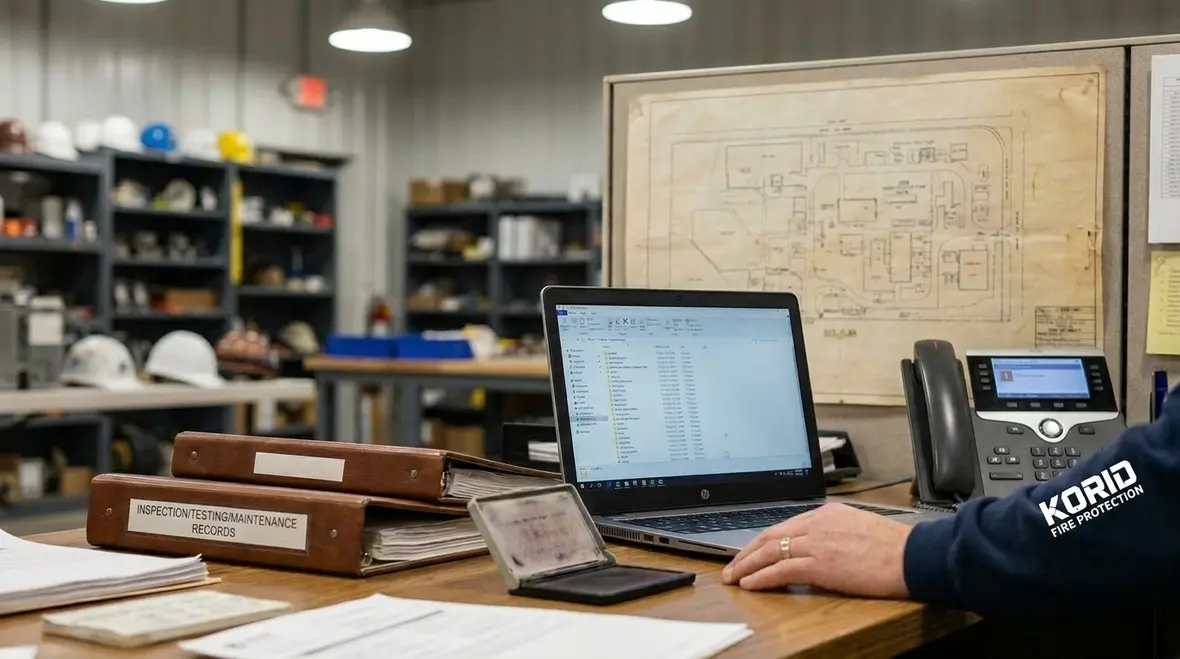
Next, the recordkeeping portion focuses on keeping documentation that supports the maintenance program. Typically, records should reflect inspections performed, testing results, conditions found, and actions taken when issues appear. Moreover, the records should link the work to the correct system and location, so a reader can understand what was checked and when.
Records should not read like a vague status update. Instead, they should support traceability. For example, if a system required corrective action, the records should reflect that the issue existed, the response occurred, and verification followed. In practice, this reduces confusion during internal reviews, tenant handovers, contractor transitions, and third party audits.
| Record element What it helps confirm | Why it matters on site Business impact |
|---|---|
| System identification and location | Prevents “right system, wrong building” mix ups, especially in large industrial sites where labels drift over time |
| Inspection and test dates | Shows schedules stay on track, which helps avoid last minute scramble and reduces risk of non compliance findings |
| Results and observed conditions | Provides evidence for performance trends and helps spot repeat faults before they become costly downtime |
| Actions taken for deficiencies | Demonstrates the owner response pathway, so the facility can show issues did not get “parked” indefinitely |
| Verification after repairs | Confirms fixes worked, which supports reliable readiness and avoids repeat failures during peak operations |
Good records also make trend analysis possible. If the same valve issue appears every quarter, or the same area repeatedly shows corrosion, the documentation stops being passive storage and starts becoming a decision tool. That means the owner is not just proving compliance after the fact. The owner is building a clearer picture of reliability over time.
How facilities keep compliance when operations never pause
Even strong teams face the reality that fire protection ITM must fit around production schedules, shop floor access, and safety routines. Consequently, compliance becomes an execution problem, not just a knowledge problem. Owners must ensure the maintenance plan actually happens in the field, with proper coordination and clean communication.
One common friction point involves handoffs between departments. Maintenance may handle the work, while compliance teams handle the records. Additionally, facility managers may manage asset registers, and contractors may manage testing. When these groups do not align, recordkeeping becomes a patchwork quilt made from scraps. That may look warm, but it does not hold up under scrutiny.
To avoid that, owners benefit from a disciplined workflow. They can standardise templates, set internal deadlines ahead of formal test dates, and use clear escalation steps when deficiencies appear. Furthermore, they can review records regularly, not just at year end.
Another practical move is pairing field access planning with documentation planning. If a test requires shutdown coordination, after hours access, or tenant notice, the paperwork needs to move at the same pace as the technician schedule. Otherwise, the facility gets the worst of both worlds: delayed work and incomplete records. Nobody frames that as a success story.
Simple systems usually outperform clever messy ones
The best compliance systems are often boring in the best possible way. They are easy to follow, easy to audit, and hard to misunderstand. Fancy dashboards are fine, but they do not replace disciplined habits. A plain process that everyone actually uses will beat a brilliant process that only one person understands and that person is on annual leave.
Where Kord Fire Protection becomes a vital partner
At this point, Kord Fire Protection can become a vital partner with this service and job, because recordkeeping works best when the field work and documentation move together. When a facility appoints Kord for inspection and maintenance, the process stops feeling like “someone will remember later.” Instead, Kord helps align the inspection activities, testing outcomes, and documentation into one controlled trail.
That matters for Australian facilities across industrial, retail, and commercial sites, where asset variety often creates complexity. Kord can support owners by helping ensure testing occurs on schedule, deficiencies get tracked to closure, and records remain complete and easy to review. In the real world, that means fewer gaps, fewer follow up emails, and fewer “Wait, who has the copy?” moments.
Think of it like this. Fire protection readiness is the smoke alarm. Recordkeeping is the manual. Most people ignore the manual until the house starts filling with smoke. Kord helps keep both in good shape, so the facility can stay calm instead of improvising under pressure.
For teams that want cleaner coordination, Kord’s service model is especially useful because it connects inspection scheduling, maintenance activity, deficiency visibility, and documentation support. That means less administrative drift between what happened on site and what the file says happened on site. In compliance terms, that is a very nice sentence to be able to say out loud.
Staying audit ready: a workflow that holds up
To stay audit ready, the owner responsibility and inspection records process should run like a system of its own. First, the facility tracks what must be inspected and when. Next, it confirms who performs the work and captures results immediately. Then, it reviews documentation for completeness, so missing fields do not hide in plain sight.
When deficiencies appear, the owner should not treat them like optional “nice to fix later” items. Instead, the facility should track corrective actions, document completion, and verify performance after repairs. In addition, owners benefit from a review cycle that checks whether records match the asset register. That step catches the quiet errors that happen when equipment gets replaced, re located, or re labeled.
Finally, the owner should store records in a way that supports retrieval. If a third party asks for documentation quickly, the facility should not spend hours searching shared drives or chasing folders. A clear system reduces stress, protects decision making, and supports faster responses.
- Track every covered system and location with consistent naming.
- Set inspection and testing schedules before due dates arrive.
- Capture findings immediately after work is completed.
- Assign deficiency owners and due dates clearly.
- Verify repairs and attach proof to the same record trail.
- Store documents where the right people can retrieve them fast.
FAQ: NFPA 25 owner responsibilities and inspection records
Call Kord Fire Protection for a compliant ITM plan and records support
NFPA 25 owner responsibility and inspection records deserve a steady process, not a last minute scramble. Kord Fire Protection helps Australian industrial, retail, and commercial facilities keep fire protection ITM on schedule, track deficiencies to closure, and maintain documentation that stands up when it counts. If a reliable partner sounds good, reach out today and get a plan built for your site, your assets, and your operational reality.
Strong compliance is rarely about one heroic day of effort. It is built through consistent inspections, useful records, visible follow through, and a partner who helps keep everything moving in the same direction. That is exactly why owner responsibility matters so much under NFPA 25. The system must be ready, and the records should prove it without anyone breaking into a stress sweat.

Join Our Newsletter!
Get the latest fire safety tips delivered straight to your inbox From our Newsletter.