NFPA 25 Fire Pump Inspection Testing Maintenance
Quick Answer
NFPA 25 governs fire pump inspection, testing, reporting, maintenance, and replacement testing. Following the standard helps protect lives, reduce downtime, and keep insurance carriers, authorities, and internal compliance teams satisfied. KORD Fire Protection supports facilities with organized scheduling, clear records, practical coordination, and fire pump service that keeps readiness from turning into a last-minute scramble. For sites that need broader system support, KORD’s full fire protection services can naturally tie pump work into a larger compliance strategy.
NFPA 25 is not “just paperwork.” It is the structured way facilities keep fire pumps ready when the building needs them, not when the calendar says it is convenient. In this article, KORD Fire Protection walks through NFPA 25 Sections 8.1 through 8.6, covering fire pump inspection, testing, reports, maintenance, and replacement testing. And yes, there will be a few moments of levity, because even the most serious pump deserves a light touch now and then.
What NFPA 25 Sections 8.1 to 8.6 require for fire pump readiness
Under NFPA 25, facilities inspect and test fire pumps on a set cadence, document what they find, and maintain the system so it performs as designed. First, the standard focuses on reliability. Next, it requires records that prove reliability is not luck. Finally, when a pump reaches the end of safe service life or major replacement work occurs, replacement testing confirms the system still meets the required performance.
For industrial, retail, institutional, and commercial sites, this matters because disruption costs money, and safety failures cost far more. Therefore, facilities treat NFPA 25 fire pump inspection testing maintenance as a planned program rather than a dramatic scramble five minutes before someone important asks for the records. Pumps are not known for sympathy. Auditors are not exactly famous for it either.
The broader framework also fits naturally with KORD’s NFPA 25 overview and complete water-based fire protection systems maintenance breakdown, which helps connect fire pump obligations to the rest of a water-based protection program.
Why the standard treats readiness as a continuous condition
A fire pump does not become dependable because it looked fine once. Readiness is built through repeated checks, meaningful records, and follow-up action when something drifts. That is why NFPA 25 links inspection, testing, reporting, maintenance, and replacement verification together. Separating those pieces usually creates the classic facility-management problem: everyone assumes someone else is handling it.
Inspection: how facilities prove the pump is in condition to run
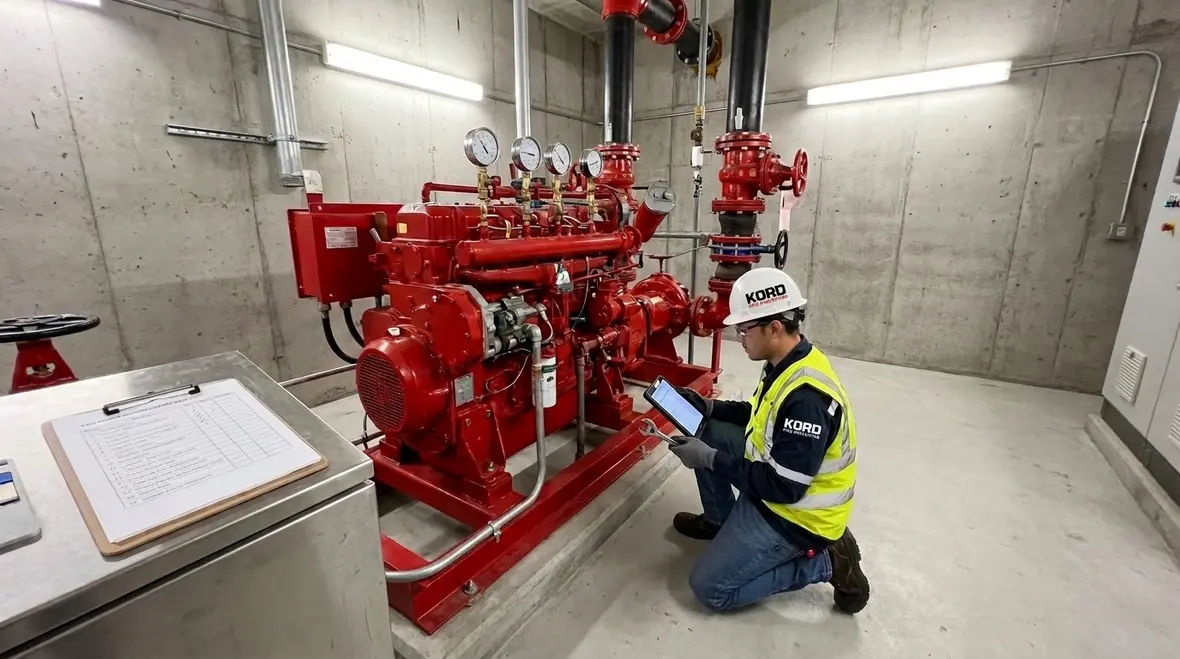
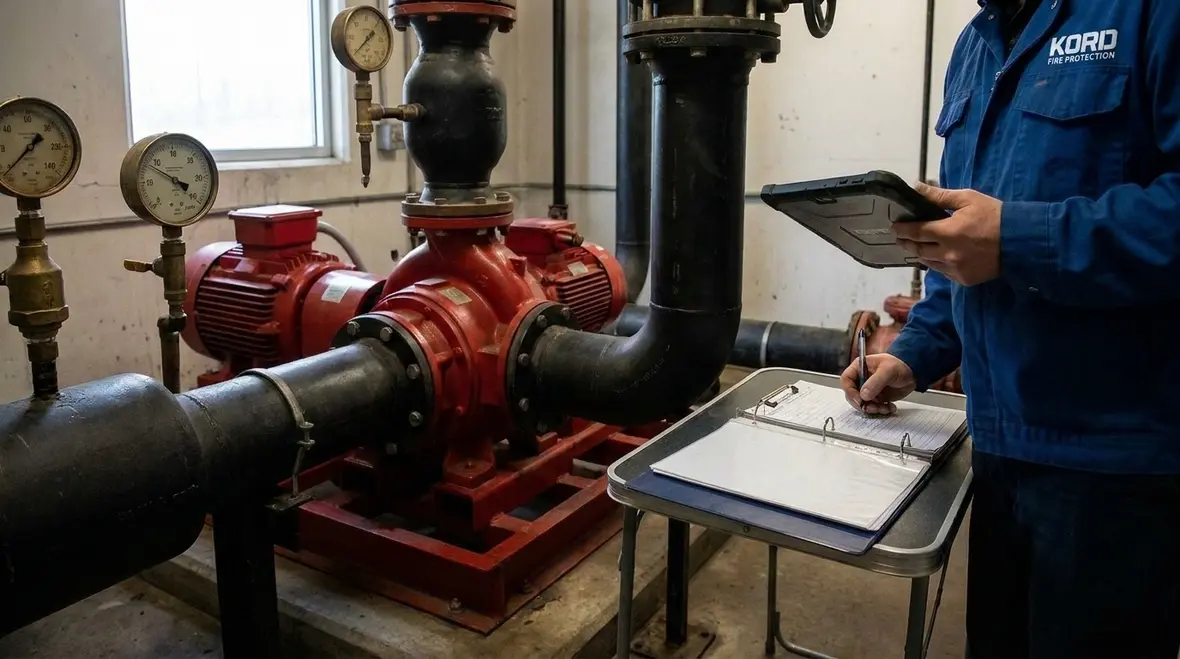
In NFPA 25 Sections 8.1 to 8.3, inspection and testing work together like a good team. During inspection, the facility checks that the pump and related components appear ready for service. This usually means verifying physical condition, confirming accessories and controls remain in proper operating state, and looking for visible deterioration that could affect performance when the pump starts under real fire conditions.
Inspections also help catch small issues early. A minor control issue, a questionable valve position, vibration, leakage, corrosion, or a suction condition that seems merely annoying today can become tomorrow’s performance failure. Consequently, the standard drives a see-it-early mindset. That approach is far less expensive than discovering a hidden problem during an emergency, which is a terrible time for a pump to reveal its personality.
KORD Fire Protection supports this by helping facilities plan inspection windows around operations, coordinating access, and keeping the process calm instead of chaotic. No site manager wants a pump room visit to feel like a treasure hunt with clipboards. Clear scheduling, access preparation, and concise notes make inspection far more useful than a rushed walk-through that creates more questions than answers.
What strong inspection documentation actually accomplishes
Documentation quality matters because the next step depends on it. If an inspection note is vague, the facility ends up repeating work, debating urgency, or waiting for clarification that should have existed from the start. If the report is clear, the maintenance path is obvious. That keeps teams aligned and prevents the classic “we thought that was already handled” conversation from making an unwelcome return.
Testing: verifying performance when it counts most
Testing under NFPA 25 centers on confirming that the fire pump can deliver the required flow and pressure. While the specific test details depend on the standard and the pump configuration, the intent stays the same. The pump must perform, the controls must respond, and the system must act predictably under the conditions it was designed to handle.
To make this practical, many facilities stage testing to reduce disruption. That is smart, but it still has to meet the standard’s expectations for accuracy and repeatability. KORD helps coordinate testing with site operations, identifies constraints ahead of time, and ensures the right checks occur at the right moment. Good testing should feel controlled and deliberate, not like everyone suddenly remembered an important anniversary.
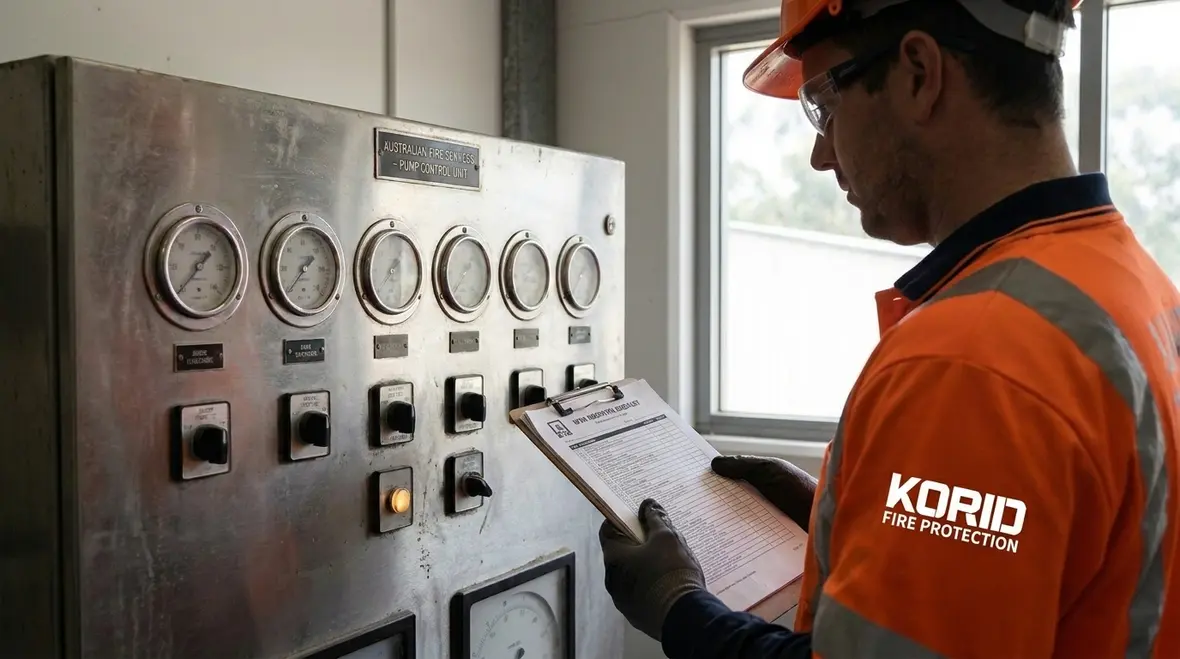
Meanwhile, testers verify not only results but also operating conditions. They look at trends, not just pass or fail. Suction pressure, discharge pressure, response behavior, and performance history all help tell the story. Then those measurements are documented so facilities can compare year over year. Over time, that trend data becomes a safety tool and a budget tool, because repairs and replacement decisions are much easier when the numbers have been speaking clearly for years.
Why repeatable testing matters more than one impressive result
One clean test result is encouraging. A repeatable testing history is far better. Facilities need evidence that the pump behaves consistently, not just that it had one particularly photogenic day. Consistency reduces guesswork, supports compliance discussions, and gives leadership a more grounded view of system health.
Reports and records: turning tests into actionable evidence
NFPA 25 requires reports that capture what happened during inspection and testing. In other words, the standard expects the facility to keep the story of the pump’s health, not just a stack of dates with no real meaning. If issues arise later, the records help determine what changed, when it changed, and how serious it might be.
Clear reporting also helps facilities respond to questions from authorities, insurers, and internal stakeholders. KORD Fire Protection supports documentation that is readable, consistent, and aligned with compliance expectations. Because when everyone can understand the record, decisions move faster. And faster decisions are generally preferable to prolonged email chains featuring six people, four theories, and zero conclusions.
NFPA 25 topic |
|---|
Fire pump testing outcomes |
Inspection findings |
Maintenance notes |
Replacement testing records |
What the facility gains |
|---|
Measured performance history that supports decisions, not guesses |
Early detection of deterioration before it becomes a failure |
Traceable actions that explain fixes and ongoing risks |
Proof that the updated pump system meets the required performance |
Maintenance: keeping reliability from drifting over time
Maintenance in NFPA 25 is about more than keeping things running. It helps ensure the pump, controls, valves, and related components stay in a condition that supports dependable performance. As time passes, normal wear can shift performance, and contamination or deterioration can affect flow. Maintenance routines exist to counter those changes before they show up during an emergency and ruin everyone’s day in record time.
In practical terms, maintenance may include checking and servicing components, verifying operational readiness, and addressing issues identified during inspection and testing. The important point is continuity. Facilities should not treat each service visit as a random event disconnected from the last one. When maintenance is tied directly to inspection findings and test data, the program becomes sharper, faster, and more defensible.
KORD Fire Protection becomes especially valuable here because it connects the dots. Instead of creating separate islands of paperwork, scheduling, testing, and repairs, KORD helps facilities maintain continuity across the full cycle. That continuity reduces repetition, supports faster resolution, and helps the site team stay in control. Think of it as keeping the pump’s health diary updated instead of waiting for the next emergency drill to reveal the plot twist.

Replacement testing: confirming the system after major changes
NFPA 25 Sections 8.5 and 8.6 cover replacement testing and the need to verify performance after replacement work. This is where facilities get serious, because a replaced pump is not automatically good just because it is new. The standard requires testing that confirms the updated system performs as required.
Replacement testing also protects the facility from false confidence. A new pump installed incorrectly, matched poorly to the system, or set up with the wrong operating parameters can still fail under demand. Therefore, replacement testing verifies the outcome, not just the installation activity. It closes the loop between the decision to replace and the proof that the new arrangement can actually do the job.
KORD Fire Protection supports this phase by coordinating replacement work, aligning follow-up testing, and documenting the results clearly for compliance and operational assurance. That way, the facility is not left with a shiny new component and an uncomfortable number of unanswered questions.
Building a compliant program across complex facilities
Many organizations manage multiple buildings, varied risk profiles, tenant expectations, and operating constraints such as production schedules, occupancy demands, delivery access, and limited shutdown windows. Because of that, an effective NFPA 25 fire pump inspection testing maintenance program needs planning, not just a date on the calendar.
KORD Fire Protection supports compliance by managing how inspections and tests fit into real site operations. That may include preparing access, coordinating downtime needs, aligning documentation formats, prioritizing follow-up actions, and helping teams understand which findings affect performance most. As a result, facilities reduce surprises and maintain a steadier compliance posture without turning every pump event into a mini crisis.
That prioritization matters. Not every note carries the same urgency, and not every correction belongs in the same bucket. When facilities can rank issues sensibly, they improve safety while protecting maintenance budgets. That is the difference between a managed program and a very expensive guessing game.
FAQ: NFPA 25 fire pump inspection, testing, and maintenance
Conclusion and call to action
NFPA 25 Sections 8.1 to 8.6 give facilities a clear path: inspect, test, report, maintain, and confirm performance after replacement. KORD Fire Protection helps organizations follow that path with stronger coordination, practical scheduling, and documentation that stands up to scrutiny. The result is a more confident fire pump program and fewer unpleasant surprises when readiness matters most.
If your property needs a compliant, confidence-building fire pump program, KORD can be the steady partner that keeps the system ready instead of reactive. Reach out to plan your next inspection and testing cycle, connect pump obligations to your wider life safety strategy, and keep your records as dependable as the equipment they describe.

Join Our Newsletter!
Get the latest fire safety tips delivered straight to your inbox From our Newsletter.