
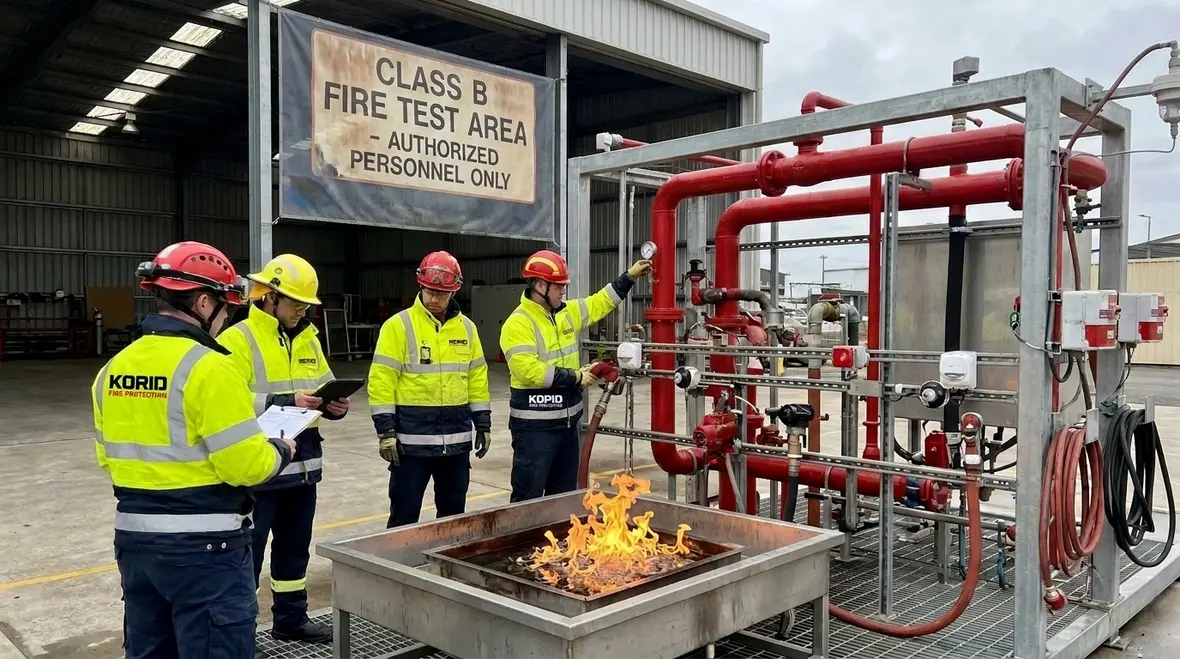
NFPA 18 Section 7.1: General Provisions for Class B Fire Extinguishment Tests
Quick Answer
NFPA 18 section 7.1 class B fire extinguishment test general provisions establish how extinguishment performance tests must be planned, conducted, documented, and verified. The goal is consistent test conditions, repeatable methodology, and defensible results that support design, evaluation, and compliance decisions for Class B hazards.
Why section 7.1 matters for Class B systems
Class B hazards involve flammable liquids and liquid fuels, where fire behavior and extinguishment dynamics differ sharply from Class A materials. NFPA 18 section 7.1 class B fire extinguishment test general provisions focus on making the test process reliable enough to be used for engineering decisions, approvals, and procurement specs. For commercial facilities, the practical challenge is not only meeting the standard once during acceptance. The challenge is maintaining test readiness, training documentation, and equipment condition so results remain credible over time.
If your team is tightening up readiness across the broader compliance program, it helps to connect testing discipline with a structured inspection, testing, and maintenance fire protection program. That way, the Class B test is not treated like a one day performance but part of a system that stays ready when auditors, insurers, or real life come knocking. ([kordfire.com](https://kordfire.com/itm-fire-protection-inspection-testing-maintenance/?utm_source=openai))
What the general provisions require before any test starts
General provisions in NFPA 18 section 7.1 class B fire extinguishment test general provisions drive the pre test controls that prevent misleading outcomes. Facilities and test organizations typically must control the test environment, define the hazard configuration, confirm system readiness, and establish measurable criteria for success.
1) Test planning and defined acceptance basis
Tests should be executed with a clear test plan that aligns with the specific extinguishing agent, delivery method, application scenario, and container or compartment geometry. In practice, common failure points occur when the test setup does not match the intended hazard class or the installation assumptions used in engineering.
2) System configuration verification
Before extinguishment discharge, technicians verify that all relevant components reflect the as installed configuration, including actuation logic, nozzles or delivery openings, agent supply integrity, and any interlocks that affect release sequence. For commercial sites, this includes ensuring that facility modifications after commissioning have not altered flow paths, obstructions, or nozzle orientations.
3) Instrumentation and data capture
Reliable tests require measurement traceability. Teams commonly confirm that pressure indicators, flow measurement points, timing capture, and environmental conditions are suitable to support repeatability. Without defensible instrumentation records, test results become difficult to defend during audits, insurance reviews, or authority having jurisdiction discussions.
How Class B extinguishment tests should be executed
During execution, section 7.1 expectations typically emphasize consistency and control of variables that affect flame spread, vapor generation, and agent distribution. For Class B, small changes in fuel properties, pre burn duration, or discharge alignment can change the observed extinguishment performance.
1) Hazard representation and fuel behavior control
Test fuels must be used and prepared under defined conditions so that heat release rate and vapor production remain predictable. Operationally, facilities must guard against fuel contamination, inconsistent fill levels, and improper surface preparation. These issues are frequent in industrial and retail storage areas where housekeeping variations occur.
2) Discharge performance and agent distribution
Agents must be delivered as intended to achieve extinguishment, suppression, and prevention of re ignition when applicable. Key operational checks include verifying actuation timing, confirming nozzle performance, and ensuring the discharge achieves the target coverage. Misalignment, clogged distribution elements, or degraded components can produce localized under application.
3) Timing, sequencing, and observation discipline
Teams should maintain strict timing for discharge and observe performance using consistent criteria. A typical compliance risk is inconsistent observation notes or incomplete documentation of time to extinguishment, re ignition indicators, and any anomalies. Well trained documentation practices support easier internal review and stronger audit outcomes.
Documentation that withstands compliance scrutiny
NFPA 18 section 7.1 class B fire extinguishment test general provisions support defensible results. In commercial facilities, the strongest compliance posture comes from complete, consistent records that connect the test setup to the installed system design and future maintenance plans.
What records should typically include
- Test plan, hazard description, and configuration drawings or references
- Equipment identification, configuration confirmation, and calibration or traceability details
- Environmental conditions and agent delivery parameters
- Observed performance metrics, including extinguishment and any re ignition indicators
- Deviations, anomalies, and corrective actions taken during the test cycle
Facilities that rely on ad hoc documentation often discover the gap during inspections. When records do not clearly show test alignment to the installed system, repeat testing may be required, increasing downtime and cost. A structured approach reduces both technical and operational risk.
That is also why many teams benefit from keeping a formal fire protection system documentation checklist in the workflow. It helps connect inspection and testing reports with the evidence trail you actually need when someone asks, politely or otherwise, “Can you prove this setup matched the installed system?” ([kordfire.com](https://kordfire.com/fire-protection-system-documentation-checklist/?utm_source=openai))
Common failure points in real world Class B environments
In commercial, industrial, and retail spaces, test integrity can degrade between initial commissioning and later compliance verification. The following issues routinely undermine Class B performance unless proactively managed.
1) Maintenance drift and unnoticed configuration changes
Changes in layout, obstructions, minor mechanical adjustments, or replacement of components with non equivalent parts can affect agent distribution. Even small deviations can alter coverage and effectiveness during extinguishment.
2) Agent performance degradation
Physical condition changes, improper storage handling, or aging effects can impact discharge characteristics and agent behavior. This is particularly important when extinguishing effectiveness depends on wetting, spreading, or suppression mechanisms.
3) Nozzle, delivery, and flow path problems
Blockages, partial obstructions, damaged distribution components, or leaks in supply lines can reduce delivered performance. These defects may remain invisible until functional testing. A proactive maintenance program identifies and corrects these issues ahead of extinguishment verification.
How partner support helps
Kord Fire Protection supports commercial compliance through ongoing inspection, maintenance, and testing readiness for fire protection systems. For facilities addressing agent behavior and application performance, Kord Fire Protection also provides technical guidance on wetting agent considerations through relevant best practice resources, including NFPA 18 overview and wetting agents. Service continuity matters because Class B performance depends on both the test setup and the installed system condition. ([kordfire.com](https://kordfire.com/itm-fire-protection-inspection-testing-maintenance/?utm_source=openai))
Build a compliance program around testing, not just reporting
Facilities achieve better outcomes when they treat NFPA 18 testing requirements as part of an integrated lifecycle program. That means aligning acceptance testing, inspection intervals, maintenance scopes, and operational readiness drills.
- For sprinkler and related system support, consult Kord Fire Protection sprinkler services to strengthen ongoing system reliability.
- For pump and water supply technical context that often intersects with system performance during discharge, review Fire Pumps technical resources.
Integrating these elements helps facilities reduce the chance that a future compliance review triggers a costly re test due to condition drift, missing documentation, or mismatched equipment configuration. For teams that want extra water supply context beyond the basics, Fire Pumps also has a practical NFPA 16 fire pump foam systems guide that fits naturally alongside Class B and foam related planning. ([firepumps.org](https://firepumps.org/blog/nfpa-16-fire-pump-foam-systems-guide/?utm_source=openai))
Frequently Asked Questions
Next step for facility compliance
To protect uptime and reduce re testing risk, facilities should validate that their installed Class B extinguishment configuration remains aligned with the expectations behind NFPA 18 section 7.1 class B fire extinguishment test general provisions. Kord Fire Protection can help plan documentation, maintenance readiness, and service continuity for commercial environments. Contact Kord Fire Protection to schedule a compliance focused review of system condition and test preparedness.

Join Our Newsletter!
Get the latest fire safety tips delivered straight to your inbox From our Newsletter.



