
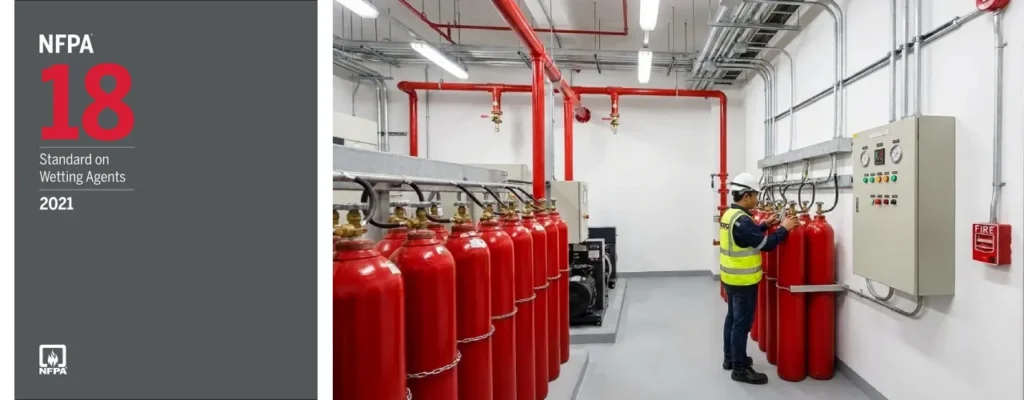
NFPA 18 Overview: Wetting Agents, Fire Extinguishment Testing, and Compliance Explained
Wetting agents are one of the least understood parts of water-based fire protection — yet when a deep-seated fire is burning inside a wood pile, a stack of timber, or a mass of fibrous material, plain water often can’t do the job. NFPA 18, the Standard on Wetting Agents, is the document that governs these additives: what the product must be, how its performance must be proven against real fires, how it should be supplied, stored, and labeled, and how fixed systems using it must be maintained. This overview explains what the standard covers and what facility managers, fire officials, and contractors should take from it.
Quick Answer
NFPA 18 sets the requirements for wetting agent concentrates and solutions used in fire control. It defines the product’s physical and chemical requirements, the test methods used to prove the agent extinguishes Class A (ordinary combustible) and Class B (flammable liquid) fires, the rules for fire department supply and fixed systems, and the inspection, testing, and maintenance expectations once a system is installed. It is aimed at manufacturers, fire departments, and facilities that use or store wetting agents — not at ordinary water sprinklers or foam systems, which are governed by other standards.
What Wetting Agents Actually Are
A wetting agent is a surfactant mixed into water to reduce its surface tension. That sounds like a chemistry detail, but it changes how the water behaves during a fire:
- Penetration — instead of sheeting off a surface, water carries into piles of wood, fiberboard, and other porous, deep-seated fuel.
- Adhesion — the treated water clings to surfaces, increasing the contact time that does the cooling.
- Suppression support — by keeping fuel saturated after knockdown, wetting agents reduce rekindle potential.
Wetting agents are often confused with firefighting foam, and the two are different tools. Foam forms a blanket over burning liquids; wetting agents make water itself work harder on ordinary combustibles and, in some formulations, on flammable liquids. If you’re already familiar with our guides on foam fire protection for flammable liquids or the concentrate types guide covering AFFF, AR-AFFF, and protein, wetting agents sit in the same family of water additives but serve a different mission.
What the Standard Covers
NFPA 18 works through the wetting agent from product to installed system:
Scope and application. The standard defines what it covers — wetting agent concentrates and solutions used in fire control — who must comply with it, and the general provisions (retroactivity, equivalency, units) that apply.
Uses and limitations. Not every fire is a wetting agent fire. The standard sets out where wetting agents may and may not be used, and it places explicit limits on their application.
Compatibility and concentration. Mixing different concentrates, or diluting them to the wrong ratio, quietly degrades performance. The standard requires verification that concentrates and solutions are compatible and that they are used at the correct concentrations.
Health, safety, and environmental considerations. Handling constraints for personnel and the environment are part of the requirements, not an afterthought.
Product requirements and test methods. This is the technical core. The standard specifies the physical and chemical property requirements for wetting agent concentrates and solutions, along with the test methods and acceptance criteria used to verify them.
Class A fire extinguishment tests. For ordinary combustibles, the standard prescribes real-fire test methods — including a wood crib fire test, a deep-seated fire test, and a penetration test on wood fiberboard — that demonstrate the agent actually works where plain water struggles.
Class B fire extinguishment tests. For flammable liquid fires, the standard sets listing requirements, a prescribed test method, and a quantitative performance requirement the agent must satisfy.
Wetting agent supply. Requirements extend to how wetting agents are supplied — both for fire department use at incidents and for permanently installed fixed systems.
Packaging, storage, and labeling. The product must be packaged to preserve integrity, stored under conditions that keep it effective, and labeled with the information needed for safe and compliant use.
Inspection, testing, and maintenance. Once a fixed wetting agent system is installed, the standard defines how the system and the stored concentrate are inspected, tested, and maintained over time.
Why Real-Fire Testing Is the Heart of the Standard
A wetting agent can look fine on a spec sheet and still underperform when it matters. NFPA 18’s approach is deliberately performance-based: the product has to prove itself against actual fires, including deep-seated fires buried inside a fuel pile — the scenario where rekindle and loss of containment are the real risks. For any facility evaluating a wetting agent, that’s the detail worth asking about: not just the product’s chemistry, but the test history that backs its performance claims.
Who Actually Uses Wetting Agents
In practice, wetting agents show up in a few specific places:
- Fire departments that carry wetting agent supply for structural, wildland-adjacent, and pile-fighting work.
- Industrial facilities with deep-seated fire potential — wood processing, lumber storage, paper and fiber operations, and similar environments.
- Facilities with fixed wetting agent systems that require ongoing inspection, testing, and maintenance to stay code-compliant.
It’s a narrower niche than foam or water mist, which is why it’s frequently overlooked in general fire protection planning — and why it deserves a deliberate look when a facility has pile or deep-seated fuel exposures. Our fire suppression services and full fire protection services teams can assess whether a wetting agent strategy fits a given exposure.
What Facility Managers Should Know
Even if wetting agents are a small part of your fire protection picture, a few points matter:
- Never assume compatibility. Different concentrates should not be combined without verification — incompatible mixes can lose their effectiveness entirely.
- Concentration accuracy is part of performance. An under-diluted or over-diluted solution is not the solution the product was tested as.
- Stored product degrades. Packaging integrity, storage conditions, labeling, and the condition, quantity, and dating of stored concentrate are all checkable items — and they’re the first things an inspector looks for.
- Fixed systems need a maintenance program. A wetting agent system that is installed but not inspected and maintained is a system whose compliance status is unknown.
- Document everything. Product test history, dilution procedures, storage conditions, and inspection records are what turn a compliant installation into a defensible one.
Compliance and Jurisdiction Considerations
NFPA 18 is a model standard. Whether it applies to a specific facility depends on the adopted code edition, local amendments, the occupancy and hazard profile, and the interpretation of the authority having jurisdiction. The current edition is the 2021 edition, and the revision cycle is published on NFPA’s standard development page — worth checking before relying on edition-specific details. If wetting agents are part of your facility’s fire protection strategy, confirm the applicable requirements with your AHJ and a qualified fire protection contractor before finalizing design or maintenance plans.
When to Call a Professional
General education covers what the standard requires; it doesn’t cover what your specific facility needs. If you have deep-seated fuel exposures, an existing fixed wetting agent system, or questions about product compatibility and storage, that’s professional territory. Kord Fire serves the Los Angeles area with NFPA-compliant inspection, testing, and maintenance across our fire protection services — contact us if you want a look at your setup.
Key Takeaways
- NFPA 18 governs wetting agents from product chemistry through installed-system maintenance.
- Performance is proven with real-fire tests, including deep-seated fire and penetration tests for Class A, plus listing and performance requirements for Class B.
- Compatibility, correct dilution, storage, labeling, and ITM are where real-world compliance lives or dies.
- Wetting agents are a niche tool — but for deep-seated fuel exposures, they may be the right one.
- Adoption varies by jurisdiction; verify with your AHJ and a qualified professional.
Sources / References
Internal (kordfire.com):
- Fire Suppression Services — https://kordfire.com/fire-suppression/
- Foam System Fire Protection for Flammable Liquids — https://kordfire.com/foam-system-fire-protection-for-flammable-liquids/
- Fire Protection System Concentrate Guide — https://kordfire.com/foam-fire-protection-system-concentrate-guide/
- Full Fire Protection Services — https://kordfire.com/full-fire-protection-services/
- Contact — https://kordfire.com/contact/



