
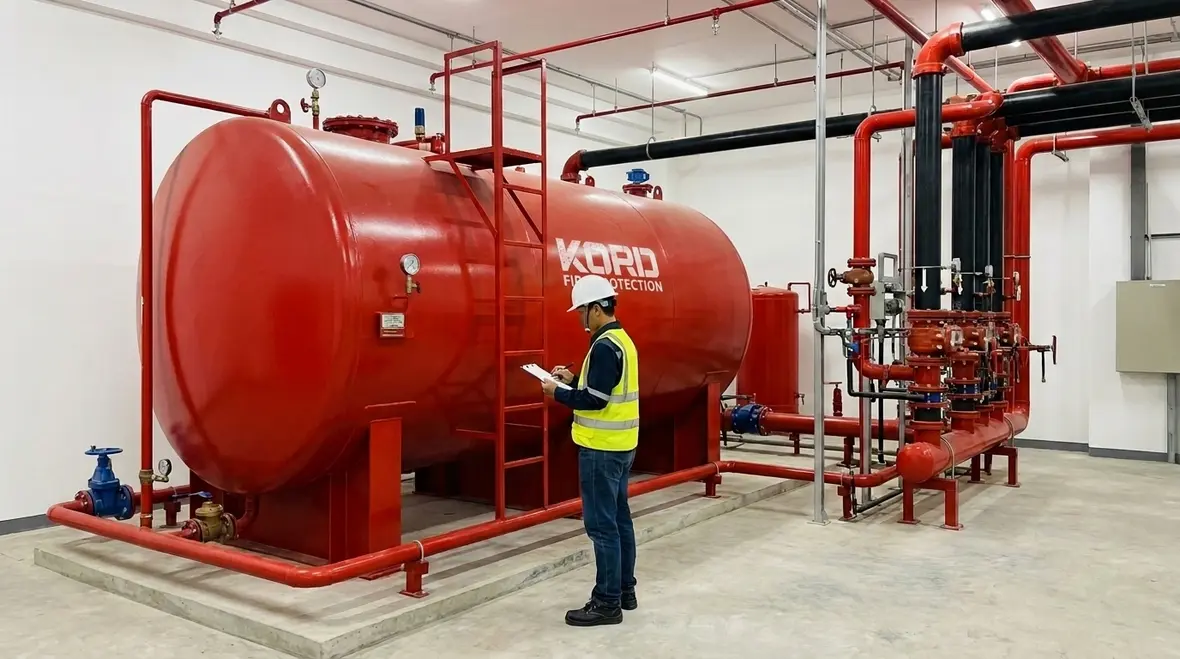
NFPA 16 Section 6.6: Storing Foam Concentrate – Tank Requirements
Quick Answer: NFPA 16 Section 6.6 sets performance focused tank requirements for foam concentrate storage, addressing capacity, construction, labeling, compatibility, and delivery conditions to ensure reliable proportioning. Facilities must also manage inspection, maintenance, and operational controls to prevent contamination and degraded concentrate.
If your facility is reviewing broader foam fire suppression inspection requirements and service, this section on storage tanks fits right into the bigger picture because concentrate condition and tank reliability affect the whole system, not just one lonely vessel pretending it is off the clock.
Why foam concentrate storage tank requirements matter in the real world
Foam proportioning systems depend on consistent foam concentrate quality and dependable delivery from storage tanks to the proportioning equipment. When facilities do not meet foam concentrate storage tank requirements, the usual outcomes include air entrainment, incorrect concentrate ratios, degraded expansion performance, and delayed suppression effectiveness. NFPA 16 Section 6.6 focuses on the tank and tank related controls needed to protect concentrate integrity and system reliability over time.
For many commercial, industrial, and retail occupancies, the compliance challenge is not a missing component. It is aging tanks, unclear installation records, degraded hoses and connections, mismatched materials, and weak inspection routines that fail to catch slow deterioration.
Facilities can reduce this risk with documented tank condition checks, scheduled maintenance, and professional system testing. Kord Fire Protection supports owners and operators with ongoing compliance work aligned to the NFPA 16 Standard.
What NFPA 16 Section 6.6 requires for foam concentrate tank placement and installation
Section 6.6 centers on ensuring the foam concentrate tank system supports the foam system design intent. In practice, that means the tank setup must support stable concentrate supply under the range of operating conditions that the foam system can experience.
1) System compatibility and concentrate preservation
The tank must be suitable for the foam concentrate type being stored. Concentrates can be sensitive to contamination and certain construction materials. A common failure point is not the tank body itself, but adjacent piping, fittings, gaskets, valves, and seals that introduce incompatibility. Even small changes in wetted materials can affect concentrate stability and concentrate performance.
2) Accurate connection arrangements for proportioning reliability
Installation details around the tank connections determine whether the proportioning system receives concentrate consistently. Installations that create unnecessary restrictions, allow trapped air, or promote siphoning can cause unstable feed rates. These conditions may not appear during routine visual checks but show up during flow testing or full system actuation.
3) Environmental protection and operational control
Commercial facilities often store foam concentrates in areas subject to temperature swings, vibration, or accidental mechanical impact. Tank placement and physical protection should support concentrate preservation and continued safe operation. A compliance gap frequently shows up when tanks are installed in maintenance corridors, storage closets, or auxiliary spaces without adequate protection from damage or unauthorized access.
Foam concentrate storage tank requirements for tank construction and mechanical integrity
NFPA 16 Section 6.6 addresses construction and integrity considerations that directly affect concentrate delivery. Tank design should support long term reliability and resist conditions that drive failure.
Tank materials and wetted components
Wetted materials must maintain chemical compatibility with the stored concentrate. Tanks and associated components should not add contaminants or promote material degradation. A frequent operational issue involves retrofit work where a facility replaces an older valve or connector with a different material type without confirming concentrate compatibility.
Access for inspection and maintenance
Tank requirements also support practical inspection. Facilities should maintain access to the tank and key components so that visual condition checks and integrity verification can occur without hazardous disassembly. When access is restricted, inspection programs degrade and small problems progress to large failures.
Proper venting and air management
Air management is a critical practical requirement. If the tank arrangement allows air to enter the concentrate supply path, the proportioning equipment can deliver an incorrect foam concentration. Air entrainment can also lead to inconsistent foam expansion and reduced overall effectiveness during incidents. Inspection should include verifying that air related controls remain functional and unobstructed.
Capacity, labeling, and documentation controls that support compliance
Compliant tank systems depend on accurate information. Many commercial owners assume concentrate type and tank capacity remain stable because the tank has not been replaced. NFPA 16 Section 6.6 emphasizes the need to maintain conditions that support the foam system design.
Capacity aligned to the system design
Tank capacity must support the required discharge duration and system demand. Under sizing leads to supply depletion during operations. Oversizing can create additional maintenance burdens and longer concentrate dwell time, which can raise the chance of unnoticed degradation. Facilities should confirm tank capacity against the system design basis and ensure any changes after installation are documented.
Concentrate identification and labeling
Labeling supports safe operations and prevents cross contamination. If a site stores multiple concentrate types, robust labeling reduces the risk of installing the wrong concentrate into the tank. A common failure point is unlabeled or faded labels, especially after renovations or equipment moves.
Records and traceability for service history
Documentation supports inspection and maintenance decisions. Owners should retain proof of concentrate type, refill history, and service actions, including any component replacements. When records are missing, technicians often rely on assumptions, which increases the risk of noncompliant configurations.
Inspection and maintenance: what to check to prevent foam concentrate tank failures
NFPA 16 tank requirements connect directly to ongoing maintenance. The most reliable compliance programs treat foam concentrate tanks as active process equipment, not static storage.
Routine checks that catch problems early
Verify tank condition for corrosion, deterioration, loose connections, and physical damage.
Check labels for legibility and verify concentrate identification matches the system design documents.
Inspect fittings, valves, and gaskets for leakage and wear that can introduce air or contamination.
Confirm that access covers and protective measures remain intact and functional.
Ensure temperature and environmental exposure remain within acceptable operating considerations for the foam concentrate.
Common failure points during testing and real incidents
Air entrainment caused by air pathways, improper venting, or loose suction side connections.
Incorrect concentrate ratio due to restriction changes, degraded hoses, or component incompatibility.
Degraded foam performance when concentrate has been contaminated, overheated, or stored beyond effective life assumptions.
Supply depletion during longer hazard scenarios when tank capacity assumptions do not match the current design or piping configuration.
How Kord Fire Protection supports ongoing compliance
Kord Fire Protection helps commercial facilities maintain foam systems beyond initial installation. The service approach typically includes system verification, documentation support, inspection planning, and testing coordination aligned to NFPA expectations. This reduces the operational risk of “passive storage” behavior and ensures tank related components remain fit for purpose.
For guidance on the standard scope and how Section 6 integrates with system design and acceptance, visit NFPA 16 Standard resources through Kord Fire Protection. If you are also planning service intervals and field verification, Kord’s foam fire suppression system maintenance and testing resource is a natural next read.
How to prepare for compliance walkthroughs and code reviews
Commercial owners often get surprised during walkthroughs because the tank looks intact but documentation and maintenance practices are unclear. A strong compliance posture includes both equipment condition and proof that operations remain controlled.
Maintain an up to date binder or digital folder that shows tank capacity, concentrate type, and system configuration.
Keep records of concentrate service actions, component replacements, and any retrofit work.
Ensure the tank area supports inspection access without unsafe disassembly or obstructed view.
Train facility personnel on what not to change and how to report abnormalities such as leaks, label issues, or unusual system behavior.
This approach helps prevent findings driven by uncertainty rather than demonstrated defects.
Frequently Asked Questions
Conclusion and call to action
NFPA 16 Section 6.6 tank requirements are not just installation details. They protect foam concentrate integrity and ensure reliable proportioning when conditions matter most. Owners and operators should review tank construction, connection arrangements, labeling, capacity alignment, and inspection access, then confirm performance through professional testing and maintenance. Kord Fire Protection can help commercial facilities verify compliance and maintain readiness with a structured, documentation supported service program.

Join Our Newsletter!
Get the latest fire safety tips delivered straight to your inbox From our Newsletter.



