
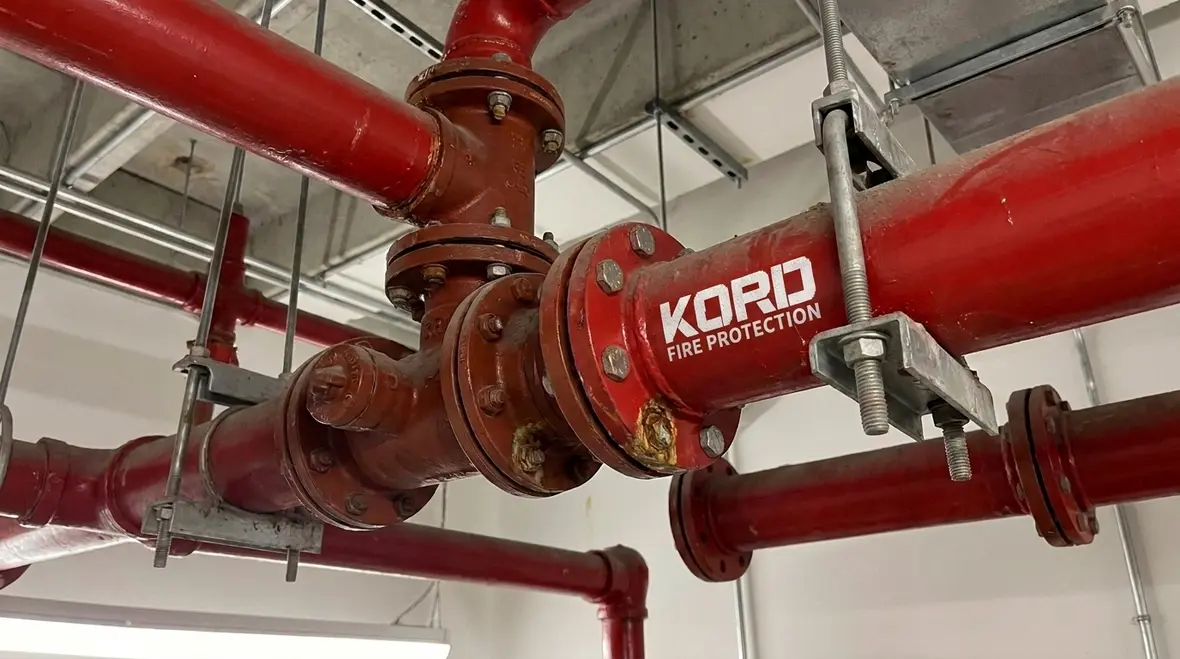
NFPA 16 Section 6.7: Piping, Valves, Fittings, and Hangers for Foam Systems
Quick Answer: NFPA 16 Section 6.7 specifies how foam water system piping, valves, fittings, and hangers must be installed, supported, and maintained to ensure reliable foam delivery. Compliance centers on correct materials, secure connections, proper support, and inspection readiness throughout a facility.
NFPA 16 addresses inspection, testing, and maintenance (ITM) for foam water systems. Section 6.7 focuses on piping, valves, fittings, and hangers, which directly affect foam proportioning accuracy, flow path integrity, and delivery reliability. In commercial, industrial, and retail occupancies, the most frequent compliance gaps involve aging components, poor support and alignment, inaccessible valve locations, and undetected leaks or corrosion.
For facility teams seeking a single source of truth for implementation, Kord Fire Protection supports compliance planning, field verification, and documented maintenance aligned to the NFPA 16 standard. See more at NFPA 16 standard guidance from Kord Fire Protection.
For a broader look at related system performance and testing workflows, fire pump testing requirements can help teams connect foam system compliance with real-world inspection and maintenance planning.
What NFPA 16 Section 6.7 is really protecting
Section 6.7 is not only about “installing piping correctly.” It is about preserving the system’s ability to move foam concentrate and water through the correct hydraulic pathway, with the right restrictions and the right connection integrity. Foam systems often operate at high flow rates during tests or emergency discharge. Small mechanical defects in foam-water system piping valves fittings can become major performance issues when flow and pressure increase.
In practice, this section targets common failure modes such as:
- Leaks at threaded, flanged, or coupler joints that only appear under test pressure
- Valve issues that prevent full travel or prevent repeatable flow control
- Misaligned piping supports that induce stress and accelerate corrosion or joint separation
- Hanger and support deterioration that causes sagging, binding, or strain on fittings
- Incorrect materials or incompatible sealants leading to chemical degradation
Foam-water system piping valves fittings: design, installation, and integrity
The core goal of foam-water system piping valves fittings requirements is to maintain predictable hydraulic performance and reliable system operation. Even when proportioning equipment is properly selected, compromised piping and fittings can introduce excessive restriction, air entrapment, or flow imbalance.
Connection integrity and leak resistance
Many field failures originate at connection points. Typical problem areas include threaded fittings with insufficient thread seal control, flanged joints without consistent gasket condition, and couplings that loosen due to vibration or thermal cycling. During ITM, technicians should focus on connection evidence, including moisture patterns, corrosion staining, and signs of seepage after flow events.
Materials compatibility and corrosion control
Foam concentrates can be chemically active depending on formulation. Piping and seals must remain compatible over the service life. Corrosion can reduce wall thickness, roughen internal surfaces, and create pinhole leakage that becomes apparent only during system testing. Facilities that experience frequent washdown, chemical exposure, or high humidity often require more vigilant inspection frequency and faster corrective action.
Alignment and hydraulic continuity
Pipe misalignment and forced fit installation can induce bending stress at valves and fittings. Over time, that stress can damage seats, distort flanges, and weaken hangers. Kord Fire Protection typically includes alignment checks and support verification as part of operational readiness review to reduce preventable joint failures.
Valves in foam systems: common compliance challenges
Valves define how the system routes foam-water mixture, isolates components for maintenance, and ensures repeatable flow conditions. NFPA 16 Section 6.7 emphasizes the piping and valve installation attributes that support safe operation and maintainability.
What technicians verify during ITM
During inspections and tests, teams typically verify:
- Valve type and intended function match the system design
- Valve accessibility supports safe operation and rapid troubleshooting
- Valve position indicators are accurate and not obstructed
- Valve actuation produces full travel without binding
- Packing, seals, and stem condition prevent leakage during operation
- Any maintenance features remain serviceable, including removal clearance
Failure points seen in commercial and industrial facilities
- Sticking or incomplete travel: Often caused by corrosion, debris, or mechanical wear of the stem and seat interface.
- Seepage at packing: Small stem leaks can worsen and eventually affect system pressure and foam delivery performance.
- Blocked or inaccessible valves: Storage, insulation removal delays, or restricted access can turn routine ITM into a nonconformance.
- Improper reassembly after service: Inconsistent torque, gasket misplacement, or sealant misuse can reintroduce leaks.
Fittings and accessories: how small components drive big results
Foam systems rely on fittings, check devices, strainers, reducers, and measurement points to control flow characteristics. NFPA 16 Section 6.7 places importance on the physical and maintenance readiness of these components because they often degrade quietly.
Strainers and check devices
Strainers can collect debris and shift flow behavior. Check valves or other backflow prevention components can stick due to corrosion or sediment, leading to reverse flow or reduced discharge performance. Inspection should include evidence of fouling and verification that the device remains functional within the expected operating conditions.
Hose connections, adapters, and test points
Where foam-water system piping valves fittings include test connections or other accessories, technicians should confirm connection integrity and that caps or plugs remain in place. Missing or damaged caps can lead to contamination, moisture intrusion, and seal degradation, which later manifests as difficult-to-diagnose leakage during testing.
Hangers and supports: preventing stress, sag, and “silent” damage
Hangers and hangers, supports, and restraints control load transfer from piping to structure. If supports degrade, pipes can sag, joints can become strained, and valves can experience misalignment. In foam systems, this matters because mechanical stress can accelerate wear, distort sealing surfaces, and compromise connection integrity.
What to look for during field verification
- Corrosion or deformation of hangers, rods, or brackets
- Missing, mislocated, or incorrectly installed support components
- Unusual deflection or pipe sag near valves and fittings
- Evidence that piping is pulling on equipment connections
- Clearance issues that indicate interference or improper restraint
Commercial facility realities
Retail and industrial properties often modify layouts, add cable trays, or retrofit process equipment. These changes can alter load paths and clearance conditions. A support that worked at installation may fail years later after building modifications. Kord Fire Protection routinely coordinates inspection observations with facility maintenance workflows to reduce repeat nonconformance, especially where access constraints exist.
Maintenance and documentation: keeping compliance defensible
NFPA 16 ITM expectations require that findings and corrective actions are captured in a way that supports operational readiness. For foam-water system piping valves fittings, documentation typically includes condition notes, leak evidence, component identification, and any adjustments made to restore proper function.
Operational procedure best practices
- Use consistent inspection points so technicians can trend changes over time
- Confirm valve positions before and after testing to ensure repeatability
- Document support condition and any corrective actions taken for alignment
- Record observed leakage location, severity indicators, and root cause hypotheses
- Verify that system is returned to a safe, configured state immediately after tests
Root cause thinking that avoids repeat failures
Facilities often replace leaking fittings without addressing the stress source that caused the leak. A comprehensive approach treats the entire mechanical chain: supports, alignment, valve actuation condition, and connection integrity. This is where ongoing commercial service support reduces downtime and reduces the chance of recurring defects.
Frequently Asked Questions
Take action now
Compliance for foam-water systems depends on more than annual testing. Kord Fire Protection helps commercial, industrial, and retail facilities verify piping, valves, fittings, and hangers are in serviceable condition, then documents corrective actions to keep NFPA 16 compliance defensible. Contact Kord Fire Protection to schedule an ITM readiness review and establish a maintenance plan that reduces repeat failures.

Join Our Newsletter!
Get the latest fire safety tips delivered straight to your inbox From our Newsletter.



