
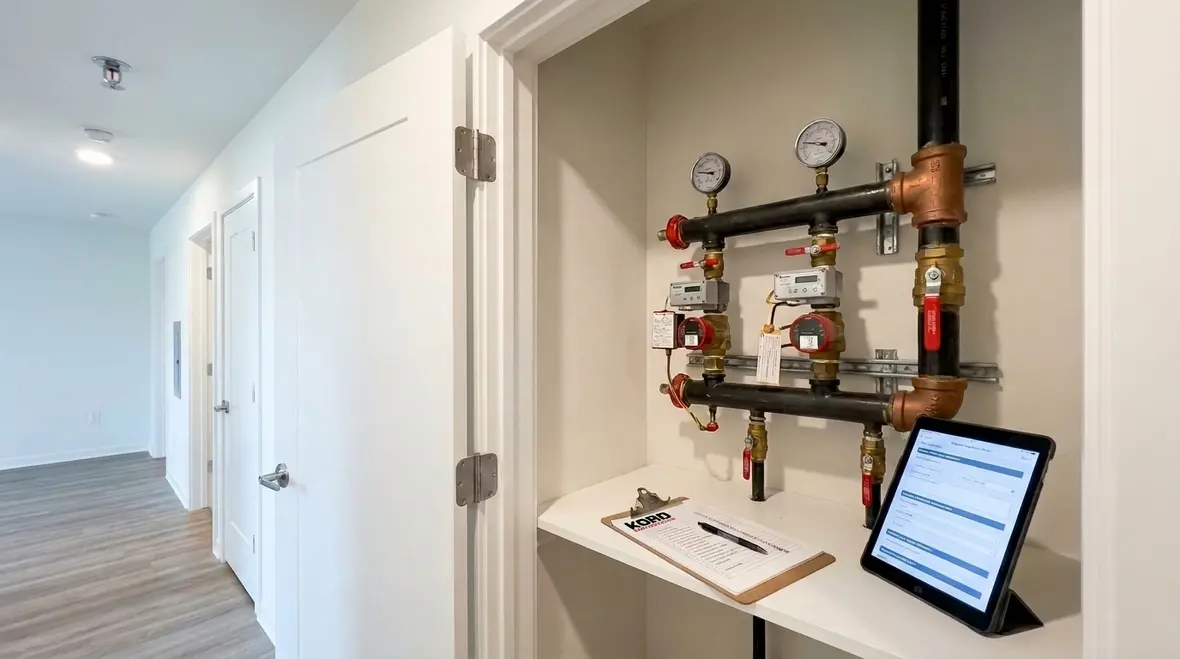
NFPA 13R 11.3 Care and Maintenance: Where NFPA 25 Applies to Residential Systems
Quick Answer: NFPA 13R 11.3 covers care and maintenance duties for residential fire sprinkler systems and explicitly directs users to NFPA 25 for inspection, testing, and maintenance requirements in defined circumstances. The result is a hybrid compliance framework that standardizes ongoing verification while preserving NFPA 13R scope limits.
For commercial, industrial, and retail facilities that operate residential style properties, mixed occupancies, or condominium housing, maintenance obligations frequently cause confusion. NFPA 13R provides the installation basis for residential sprinkler systems, while NFPA 25 governs many of the ongoing inspection and testing activities that verify those systems remain capable of performing as designed.
When teams treat NFPA 13R installation requirements as a one time task, they typically discover gaps during audit, insurance review, or operational risk assessments. This article explains how NFPA 13R 11.3 interfaces with NFPA 25, what that means for practical inspection testing maintenance, and where field failures usually occur.
If your team is building a stronger ongoing program, Kord Fire Protection’s ITM fire protection inspection testing maintenance service is a natural next step for turning code language into a real inspection workflow.
What NFPA 13R 11.3 is actually trying to prevent
NFPA 13R 11.3 addresses care and maintenance so systems do not degrade after installation. In practice, degradation is common and usually stems from conditions that do not show up during acceptance testing. Examples include blocked flow paths, partially closed control valves, tampered or painted sprinkler heads, corrosion inside piping, and control equipment that has not been exercised.
NFPA 13R 11.3 aligns the responsible parties on expectations: the system must remain in service, and scheduled oversight must occur. The standard does not intend for building owners, property managers, or maintenance contractors to improvise a program. Instead, it points to the detailed inspection testing maintenance framework found in NFPA 25 when specific triggers or system components fall under that scope.
For compliance managers, this is a critical distinction. NFPA 13R 11.3 establishes the care and maintenance obligation and identifies when NFPA 25 governs the operational verification details. That means your program should not be a generic checklist. It should be built from the NFPA 25 inspection testing maintenance frequencies and procedures that match the system configuration you installed.
Where NFPA 25 applies under NFPA 13R 11.3
The key compliance concept is that NFPA 13R 11.3 does not replace NFPA 25. It directs the user to NFPA 25 requirements for inspection testing maintenance NFPA 25 activities that are applicable to the system. In other words, the residential installation standard sets the initial design and acceptance expectations, while the sprinkler maintenance standard establishes how to verify performance over time.
In field terms, this interface usually matters for four areas:
- Valve and water control equipment verification: Control valves, check valves, and alarm connections must be checked and exercised according to NFPA 25 schedules and procedures.
- Water flow and delivery confirmation: Where required by the system configuration, flow tests and functional checks help confirm that water delivery remains within design intent.
- Sprinkler and obstruction condition monitoring: Visual inspection and proper handling of damaged, obstructed, or modified sprinklers aligns with NFPA 25 inspection guidance.
- Documentation and impairment management: Maintenance records, impairment notices, and return to service requirements must support audit readiness.
Commercial facility teams often run into friction because their standard operating procedure is written around NFPA 25 only, while the property uses NFPA 13R for initial installation. A combined approach is required: use NFPA 13R 11.3 as the compliance anchor for care and maintenance duties, then implement the inspection testing maintenance NFPA 25 procedures for the specific equipment and system types present.
How the inspection program should be built in mixed-use facilities
Commercial, industrial, and retail facilities frequently manage portfolios that include residential style occupancies, apartment buildings, or condominium common areas. That creates a risk that one maintenance program is used for everything without verifying which standard applies to which system.
To reduce compliance gaps, the maintenance plan should be built using a system inventory approach:
- Identify system standard and design basis: Confirm whether the installed sprinkler system follows NFPA 13R and what design features were used. For installation context and baseline understanding, teams often start with an overview such as NFPA 13 overview for automatic sprinkler system installation, then map the differences that apply to NFPA 13R systems.
- Map equipment to NFPA 25 inspection categories: Determine what control valves, alarm devices, drain assemblies, pressure switches, and ancillary components exist. NFPA 25 schedules depend on what equipment is installed.
- Define the operational testing pathway: Some testing activities require coordinated access, utilities coordination, or controlled water flow. A site specific plan avoids surprises during peak operations.
- Set impairment and documentation rules: Written procedures should specify how impairments are documented, how hot work or construction activity is coordinated, and how return to service is verified.
- Assign inspection and acceptance responsibilities: Clarify who checks visibility, who performs operational tests, and who approves the system back into service.
This is where Kord Fire Protection typically adds value. Commercial facilities benefit from a structured maintenance program that converts code requirements into repeatable field workflows, aligns with facility standards, and keeps documentation audit ready across multiple buildings and occupancy types.
For additional technical background on fire pump and system reliability concepts that often intersect with maintenance planning, review resources hosted at Fire Pumps acceptance testing guidance.
Operational mechanisms that fail even when installation passed
Why do systems that passed inspection at commissioning later fail audits? The most common reasons are practical and mechanical, not theoretical. NFPA 13R 11.3 requires care and maintenance, and NFPA 25 provides the verification details that catch these issues.
1) Control valves drift out of position
Valve handles get repositioned during maintenance, tenant work, or mechanical upgrades. Valves also remain closed after draining operations without proper reset. NFPA 25 oriented inspections focus on identifying the correct valve status and ensuring equipment remains capable of initiating alarm and water delivery.
2) Sprinklers become obstructed or visually compromised
Obstructions can be introduced by storage shelves, renovations, ceiling tile changes, or temporary construction materials. Even minor modifications can alter the sprinkler deflector spray pattern or delay activation. Maintenance programs should include consistent visual verification tied to NFPA 25 inspection requirements for obstructions and sprinkler condition.
3) Internal corrosion and scale degrade flow performance
Water quality issues, long stand time, and limited exercise can lead to scale formation or corrosion that impacts flow. This failure mode is common where systems have water stagnation or where maintenance schedules are inconsistent. Functional and flow related verification aligned to NFPA 25 helps identify the issue before it becomes an operational failure.
4) Alarm and supervisory circuits lose reliability
Alarm devices can be connected incorrectly during remodel work, or sensors can fail silently. A robust inspection program includes testing that verifies supervisory signals and alarm circuit integrity as applicable to the system configuration.
Residential style systems do not always trigger the same expectations as high rise or warehouse systems, but the physics of failure do not care about the building category. The best approach combines care obligations in NFPA 13R 11.3 with NFPA 25 inspection testing maintenance NFPA 25 procedures matched to the actual components installed.
Compliance challenges that show up during audits and insurance reviews
Organizations typically lose points in three areas: incomplete documentation, inconsistent frequency execution, and unclear responsibility boundaries.
- Documentation mismatch: Reports describe “inspections” without stating which NFPA 25 procedures were performed and what outcomes were observed.
- Frequency drift: Teams perform checks annually even when NFPA 25 requires different periodicity for specific tasks.
- Return to service gaps: After testing or shutdown, systems get restored without verification that the system is fully returned to its normal operating condition.
- Tenant and contractor coordination: Work in residential units can introduce obstructions or modifications. Without coordination workflows, maintenance teams discover problems too late.
- Mixed standards confusion: Facilities mistakenly assume NFPA 13R alone defines all ongoing requirements. The audit outcome then reflects only partial adherence.
To prevent this, maintenance programs should explicitly reference the inspection testing maintenance NFPA 25 framework as the procedure source, while using NFPA 13R 11.3 as the compliance anchor for care and maintenance responsibilities. Kord Fire Protection supports this by translating code intent into consistent field practices and maintainable records that stand up to review.
For teams managing broader sprinkler design concepts, the Kord Fire Protection resources at kordfire.com can help standardize understanding across engineering, operations, and maintenance stakeholders. International support is also available through kordfire.com.au and related Kord platforms, depending on regional program structures.
Frequently Asked Questions
Conclusion and Call to Action
Compliance succeeds when teams connect NFPA 13R 11.3 care and maintenance duties to the detailed inspection testing maintenance NFPA 25 requirements that match the installed equipment. Kord Fire Protection helps commercial facilities build a defensible maintenance program, execute NFPA aligned testing, and maintain audit ready records across residential and mixed occupancy portfolios.
Contact Kord Fire Protection to review your current program, confirm NFPA 13R 11.3 and NFPA 25 applicability, and schedule the next inspection testing maintenance cycle with clear documentation and controlled return to service.

Join Our Newsletter!
Get the latest fire safety tips delivered straight to your inbox From our Newsletter.



