
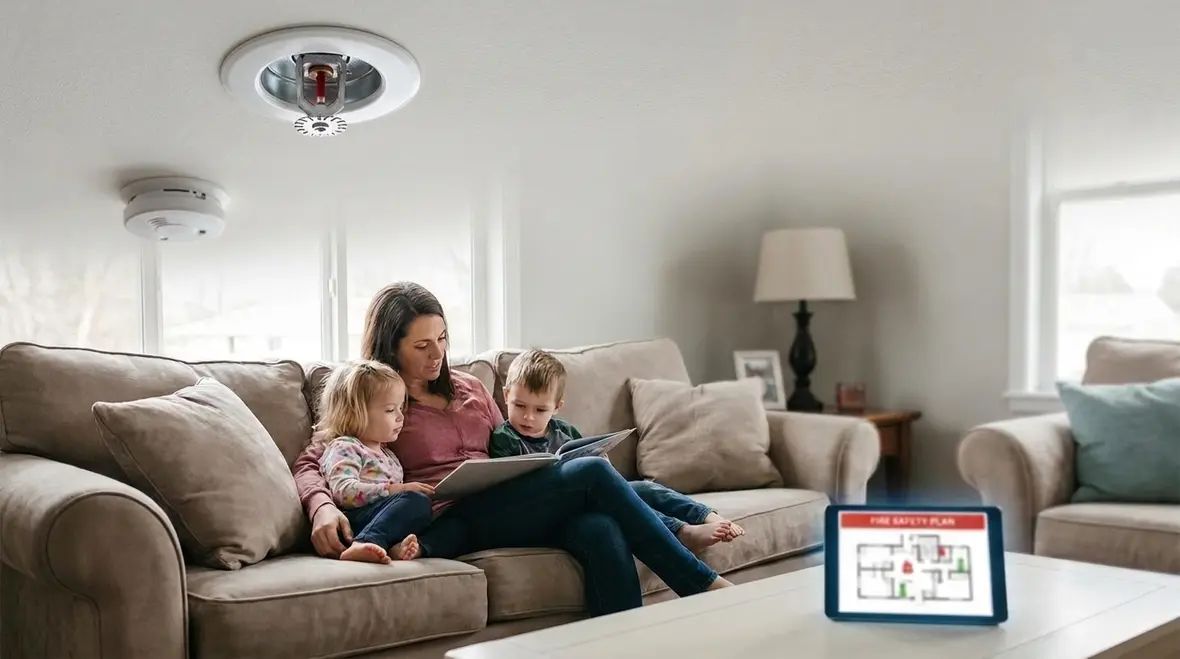
NFPA 13D Section 1.2: Life Safety Purpose Behind Residential Sprinkler Standards
Quick Answer: NFPA 13D Section 1.2 establishes that residential sprinklers exist primarily for life safety, not property protection. The standard aims to control fire growth long enough for occupants to escape and for firefighters to arrive with improved conditions.
Facilities looking to connect that life safety intent with ongoing system readiness can also review Kord Fire Protection’s inspection, testing, and maintenance services for practical support around sprinkler reliability, documentation, and compliance.
Why NFPA 13D Section 1.2 matters to real-world life safety
The NFPA 13D Section 1.2 residential sprinkler system life safety purpose sets the design intent for residential fire sprinkler systems. Unlike codes that focus mainly on minimizing damage costs, Section 1.2 directs attention to how sprinklers perform during the first minutes of a fire. That period determines whether occupants can self-evacuate and whether fire service actions start under survivable conditions.
In practice, that life safety intent drives system choices that affect water delivery timing, coverage effectiveness, and reliability. Even for facilities that are not strictly “residential,” commercial facility operators often adopt similar thinking for smaller occupancies, mixed use buildings, and tenant fit-outs where early control of fire growth can reduce both injuries and escalation risks.
What “life safety purpose” means in sprinkler design terms
NFPA 13D Section 1.2 frames sprinkler systems as an intervention that supports escape and reduces fire severity. That intent translates into operational expectations:
- Control, not necessarily extinguishment: The system helps limit heat release and flame spread so evacuation routes stay tenable longer.
- Earlier activation is critical: Sprinklers must activate quickly enough at the seat of fire to interrupt fire growth.
- Coverage aligned to hazard behavior: Layout and spacing aim to place water application where it can meaningfully reduce temperature and smoke conditions.
- Reliability under typical service conditions: Components must function when called upon without relying on occupants to take corrective action.
For technicians and compliance teams, “life safety” also affects how they evaluate system effectiveness during inspection and maintenance. Waterflow and alarm related impairments cannot be treated as minor if they reduce the probability of timely sprinkler operation.
How the life safety intent impacts installation details and inspection outcomes
Section 1.2 influences the practical realities of installation quality and ongoing readiness. Fire protection professionals often see that the biggest compliance gaps arise from workmanship issues that reduce the probability of correct discharge at the critical moment.
1) Hydraulic performance affects time to fire control
Residential sprinkler systems commonly use specific design densities and pressures. If installation results in unexpected friction losses, partially blocked piping, or improperly sized components, the system may deliver insufficient flow at the sprinkler location. That undermines the life safety purpose by delaying or reducing fire control performance.
Commercial facilities and industrial tenants face the same physics, even when they are operating under a different occupancy framework. Water supply adequacy, pipe condition, and correct calculation assumptions remain central to whether the system supports evacuation.
2) Correct sprinkler selection and placement drive activation accuracy
Sprinklers must match the intended environment and the manufacturer’s listed parameters. Common failure points include:
- Using the wrong temperature rating or sprinkler type for the thermal conditions.
- Improper alignment due to ceiling interference or incorrect mounting practices.
- Damage during installation that affects deflector orientation and glass bulb integrity.
In mixed use commercial properties, these issues are often discovered during impairment reviews, after tenant works, or following ceiling changes. The life safety purpose requires that change control processes treat sprinkler system components as mission critical.
3) Valves, pressure switches, and detection components must support system function
Even when sprinklers are properly installed, the system must remain operable. Inspectors and maintenance personnel focus on readiness items such as valve position, control valve supervision where applicable, and ensuring alarms operate as intended.
If a system is isolated for repairs and left in an abnormal state, the life safety intent is compromised. For many facilities, documentation, tag-out control, and post-work verification become as important as the initial installation.
Compliance challenges in commercial, industrial, and retail settings
Although NFPA 13D targets residential occupancies, the same life safety reasoning influences how commercial facility teams evaluate smaller residential style spaces, adjunct buildings, and retrofit work. The real challenge often involves operational continuity rather than the initial design.
- Tenant turnover and ceiling modifications: Work in drop ceilings or soffits can move obstructions, change heat dynamics, or compromise sprinkler clearance.
- Interference and storage loading: Storage can intrude into sprinkler discharge patterns. Even minor obstructions can reduce effectiveness at the time evacuation depends on tenable conditions.
- Water supply changes: Building modifications and temporary shutdowns can affect static pressure and flow demand. Life safety performance requires post change verification.
- Maintenance scheduling gaps: Systems that sit idle between inspections risk accumulation of impairments that are not identified until the next cycle.
Because commercial owners need predictable compliance outcomes, ongoing testing and maintenance support are essential. Kord Fire Protection provides practical assurance through service planning, documentation, and readiness checks that align with life safety priorities.
For a broader installation context, review this guide: NFPA 13 overview for automatic fire sprinkler system installation. It helps teams connect residential life safety intent to common sprinkler system installation principles used across occupancies.
Operational procedures that protect the life safety purpose over time
Maintaining the life safety intent of NFPA 13D Section 1.2 requires operational discipline. The system must work in the way it was designed, at the time it is most needed.
Inspection and testing practices that matter
Practical compliance typically includes visual checks, confirmation of valve positions, and monitoring the system’s ability to generate the required alarm and water delivery indicators. After any work that touches piping, ceilings, or water supply interfaces, a verification step should occur before the area resumes normal operations.
Common failure points to watch during field reviews
Service teams often find these issues during routine rounds:
- Corroded fittings, sediment in piping, or partially obstructed lines affecting flow.
- Paint, drywall compound, or storage materials that cover sprinkler components or change spacing.
- Incorrect reinstallation after maintenance where sprinkler orientation or clearance is not restored.
- Improper alarm or supervisory signaling response due to disconnected or disabled components.
Why maintenance records influence compliance decisions
When a facility must demonstrate readiness, history matters. Detailed service documentation shortens troubleshooting, reduces rework, and supports faster return to compliance after impairments. A consistent maintenance program also improves the probability that life safety systems remain in service without interruption.
For industry background on fire pumps and water supply reliability, see this guide on fire pump test failures and water supply reliability. Water supply performance is one of the most common contributors to reduced sprinkler effectiveness.
Best practice takeaway: treat life safety as the performance benchmark
NFPA 13D Section 1.2 residential sprinkler system life safety purpose is not a theoretical statement. It defines what the system must achieve when fire starts: provide a workable time window for occupant evacuation and limit fire growth. That is why installers must follow listed configurations, and why facility managers must maintain the system’s readiness between inspections.
For commercial owners, the best operational posture is to integrate change control, post-work verification, and disciplined impairment management. Kord Fire Protection supports that approach by providing ongoing compliance, testing, and maintenance services focused on reliable system performance.
Frequently Asked Questions
Call to action
For life safety compliance and reliable sprinkler performance, schedule a documented inspection and maintenance review with Kord Fire Protection. Ensure system readiness, confirm protection remains aligned with installation intent, and address impairments before they compromise evacuation support. Take control of inspections, testing, and post-work verification now, so your sprinkler system performs as designed when the fire starts.

Join Our Newsletter!
Get the latest fire safety tips delivered straight to your inbox From our Newsletter.



