High Rise Fire Alarm Communication Protocols by Kord
High rise fire alarm systems rely on high rise fire alarm communication to move critical signals fast, so people and equipment get what they need the moment smoke or heat shows up. In practice, that means the system uses clear rules, reliable paths, and tight supervision across floors, risers, and control cabinets. And yes, it must work even when the building is busy, crowded, and doing its best impression of “anything but calm.”
That is where Kord Fire Protection technicians step in. They explain how communication protocols guide signals between devices and panels, so the system behaves the same way on a Tuesday afternoon as it does during a power event at 3 a.m. In other words, the network stays disciplined, not dramatic. Building owners who want broader background on the company behind that approach can also visit About Kord Fire Protection.
How fire alarm communication moves through tall buildings
In a high rise, the fire alarm system does not just “talk.” It follows a set of rules for how devices send, receive, and confirm messages. First, it maps zones and floors so the control panel knows where a signal started. Then it routes those messages through specific wiring and device types. Finally, it monitors the path so trouble shows up early.
Normally, the system uses a mix of control panel logic, initiating device circuits, and notification circuits. However, when people say “communication,” they often mean the protocol layer that controls message format, timing, and supervision. As Kord Fire Protection technicians explain during site visits, these protocols reduce confusion like an airport announcer who never forgets gate numbers.
Because tall buildings add distance and noise, the system must also handle signal loss and fault conditions. Therefore, protocols include checks that detect open circuits, short circuits, and ground faults, and they report them in a way that operators can act on right away. That same logic is part of why consistent fire alarm inspection and testing for commercial buildings matters so much. A protocol can be beautifully designed, but if nobody verifies how it performs in the real world, the system becomes a little too confident for comfort.
Why communication discipline matters in a high rise
A smaller building may tolerate a little inefficiency without anyone noticing right away. A high rise usually does not. The system has more floors, more devices, more cable length, more interfaces, and far more chances for one vague signal to create a giant headache. Clear communication rules help the panel know what happened, where it happened, and whether the condition is an alarm, trouble, or supervisory event. That distinction is not just technical trivia. It shapes the next move for operators, maintenance staff, and emergency responders.
Common protocol choices for high rise fire alarm systems
Most systems fall into a few protocol categories that govern how devices communicate with the panel. Some buildings use conventional signaling, where each circuit behaves like a supervised path. Other buildings use addressable signaling, where devices carry unique identities and report detailed information.
As a rule, addressable systems offer more granularity. For example, instead of only saying “alarm on floor 12,” the system can often identify the device or subzone. That matters because emergency teams plan actions based on location and event type. Meanwhile, conventional systems still work well in many setups, especially where device density and complexity remain moderate.
Kord Fire Protection technicians often stress that the “best” protocol is the one that fits the building plan, code requirements, and the expected maintenance workflow. In fact, a highly complex protocol in a simple building can become like putting a sports car engine into a bicycle. It runs, but it does not always help.
Choosing between detail and simplicity
Addressable systems earn a lot of attention because they provide specific device data, cleaner troubleshooting, and easier event tracking across large buildings. Conventional systems, however, still have a place where layouts are straightforward and the operational goals are modest. The real question is not which option sounds fancier. The real question is which one supports reliable maintenance, clear event reporting, and efficient response over the long haul. Fancy for fancy’s sake is a bad design strategy and a worse personality trait.
Wiring supervision and what the panel must verify
A communication protocol becomes useful only when the system can trust what it receives. For that reason, high rise fire alarm communication relies on supervision methods that watch the integrity of circuits and connections. The control panel continuously checks that wiring remains intact and that devices respond as expected.
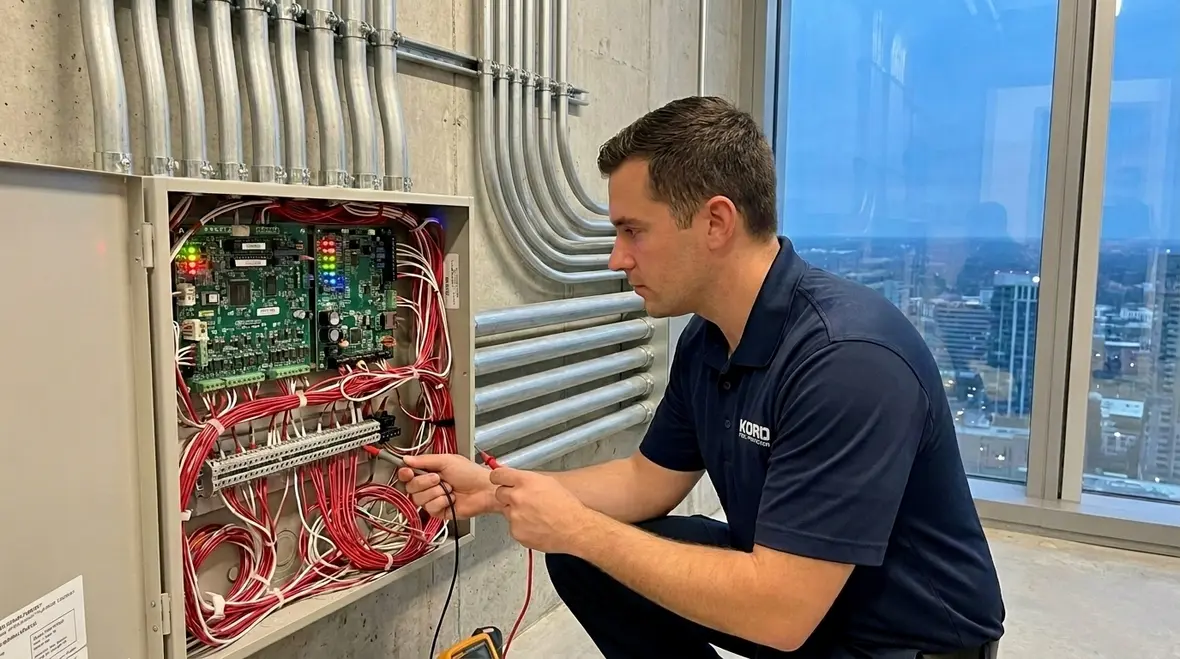
Typical supervision targets include the presence of proper circuit resistance ranges, correct device responses, and consistent signal levels. If a circuit opens, shorts, or drifts out of tolerance, the panel logs a trouble condition. Then it sends that trouble through the building interface, such as a building management system link or remote annunciation.
To make this practical, technicians also consider how installers label and route wiring. So even when the protocol behaves perfectly, a sloppy route can create nuisance faults. Kord Fire Protection technicians therefore teach that clean wiring practices help the protocol do its job, and they prevent troubleshooting headaches later. This is also where topics like battery health and system readiness intersect with signaling performance, which pairs naturally with Kord’s article on fire alarm system reliability and battery health.
How loops, risers, and floor zones stay coordinated
In high rise buildings, the physical layout drives the logical communication design. The system uses loops or circuit groups that match the building structure. Risers carry signals between levels, while floor zones organize initiating and notification devices into manageable sections.
Then the protocol assigns message timing so devices do not “talk over” each other. It also handles device addressing so the panel can interpret which device triggered the event. As the building grows, the system must scale without losing speed. Otherwise, alarms may arrive late, and that defeats the entire purpose.
When Kord Fire Protection technicians explain this to facility managers, they often compare it to a well run meeting. If everyone speaks at random, nobody understands the message. But if the rules set who speaks, when they speak, and how confirmation works, the system stays calm under pressure.
In addition, high rise fire alarm communication must account for device spacing and wiring limits. The protocol timing and electrical characteristics must match the cable type, length, and number of devices per section. That is why expansion planning matters. A building that starts with one arrangement can evolve floor by floor, tenant by tenant, and remodel by remodel. If the communication structure does not scale thoughtfully, the system may eventually feel like it is juggling chainsaws in dress shoes.
Remote signaling, interfaces, and event reporting
Fire events rarely stop at the fire alarm panel. Therefore, high rise systems must report alarms, troubles, and supervisory signals to remote locations. These can include fire command centers, monitoring services, elevators interfaces, damper controls, and building management platforms.
The communication protocol defines how the panel formats event information. It also controls how the system distinguishes alarm from supervisory events. In real operations, that difference changes response steps. For example, an alarm may require evacuation actions, while supervision may require corrective maintenance without full building evacuation.
Kord Fire Protection technicians help teams set up interfaces so the message arrives with the right priority and without confusion. In practical terms, that means mapping device types to event categories and verifying point labeling. Otherwise, the screen might show something like “mystery trouble,” which is fun for nobody in an emergency. And no, the building cannot be told to “figure it out later.”
They also test how the system handles simultaneous events, such as a trouble report arriving while an alarm triggers on another floor. Good protocols prevent message conflicts and help operators understand what happened first. For facilities that want a more service focused overview, Kord’s Fire Alarm Services page gives a useful snapshot of the types of systems and support options available.
What good event reporting looks like
A well configured system does more than scream for attention. It reports information in a way humans can actually use. The panel should show the right floor, the right point, and the right event type with consistent naming. Monitoring pathways should pass the information without mangling it into vague nonsense. In an emergency, clarity saves time. In maintenance, clarity saves sanity. Both are excellent goals.
Installation practices that keep protocols reliable
Even the best protocol cannot overcome bad installation. That is why high rise fire alarm communication depends on careful workmanship. Technicians manage cable routing, separation from noisy power sources, and termination quality. They also confirm device wiring polarity, addressing, and circuit continuity.
Because tall buildings include many trades, coordination matters. When electrical contractors run power circuits near signal wiring, the system can pick up interference. Consequently, installers need to follow separation guidelines and keep splices controlled. If the system uses supervised loops, every splice and connection can affect signal quality.
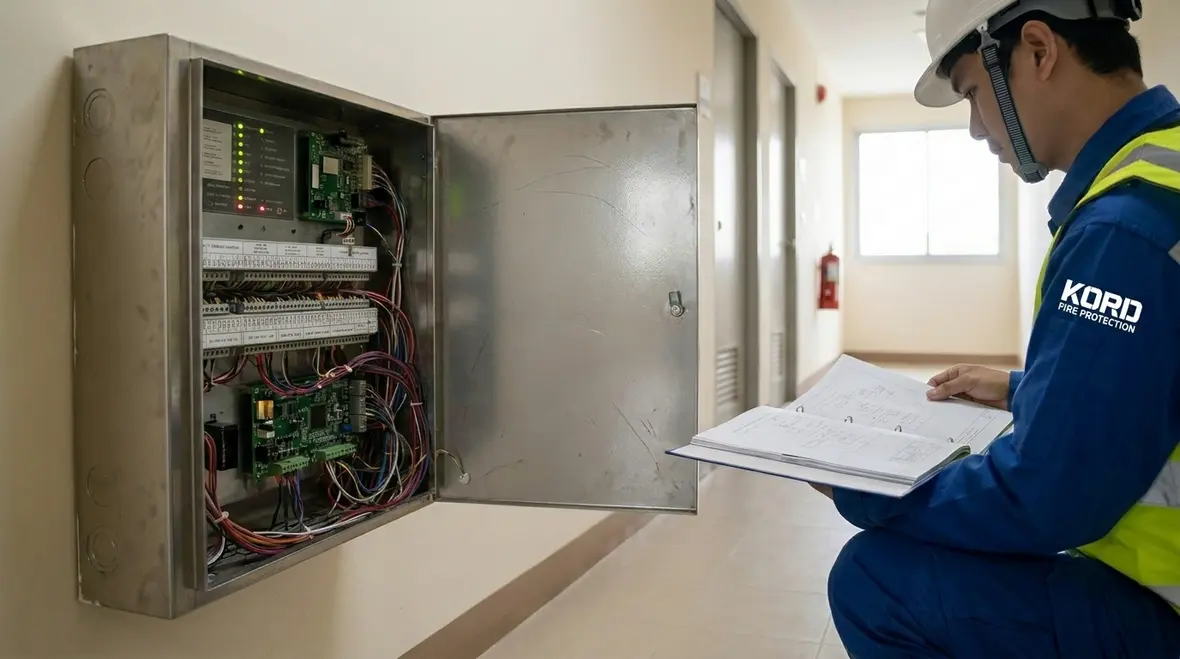
Kord Fire Protection technicians also recommend disciplined documentation. After installation, they verify that software programming matches the as built drawings. Then they run acceptance tests and functional checks, including alarm initiation and notification behavior.
To keep the process clear, technicians often use a two column checklist during commissioning to tie observations to required actions. It is simple, practical, and much more helpful than hoping everyone remembers every detail while standing in a loud equipment room with three radios going at once.
FAQ about communication protocols for high rise fire alarm systems
Call Kord Fire Protection for dependable protocol design and testing
High rise fire alarm systems demand communication that stays steady when conditions get rough. Kord Fire Protection technicians can review your building layout, confirm the right protocol approach, and guide installation and programming so high rise fire alarm communication performs as designed. Then they test and document alarm, trouble, and remote reporting, so your team does not chase ghosts during an emergency.
If your system is due for upgrades, expansion, or inspection support, contact Kord Fire Protection today and get clear next steps. For teams looking for a direct service path, visit Full Fire Protection Services to explore support options for high rise properties, commercial buildings, and ongoing compliance work.

Join Our Newsletter!
Get the latest fire safety tips delivered straight to your inbox From our Newsletter.