Fire Extinguisher Placement for Restaurants Guide
Fire extinguisher placement for restaurants is not just about checking a box on a safety inspection form. It is about protecting guests enjoying a quiet dinner, chefs moving at full speed, and owners who have poured their life savings into a dream. Within the first few minutes of a fire, the right extinguisher in the right place can mean the difference between a minor incident and a headline on the evening news. Therefore, understanding where extinguishers belong in both front of house and back of house areas is essential. As Kord Fire Protection technicians often explain, placement is not random. It is strategic, calculated, and built around how restaurants actually function.
Now, let us take a steady walk through the dining room, behind the swinging kitchen doors, and into the practical decisions that keep flames in check.
Understanding Fire Extinguisher Placement for Restaurants
Every restaurant has two distinct worlds. First, the front of house where ambiance reigns and guests sip sparkling water as if they are royalty. Second, the back of house where flames leap, pans sizzle, and the pace would make a Formula One pit crew nervous. Because these areas serve different purposes, they require different fire protection strategies.
Fire extinguisher placement for restaurants must follow local codes, national standards, and common sense. However, codes only set the minimum. Smart operators go beyond that. Kord Fire Protection technicians frequently remind owners that extinguishers must be visible, accessible, and appropriate for the hazards present. In other words, a water based extinguisher next to a deep fryer is about as useful as a chocolate teapot.
Additionally, travel distance matters. Staff should never have to run a marathon to reach an extinguisher. Most regulations limit how far someone can travel to access one, depending on the type of hazard. Therefore, placement should reflect both square footage and workflow. For deeper background on travel distance and mounting height, many owners also review NFPA 10 portable extinguisher guidelines from Kord Fire’s resource library, such as the article on NFPA 10 placement standards and travel distance limits.

Front of House: Protecting Guests Without Disrupting Ambiance
The dining area, bar, waiting lounge, and entryway form the public face of the restaurant. Although these spaces do not carry the same fire load as the kitchen, they still present risks. Electrical equipment, decorative lighting, candles, and overloaded outlets can all spark trouble.
Therefore, front of house extinguisher placement must balance safety with aesthetics. No guest wants to stare at a bright red cylinder while enjoying a candlelit anniversary dinner. Yet hiding it behind a locked cabinet defeats the purpose.
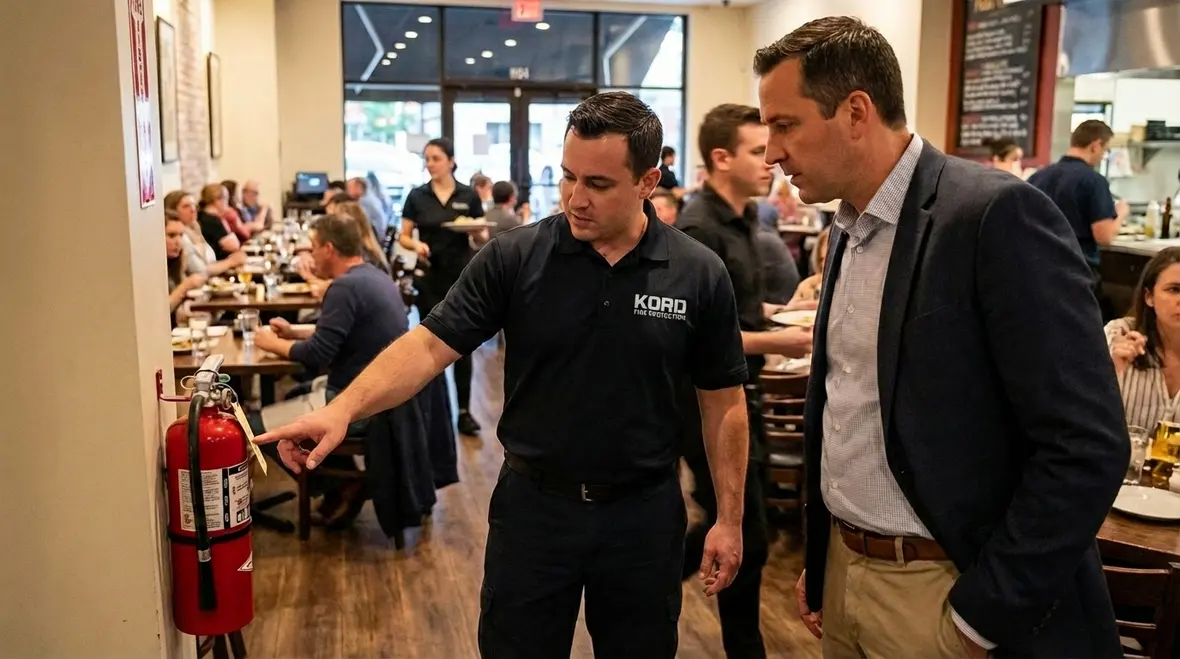
Kord Fire Protection technicians often recommend mounting extinguishers along exit paths. This approach accomplishes two goals. First, staff and guests can access the unit while moving toward safety. Second, the extinguisher remains visible without dominating the room’s design.
In bars, placement near electrical panels and behind the counter is common. However, it must not block walkways or interfere with service. Additionally, staff should know its exact location. A calm bartender reaching confidently for an extinguisher is reassuring. A frantic search is not.
Moreover, restaurants with live music or entertainment should consider additional coverage near sound and lighting equipment. While the vibe might feel like a small concert, the fire risk is very real. As one technician joked, “We love a good guitar solo. We just prefer it without sparks.”
Back of House: High Heat, High Risk, Higher Standards
Step through the kitchen doors and the risk level changes instantly. Open flames, hot oils, gas lines, and heavy electrical loads create a perfect storm. Consequently, fire extinguisher placement for restaurants becomes more technical in this zone.
Class K extinguishers are essential near commercial cooking equipment that uses oils and fats. These units are specifically designed to handle grease fires. Using the wrong extinguisher on a grease fire can spread flames rapidly. It is the culinary equivalent of adding gasoline to a campfire and hoping for the best.
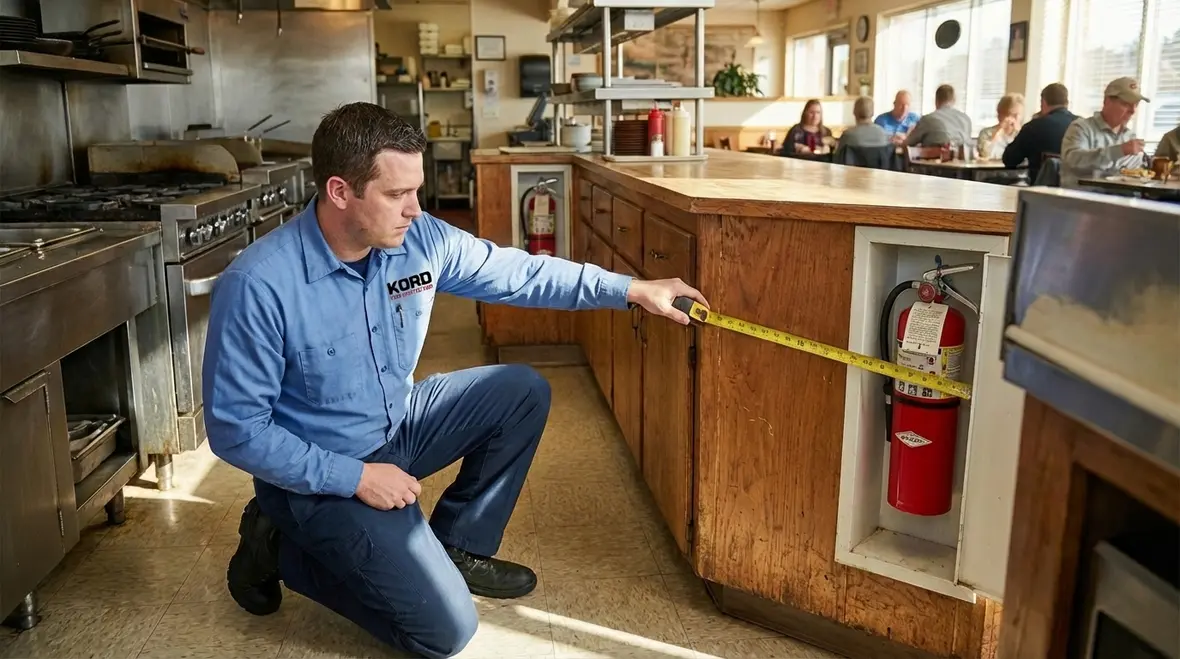
Extinguishers should be mounted within a short distance of cooking lines, but not so close that staff must reach through flames to grab one. Kord Fire Protection technicians emphasize this point during on site walkthroughs. The unit must be accessible without placing the user in immediate danger.
Furthermore, additional extinguishers may be required near dishwashing stations, storage rooms, and areas with electrical panels. Because kitchens often contain tight corridors, placement must account for clear egress paths. No one should trip over safety equipment while trying to escape an emergency.
Side by Side Comparison: Front of House vs Back of House
Front of House
- Focus on guest safety and quick evacuation
- Common hazards include electrical wiring and decor
- Typically use ABC extinguishers
- Mounted along exits and visible walls
- Must blend with interior design
Back of House
- Focus on cooking related fire risks
- Common hazards include grease and open flames
- Require Class K near fryers and ranges
- Placed within short travel distance of equipment
- Must avoid obstructing workflow
While both areas require careful planning, the kitchen demands tighter control and more specialized equipment. Nevertheless, neither space should be overlooked.
How Many Extinguishers Does a Restaurant Actually Need?
This is the question many owners type into search engines late at night. The answer depends on square footage, layout, and hazard classification. However, there are guiding principles.
First, building codes often specify maximum travel distances. For example, an ABC extinguisher might need to be accessible within a certain number of feet in ordinary hazard areas. Kitchens with grease producing equipment require Class K units in addition to other types. Kord Fire’s overview on proper fire extinguisher placement highlights that NFPA 10 typically limits travel distance to 75 feet for Class A hazards, which many dining areas fall under.
Second, multiple floors require coverage on each level. Additionally, separate rooms with distinct hazards may require their own units. A storage room packed with paper goods is very different from a refrigerated prep area.
Kord Fire Protection technicians conduct site evaluations to map out extinguisher locations. They measure travel paths, assess obstructions, and confirm compliance with local regulations. Rather than guessing, they build a layout that aligns with both safety standards and daily operations.
As a result, owners gain peace of mind. And peace of mind, much like a perfectly plated entrée, is priceless.
Training Staff to Support Proper Placement
Even perfect fire extinguisher placement for restaurants means little if staff do not know how to respond. Therefore, training is just as important as mounting brackets.
Employees should understand the PASS method. Pull the pin. Aim at the base of the fire. Squeeze the handle. Sweep side to side. Although it sounds simple, practice builds confidence. In a real emergency, muscle memory matters.
Moreover, staff should know which extinguisher to use for which type of fire. Grabbing the nearest unit without checking its rating can cause serious harm. Kord Fire Protection technicians often provide hands on demonstrations, explaining the differences between ABC and Class K units in clear, practical language.
Additionally, management should assign responsibility for routine visual inspections. Extinguishers must remain unobstructed, properly charged, and free from damage. A decorative plant placed in front of a unit might look charming, but during a fire it becomes a regrettable design choice. To stay ahead of inspections, some owners review Kord Fire’s guide on how often extinguishers need to be serviced, which reinforces the importance of monthly checks and annual professional maintenance.
Common Mistakes in Restaurant Fire Safety Layouts
Restaurants sometimes treat extinguisher placement as an afterthought. However, small oversights can create large vulnerabilities.
One frequent mistake involves installing extinguishers too close to cooking equipment. While proximity is important, extreme heat can make access impossible. Instead, units should be positioned along a clear path of retreat.
Another issue is poor visibility. Extinguishers hidden behind doors or stacked boxes fail their basic purpose. Clear signage and proper mounting height ensure they remain easy to spot.
Additionally, some establishments rely solely on hood suppression systems. Although these systems are critical, they do not replace portable extinguishers. Fires can start in trash bins, storage areas, or electrical panels far from the hood. Therefore, a comprehensive approach is essential.
Kord Fire Protection technicians often compare fire safety to a well rehearsed orchestra. Each component has a role. When one instrument is missing, the performance suffers. In this case, the stakes are far higher than a missed musical note.
Working With Professionals to Get It Right
Because regulations change and every building differs, professional guidance makes a difference. Fire extinguisher placement for restaurants should reflect not only code compliance but real world use.
Kord Fire Protection technicians walk through properties with owners and managers, pointing out both obvious and subtle risks. They consider door swings, equipment relocation, seasonal patio expansions, and storage habits. For instance, if a patio adds heaters during colder months, extinguisher coverage may need adjustment.
Furthermore, technicians document placements and schedule regular maintenance. Annual servicing, recharge requirements, and hydrostatic testing all factor into long term safety. Rather than scrambling before inspections, restaurants stay ahead of the curve by partnering with a full service provider that can handle everything from walk in inspections to hydrostatic testing and training.
In a business where margins can be thin, avoiding fire damage protects revenue, reputation, and jobs. That reality makes professional planning not just smart, but essential.
FAQ: Quick Answers for Restaurant Owners
Conclusion: Build Safety Into Every Corner
Restaurants thrive on atmosphere, flavor, and experience. Yet behind every memorable meal should stand a quiet system of protection. Thoughtful extinguisher placement safeguards guests, staff, and investment alike. With guidance from Kord Fire Protection technicians, owners can design layouts that meet code and match real world demands.
Now is the time to review current coverage, correct weak spots, and commit to smarter safety planning before the unexpected tests it. If your California restaurant needs a partner to handle extinguisher layout, maintenance, and restaurant fire suppression, explore Kord Fire’s local county fire protection service pages, such as the San Francisco County or Sacramento County fire protection services, and request help from a team that works in commercial kitchens every day.
Know Your Weapon Before You Fight the Flame
Kord Fire Protection is your go-to when it comes to all things fire protection. For over 20 years, we’ve been serving Southern California with the quality service and equipment to keep your home or business safe at all times. Our competitive prices reflect our unwavering commitment to protecting what matters most in the event of a fire emergency. Give us a call, send an email, or use that form!

Join Our Newsletter!
Get the latest fire safety tips delivered straight to your inbox From our Newsletter.