
Emergency Exit Requirements California vs NFPA
Emergency Exit Requirements are not just lines in a codebook. They are the quiet guardians of every hallway, warehouse, school, and high rise in California. When alarms sound and nerves spike, those rules guide people toward safety with calm precision. Yet many building owners find themselves asking a familiar question. How do California regulations compare with NFPA standards, and which one takes the lead? That is where clarity matters. Kord Fire Protection technicians often explain that understanding the difference is less about memorizing legal text and more about knowing how these systems protect real lives. So let us walk through it, calmly and clearly, with just enough humor to keep things human.
Understanding Emergency Exit Requirements in California Buildings
California takes fire and life safety seriously. Earthquakes, wildfires, and dense cities will do that to a state. As a result, the California Building Code and California Fire Code outline strict emergency egress rules for commercial and residential structures.
At the heart of these regulations sits a simple goal. Every occupant must have a clear, unobstructed path to safety. That includes:
Number of exits
Most buildings require at least two exits. Larger occupant loads demand more. The idea is simple. If one path is blocked, another must stand ready.
Exit width and capacity
Doorways and corridors must support the maximum occupant load. In other words, the exit cannot resemble a concert bottleneck when seconds matter.
Travel distance limits
California codes limit how far someone can travel before reaching an exit. Sprinklered buildings often receive more flexibility, yet the intent remains firm. No one should wander through smoke filled corridors searching for daylight.
Illumination and signage
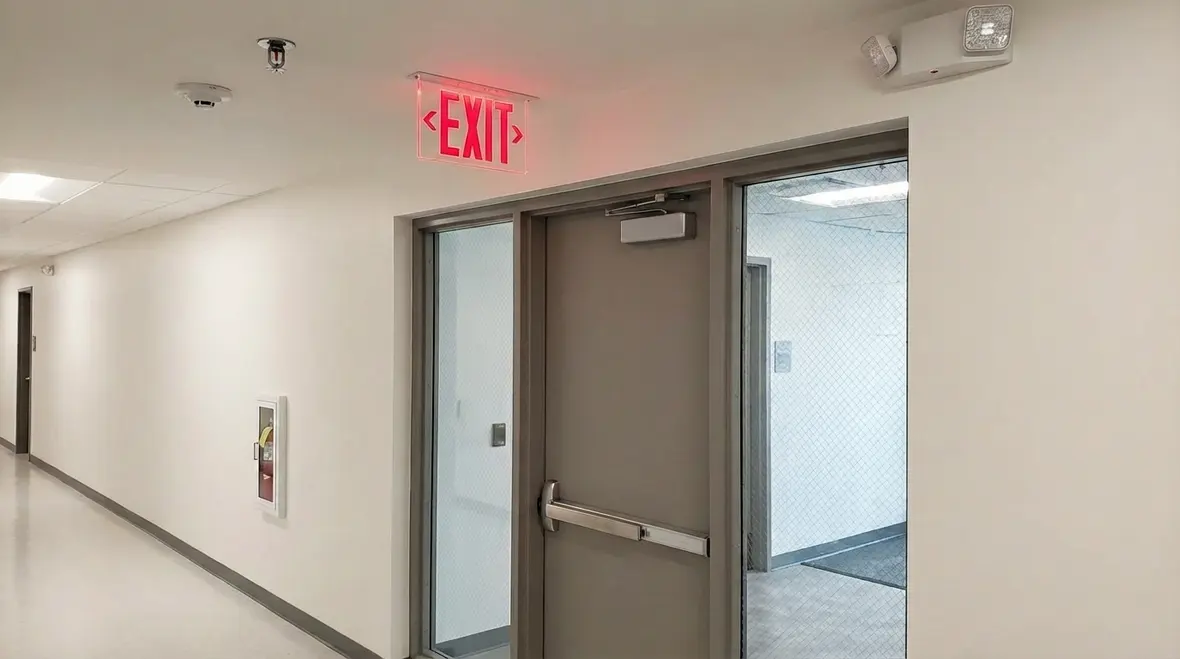
Exit signs must remain visible and illuminated during power loss. Battery backups and emergency lighting systems step in when the grid taps out.
Kord Fire Protection technicians frequently note that building owners underestimate how these elements work together. A compliant door means little if poor lighting hides it during an outage.
How NFPA Approaches Means of Egress
The National Fire Protection Association, or NFPA, develops widely adopted model codes, including NFPA 101 Life Safety Code. While California has its own codes, many provisions mirror or reference NFPA standards.
NFPA focuses heavily on what it calls the means of egress. That phrase covers three parts.
Exit access, exit, and exit discharge
Exit access which leads occupants toward an exit.
The exit itself, separated and protected from fire.
Exit discharge which leads from the exit to a public way.
Fire resistance ratings
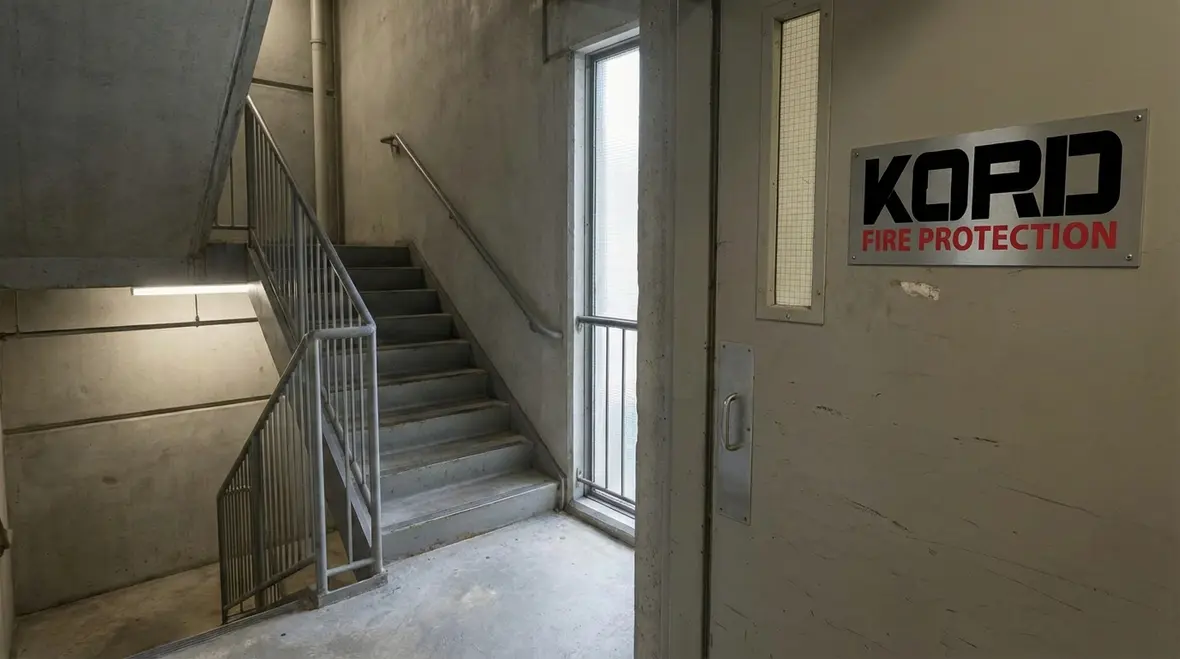
Furthermore, NFPA emphasizes fire resistance ratings for exit enclosures. Stairwells often require one or two hour fire rated construction, depending on building height. That rating ensures the stair remains a safe channel even if flames spread elsewhere.
While California codes align closely with NFPA, the state may amend or expand requirements. Therefore, compliance in another state does not guarantee compliance on the West Coast. As technicians at Kord Fire Protection often explain, assuming codes are identical is like assuming all coffee tastes the same. Technically possible, but rarely true.

California vs NFPA Side by Side
Although both frameworks share a life safety mission, they differ in structure and enforcement. The following comparison highlights practical distinctions.
| California Code | NFPA Standards |
| State adopted and legally enforced | Model codes adopted by states or localities |
| Amended for seismic and wildfire risks | National scope with broader applicability |
| Integrated into California Building and Fire Codes | Published as separate standards such as NFPA 101 |
| Enforced by local authorities having jurisdiction | Enforced when adopted by governing bodies |
| Specific amendments may exceed NFPA baseline | Provides minimum recommended safety benchmarks |
In practice, California often uses NFPA as a foundation, then adjusts it. For example, stairwell pressurization, exterior wall ratings, and high rise evacuation protocols may reflect regional risks.
Therefore, building owners must satisfy the stricter rule when differences arise. Kord Fire Protection technicians regularly remind clients that compliance is not a pick and choose buffet. It is more of a fixed menu. And yes, everyone must eat their vegetables.
What Building Owners Often Ask About Emergency Exit Requirements
Many property managers turn to search engines with practical prompts. They want direct answers, not a law school lecture. Below are common concerns, answered plainly.
How many exits does a commercial building need in California?
Most require at least two remote exits. However, occupant load, layout, and fire protection systems influence the final number.
Can exit doors be locked?
Generally, exit doors must open from the inside without keys or special knowledge. Panic hardware is common in assembly spaces.
Do emergency exits need to be ADA compliant?
Yes. Accessible means of egress must accommodate individuals with mobility challenges. This may include areas of refuge or evacuation elevators.
Are illuminated exit signs mandatory?
Absolutely. Both California and NFPA require visible, illuminated signage with battery backup.
Because codes evolve, Kord Fire Protection technicians encourage routine reviews. A building that passed inspection ten years ago may not meet today’s expectations.
The Role of Inspections and Documentation
Compliance does not end with construction. In fact, it truly begins there. Regular inspections confirm that exit routes remain unobstructed and functional.
For example, storage creeping into corridors remains one of the most common violations. It starts innocently. A few boxes here, a spare cabinet there. Before long, the exit path resembles a warehouse maze. Inspectors do not find that charming.
Additionally, doors must self close and latch properly. Fire rated assemblies lose effectiveness if propped open. While that wedge may feel convenient during deliveries, it defeats the protective design.
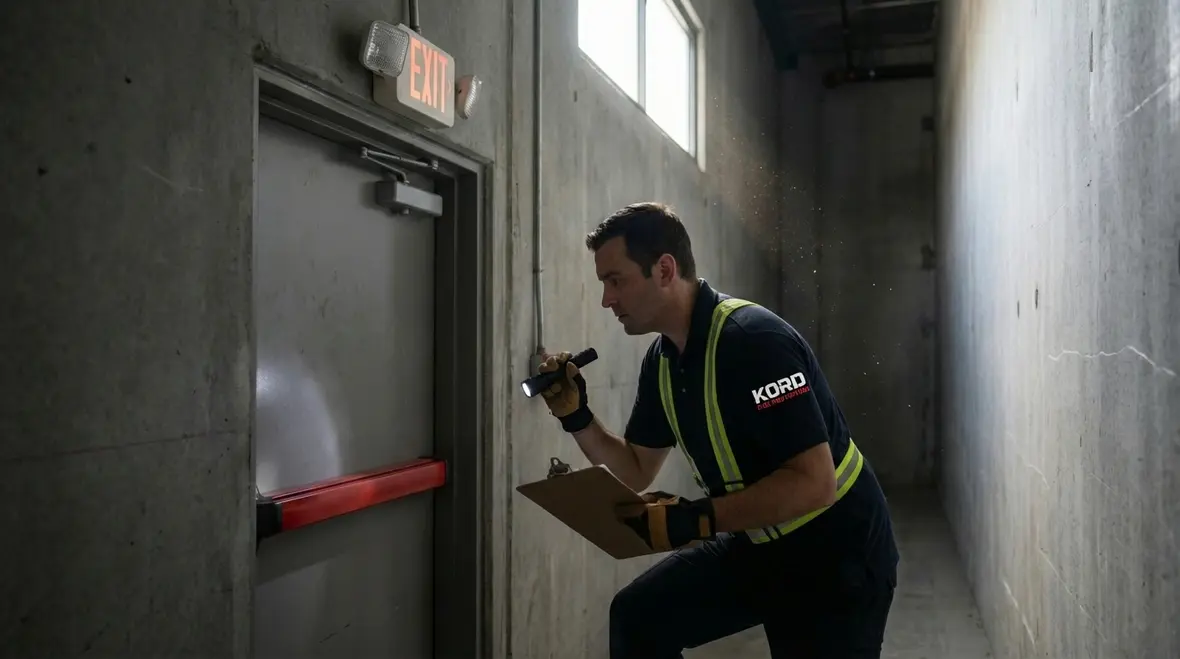
Kord Fire Protection technicians document hardware condition, signage visibility, emergency lighting tests, and door operation. Moreover, they review occupant load postings to ensure they match the current layout. Renovations often change square footage or function, which in turn affects exit capacity.
Because authorities having jurisdiction can request records at any time, organized documentation protects owners from fines and liability. It also demonstrates due diligence, which carries weight in post incident investigations.
Designing for Human Behavior, Not Just Code Books
Codes describe measurements and ratings. However, real emergencies involve human behavior. People do not always move in calm, orderly lines. They follow familiar paths. They hesitate. Sometimes they try to retrieve personal items, as if a laptop outranks fresh air.
Therefore, strong emergency egress planning considers psychology. Clear sightlines toward exits reduce confusion. Consistent signage reinforces direction. Training drills build muscle memory.
California places added emphasis on high rise evacuation procedures. Stairwell capacity, communication systems, and fire command centers support coordinated response. NFPA standards echo these concerns, yet California may layer additional seismic safeguards.
Kord Fire Protection technicians often explain that well designed emergency exit requirements anticipate stress. They remove guesswork so occupants can act quickly. In many ways, the best exit system is the one no one notices until it quietly does its job.
Common Compliance Gaps That Trigger Violations
Even well managed facilities can drift out of compliance. However, most issues fall into predictable categories.
Blocked or narrowed corridors
Furniture, displays, or storage reduce required width.
Improper door hardware
Non compliant locks or missing panic devices delay egress.
Inoperative emergency lighting
Dead batteries defeat backup systems.
Unapproved renovations
New partitions alter travel distance without review.
Missing exit signage
Remodels sometimes remove or obscure required signs.
Because California enforces its codes rigorously, these issues can lead to citations or occupancy restrictions. Aligning with NFPA alone does not guarantee local approval. Therefore, coordination with knowledgeable professionals remains essential.
Why Professional Guidance Makes the Difference
Although code books provide direction, interpretation requires experience. Fire marshals, plan reviewers, and inspectors evaluate unique building features that generic checklists may overlook.
Kord Fire Protection technicians bridge that gap. They translate technical standards into practical steps. For instance, they help owners calculate occupant load based on use, not guesswork. They also verify that stairwell enclosures meet required fire resistance ratings under both California amendments and NFPA guidance.
Moreover, they stay informed about updates. Codes change on regular cycles. What satisfied requirements five years ago may require modification today. Proactive assessments reduce the risk of surprise violations during inspections or tenant improvements.
In the end, emergency exit requirements protect more than property. They protect reputation, continuity, and most importantly, people.
Frequently Asked Questions
Take the Next Step Toward Compliance
Emergency exit requirements are not paperwork exercises. They are life safety commitments written into walls, doors, and corridors. California and NFPA standards work together, yet local amendments demand careful attention.
Kord Fire Protection technicians stand ready to review, inspect, and guide building owners through every detail. Schedule a professional assessment today and ensure every exit performs exactly as intended when it matters most.
Know Your Weapon Before You Fight the Flame
Kord Fire Protection is your go-to when it comes to all things fire protection. For over 20 years, we’ve been serving Southern California with the quality service and equipment to keep your home or business safe at all times. Our competitive prices reflect our unwavering commitment to protecting what matters most in the event of a fire emergency. Give us a call, send an email, or use that form!

Join Our Newsletter!
Get the latest fire safety tips delivered straight to your inbox From our Newsletter.


