Commercial Fire Pump Maintenance Checklist in Australia
Quick Answer: Reliable fire pumps depend on more than good intentions and an annual glance. A strong plan for Commercial Fire Pump Maintenance includes testing, inspections, pump curve checks, reliable power review, clean controllers, and prompt repairs. With the right schedule, facilities in Australia reduce downtime and stay ready when it matters most.
In many Australian facilities, fire pump performance quietly carries the whole emergency plan on its back. That is why Commercial Fire Pump Maintenance should not be treated like a box to tick. It needs steady, practical attention across the pump, jockey system, controllers, power supply, valves, and water supply conditions. And while some teams try to handle upkeep in-house, even capable operators can hit limits with testing knowledge, parts sourcing, and documentation. This is where Kord Fire Protection can become a vital partner. They help commercial sites stay compliant and dependable, not just “hopefully operational.”
For sites that want broader support beyond the pump room, Kord also offers full fire protection services that fit naturally into ongoing inspection, reporting, and readiness planning. When the pump is treated as part of the bigger life safety picture, maintenance becomes a lot more useful and a lot less theatrical.
What makes commercial fire pumps fail when no one is watching?
Fire pumps rarely fail in dramatic fashion at the exact wrong moment. Instead, they decline slowly, like a phone battery that “still works” until it does not. Common causes include corrosion, air or debris in suction lines, valve positions left wrong after maintenance, controllers drifting out of calibration, and power interruptions that look harmless during normal operations.
Additionally, water supply changes can impact performance. For instance, a small underground leak or a shift in municipal supply pressure may not show up during routine days. However, during a demand event, the pump must deliver the right flow and pressure. If it cannot, the whole system struggles. Therefore, effective Commercial Fire Pump Maintenance focuses on early detection, not late blame.
That is also why experienced teams do not judge system health based on one clean-looking inspection alone. A neat room can still hide a tired controller, a sticky valve, or suction conditions that are one bad day away from becoming everyone’s problem. Good maintenance assumes hidden issues exist until testing proves otherwise.
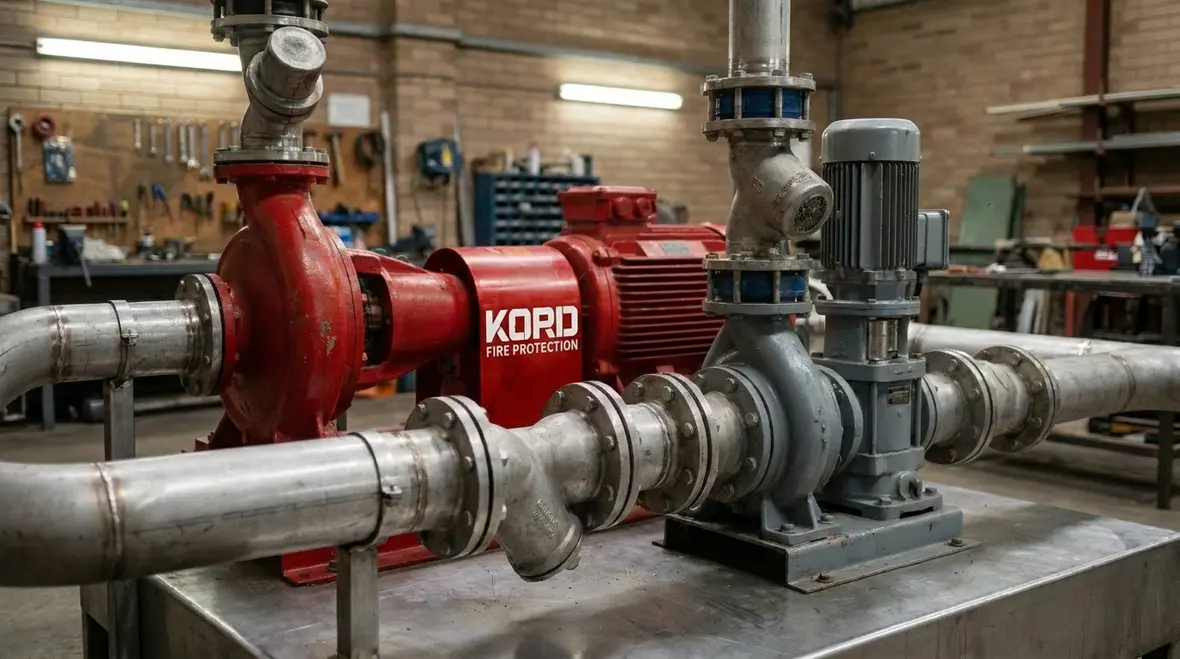
Commercial Fire Pump Maintenance checklist that actually holds up in real life
A maintenance plan needs structure, but it also needs realism. Facilities that run 24/7 operations cannot wait weeks to discover something minor became expensive. So the best teams use a checklist approach that covers the full chain of performance.
Core items every practical checklist should include
- System inspection: confirm labels, access, clearances, and that alarms and indicators make sense
- Controller checks: review status, set points, fault history, and ensure no abnormal controller drift
- Pump alignment and condition: check for vibration, wear patterns, and coupling condition
- Impeller and casing: inspect for deposits, corrosion, or damage that can reduce efficiency
- Seal and packing performance: watch for leaks and abnormal temperatures that signal trouble
- Valve position and operation: verify suction and discharge valves move correctly and remain in the required position
- Electric motor and power: check terminals, insulation condition, phase balance, and protective devices
- Diesel engines and fuel systems if installed: check readiness, fuel quality, and routine starting capability
- Acceptance and performance testing: ensure test results match required pump curve performance
When teams keep this approach consistent, reliability improves. And yes, someone will eventually forget to recheck a valve position. That is why the checklist must be boring on purpose. Boring beats chaos during an emergency. Kord Fire Protection supports facilities by helping them maintain documentation, schedules, and practical test standards that inspectors expect across Australian sites.
It also helps to separate the checklist into daily awareness, scheduled inspections, and deeper performance verification. That way, operators are not treating every task like a major shutdown event, and specialists are not wasting time rediscovering the obvious. Simple structure keeps the work repeatable, which is exactly what you want when reliability is the goal.
How routine testing protects the whole system, not just the pump
Many operators think a fire pump is a standalone machine. In reality, it is the heart of a network. That means routine testing needs to look at how the pump interacts with the rest of the fire protection system. For example, a jockey pump that cycles too much might mean leaks or an air issue. Meanwhile, a pressure switch response that seems slightly off can signal a sensor drift.
Testing points that reveal hidden trouble early
- Start reliability: the pump starts promptly when commanded
- Staging logic: controllers transition correctly between modes
- Pressure maintenance: stable pressure at the required flow
- Alarm and signals: annunciation works and communicates to the right panels
- Air and water flow behavior: the suction and discharge lines respond as intended
Because the system works together, testing reduces the chance of hidden failures. It also helps the facility prove readiness. Kord Fire Protection’s role can be especially valuable here, since test results, corrective actions, and reporting must align with operational expectations across industrial, retail, and facilities environments in Australia.
Sites that already maintain related systems such as fire alarm service systems often benefit from linking those records and observations with pump testing results. If alarm signals, controller events, and pump behavior are reviewed together, weird patterns stop looking random and start looking fixable.
This is the part where maintenance stops being paperwork and starts being intelligence. You are not just proving the pump started once. You are learning how the system behaves under pressure, which, to be fair, is when most equipment reveals its true personality.
Why valve care, suction conditions, and water supply matter
It is easy to focus on the pump body and motor. However, the suction side often tells the most honest story. If the suction line collects debris, or if strainers clog, the pump can lose performance when demand spikes. Similarly, a valve that is technically “open” but not fully open can create a restriction that no one notices until a real event.
Suction and valve checks worth taking seriously
- Suction strainers: keep them clear and ensure they sit correctly
- Suction pipe integrity: look for air ingress, corrosion, and fittings loosening
- Check valves: confirm they prevent backflow and do not stick
- Discharge valves: verify positions and smooth movement during inspections
- Water supply conditions: monitor changes that could affect pressure and flow
Additionally, maintenance should consider what happens after repairs. If a tech replaces a component, the system should be tested to confirm performance. In other words, do not assume the “fix” fixes everything. As pop culture would say, the plot twist is often hiding in the details. Kord Fire Protection helps coordinate these checks so facilities can keep confidence, not guesses.
Even something as basic as sediment buildup or a slowly deteriorating fitting can create a performance gap that only appears during high demand. That is why water path components deserve the same respect as the motor and controller. A pump can only work with the supply conditions it is given, and physics is not known for being flexible.
Controller health and power reliability for dependable starts
Even a well-maintained pump can struggle if power or controls misbehave. Therefore, Commercial Fire Pump Maintenance must include controller and electrical review as a routine practice, not a reaction to faults.
Controller and power items that deserve regular review
- Event history: review faults, warnings, and start attempts
- Set points: confirm parameters match the site’s requirements
- Battery backup: when applicable, keep it healthy so signals stay reliable
- Motor protection devices: verify they operate correctly
- Terminal integrity: inspect for corrosion, looseness, and overheating
- Phase and supply stability: check for imbalance or voltage dips
By handling these items proactively, facilities reduce nuisance faults and emergency failures. And if a controller shows a pattern of intermittent issues, the facility should address it early. It saves time, reduces downtime, and prevents last-minute scrambles that everyone hates.
This is also where documentation earns its keep. Repeated warnings, odd resets, or recurring dips might look minor in isolation, but together they tell a story. If nobody records the story, the same mystery keeps showing up in steel-toe boots every few months.
How Kord Fire Protection supports dependable maintenance across Australia
Commercial operations rarely allow long shutdown windows. Plus, each site has its own risk profile, access constraints, and reporting needs. Kord Fire Protection can become a vital partner by aligning maintenance work with real facility schedules and inspection expectations across industrial, retail, and multi-facility environments.
What that support can look like in practice
- Planned maintenance coordination: schedules that reduce disruption
- Testing and reporting: clear records that support compliance and readiness
- Corrective actions: fast responses when performance or condition issues appear
- System-wide mindset: focus on the network, not only the pump
- Knowledge transfer: helping facility teams understand what the results mean and what to watch
So instead of “maintenance as a gamble,” facilities gain a dependable routine. And yes, unlike a certain famous detective, you do not need to “eliminate the impossible.” You just need consistent checks. That is the whole game.
That practical support matters even more when a facility manages multiple systems, multiple contractors, or multiple sites. A partner that understands inspections, service sequencing, and readiness documentation can remove a lot of friction before it turns into expensive delay. Calm, organized maintenance is not flashy, but it ages much better than chaos.
FAQ: Commercial fire pump maintenance
Final word: schedule your next inspection before your next emergency
Commercial fire pump reliability does not happen by accident. It requires clear procedures, routine testing, and prompt corrective work so the system performs when demand arrives. If your facility needs Commercial Fire Pump Maintenance that fits real operations, Kord Fire Protection can help.
Book a site assessment today and turn uncertainty into documented readiness that protects people, assets, and your business reputation. The best time to schedule the next inspection is before the next emergency gives you a very rude reminder.

Join Our Newsletter!
Get the latest fire safety tips delivered straight to your inbox From our Newsletter.