Automatic Suppression Integration for Data Center Fire Safety
In a busy facility, data center fire safety can not be an afterthought. It has to work with the power system, the cooling plan, and the way technicians run alarms and shutdowns. That is exactly where automatic suppression becomes practical in a data center’s fire suppression toolkit. We’ll jump in and explain how suppression systems fit into existing data center power grids without creating new risks, new downtime, or surprise expenses. And yes, they do it with patience, because the only thing that should be fast in a server room is the network, not the fire drill.
Why automatic suppression belongs in live power environments
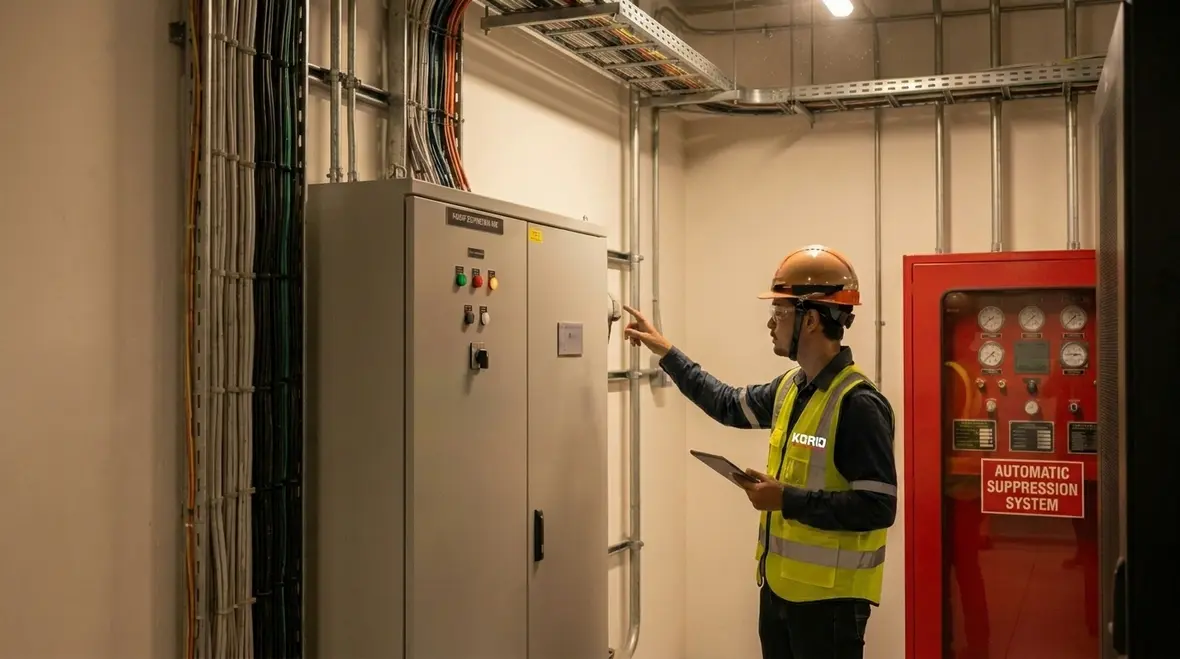
Automatic suppression should not live in a separate fantasy world. It must align with how the power grid behaves during normal loads, partial outages, and staged shutdowns. When fire starts, electrical paths often remain active for short windows of time, especially if emergency power systems kick in. Therefore, a plan that only works after devices are shut down is not enough. Instead, teams map how power flows, how control circuits behave, and how the system will trigger in real time.
As we often put it, “If the suppression system can not understand the grid, it will guess.” And guesses in fire protection are like Wi-Fi in a concrete bunker. Sometimes it works, and sometimes you wonder why you paid for it.
So the first step is to treat the data center power grid like an operating system. Then the suppression design becomes part of that system, not a bolt on project. That same system minded approach lines up with Kord Fire Protection’s broader guidance on data center fire protection and NFPA 75, where critical environments are treated like mission critical infrastructure instead of just another electrical room.
The integration mindset matters
The practical point is simple. If suppression is designed without understanding live power behavior, everything gets harder later. Testing gets messier, handoff gets slower, and operations staff stop trusting what they are seeing. In a room built around uptime, that kind of confusion spreads faster than rumors during a surprise maintenance notice.
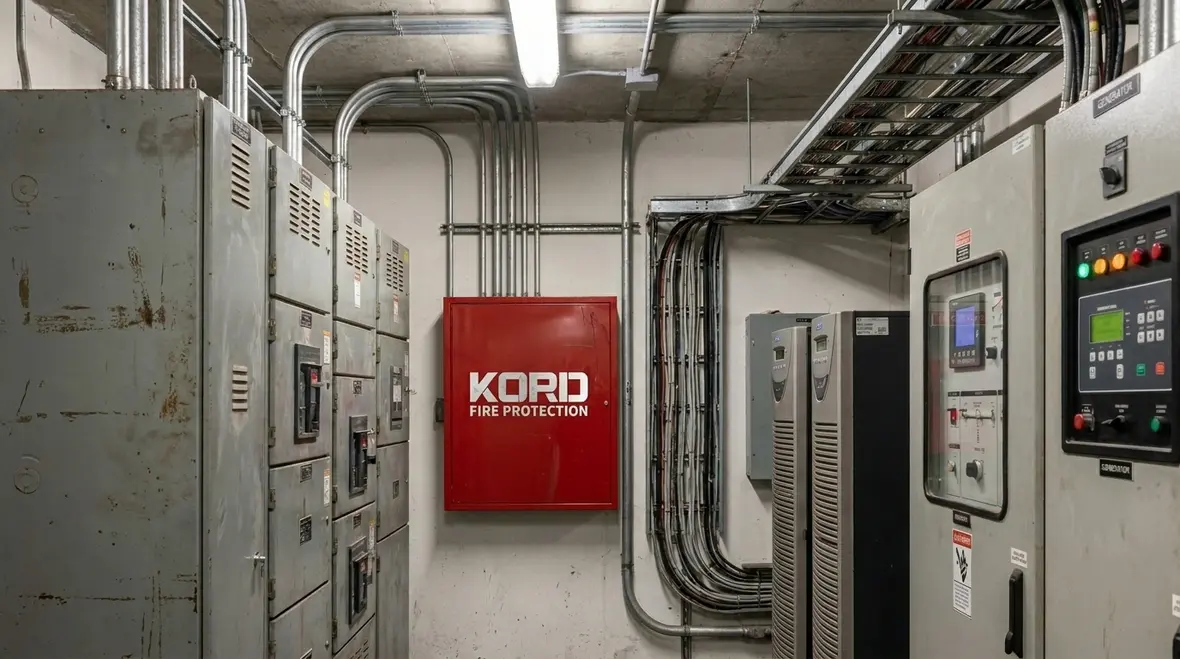
Integrating suppression controls with switchgear, UPS, and generator logic
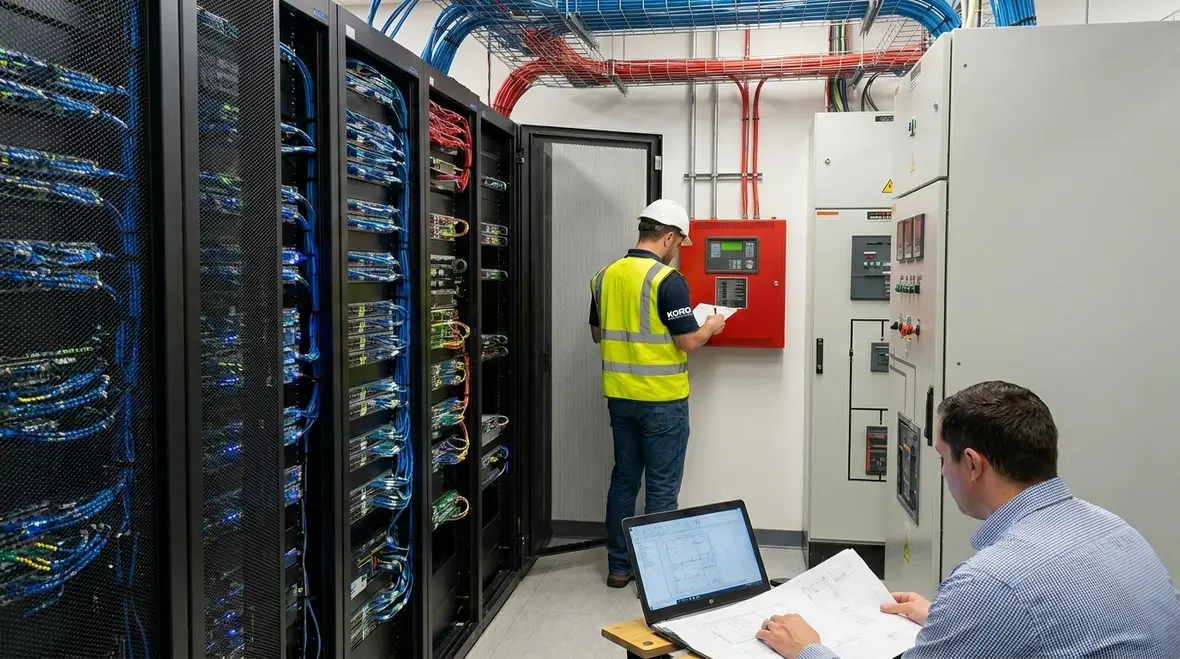
Most existing data centers already have layers: switchgear, UPS units, and backup generators. Those components decide what stays powered and when. Consequently, suppression integration must consider how alarm signals and releasing circuits route through that architecture. Teams also look at fault behavior. For example, a short circuit in one bay should not accidentally delay a release in another area, and a transfer to generator power should not reset critical control panels.
We typically verify these behaviors by reviewing as-built drawings and then testing the control pathways. They also confirm that fire detection signals and suppression release sequences follow the same logic under multiple power states. In simple terms, the system should trigger as designed whether the building runs on utility power, UPS, or generator power.
Finally, they document fail safe behavior. If a control circuit loses power, the suppression logic should still move toward safe action, not toward silence. That discipline also supports stronger data center fire code compliance, because reliability is not just about passing inspection. It is about making sure the system behaves the same way at 2 PM on utility power and at 2 AM during a transfer event.
What technicians look for during review
- Control pathways that stay stable across utility, UPS, and generator states
- Release logic that does not depend on one vulnerable branch circuit
- Interfaces that avoid resets during transfer events
- Documentation that makes future testing less dramatic and less guessy
Designing detection that triggers suppression without nuisance events
Fire safety fails when people ignore it. Therefore, the detection strategy needs to trigger suppression when it should, and avoid nuisance when it should not. In a data center, heat and smoke patterns can be tricky. Airflow patterns from cooling systems can move early byproducts fast. Also, some assets create light and heat that mimic early stages of trouble.
So technicians align detectors with the actual risk model for each zone. They consider cable trays, airflow paths, equipment density, and historical hot spot data. They also coordinate detector types with suppression release timing. For instance, if the suppression agent needs a certain travel time or concentration stability, the release sequence must match that window.
Detection has to follow the room, not assumptions
Server rooms do not behave like normal rooms. Air moves differently, heat stacks differently, and hardware layouts change over time. That is why Kord Fire Protection’s guidance on data center fire prevention strategies keeps pointing back to risk based placement. If the detection plan ignores the way the room actually breathes, then false alarms and delayed response both become much more likely.
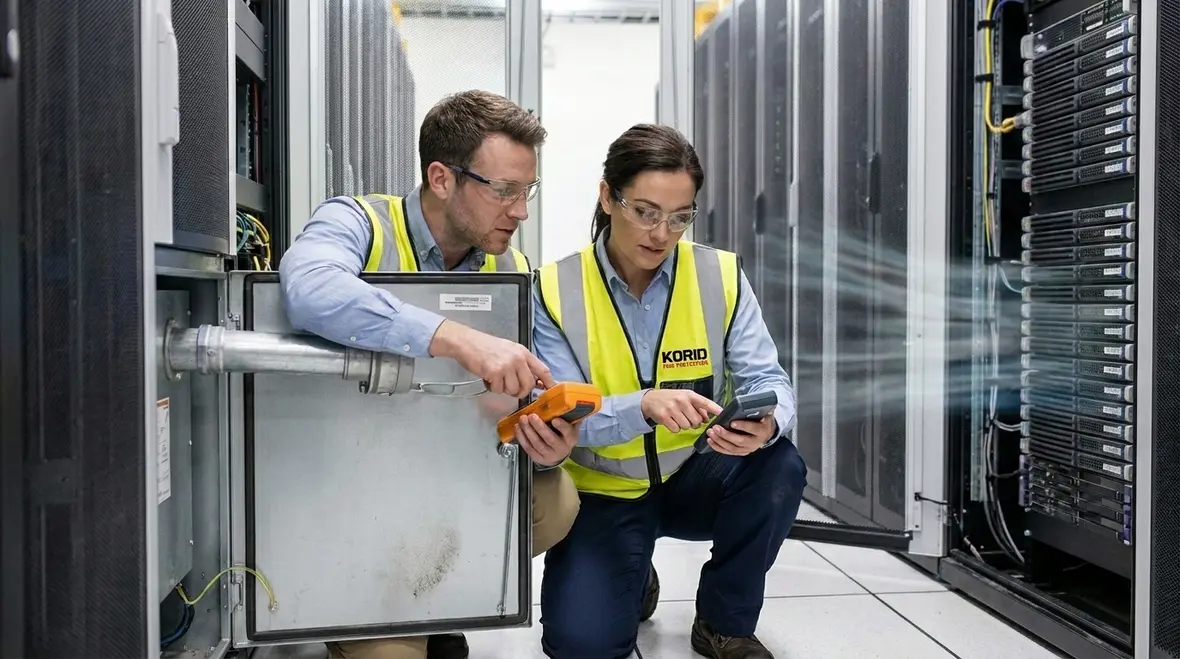
Coordinating releasing circuits with electrical safety standards
When suppression integrates into an existing power grid, electrical safety can not be optional. Technicians confirm that releasing circuits remain isolated where required, protected from unintended activation, and consistent with the site’s control philosophy. They also verify wiring routes through trays and conduits so the system does not expose crews to unsafe conditions during maintenance.
Next, they review supervision methods for circuits. Many facilities use supervised wiring to detect faults early. However, power disturbances can create weird signals. Therefore, the design needs good labeling, proper grounding, and clear separation from high voltage pathways.
In practice, technicians often use a structured approach. They start with the suppression panel requirements, then map each circuit to the existing electrical plan. After that, they plan for inspection and testing in a way that fits maintenance windows. Nobody wants a schedule that makes the operations team say, “Great, another shutdown, because that is what we needed.”
Planning for power state changes during upgrades and retrofits
Retrofitting into an active data center power grid requires careful sequencing. Crews may upgrade switchgear sections, swap UPS batteries, or change generator transfer settings while the facility stays online. That means suppression components must be installed so that temporary conditions do not break the fire safety chain.
So teams create a staged plan. They isolate work areas, protect existing circuits, and verify system integrity at each step. They also confirm which portions of the suppression system remain active during the retrofit. If a detector zone needs to be taken offline, crews coordinate that state change with monitoring and response procedures.
Just as importantly, they define what happens during testing. That includes how the system handles supervisory alarms and how operators receive notifications. We emphasize communication. They align with facility leadership, security, and the electrical contractor so that a test does not look like a real incident to the people who must respond.
Retrofit work needs staged control, not crossed fingers
This is where a lot of projects either feel smooth or feel cursed. When staged work is mapped clearly, operations teams know what is active, what is impaired, and what the response path looks like. When it is not mapped clearly, everyone starts relying on memory, hallway conversations, and optimism. That is not a life safety strategy. That is a group project with expensive consequences.
Training teams and writing procedures that operations can actually follow
Even a well engineered system can fail if people do not use it right. Therefore, training becomes part of the integration work. Technicians help operations staff understand alarm meanings, expected shutdown behavior, and how suppression events interact with power stability.
They also cover common questions. For example, what happens to critical loads when the system releases. How does the UPS continue during specific stages. Who authorizes manual reset. And what maintenance tasks require system verification. Training should feel clear and calm, not like a test you did not study for.
Kord Fire Protection often use real facility scenarios so the team can practice decision making. Then they help write procedures that match the site. Because nobody wants a binder full of pages that read like mystery novels. They want steps that work.
Implementing with a clear checklist for data center fire safety
Successful integration follows a repeatable path. The goal is to reduce uncertainty and keep the system dependable across multiple power conditions. Teams typically move through these checkpoints:
- Review as built electrical and control drawings, including UPS, transfer switches, and switchgear zones
- Map detection and control circuits to the existing power logic and supervision behavior
- Validate releasing circuit fail safe behavior under utility loss, UPS operation, and generator transfer
- Confirm detector placement and sensitivity based on airflow, equipment density, and cable layout
- Test with a staged approach that fits uptime needs and defines alarm handling during work
- Train operations and security staff so they can respond without guessing
- Document every integration step, including labeling and maintenance verification points
Where clean agent systems fit into the bigger picture
For many facilities, the discussion eventually leads to agent selection and discharge strategy. Kord Fire Protection’s data center clean agent fire suppression guide helps connect that decision to the rest of the system, so teams are not choosing hardware in a vacuum. The right agent matters, but so do the controls, timing, room conditions, and the way operations staff respond once the alarm sequence begins.
FAQ
Is your current setup ready for a real integration?
If the data center is running on multiple power paths, then the suppression plan must match those realities. Kord Fire Protection can evaluate your existing controls, confirm circuit behavior during UPS and generator transitions, and help you build a staged upgrade approach that protects uptime and people.
Reach out for an on site review and a clear integration roadmap for automatic suppression to further bolster data center fire protection. Then you can stop hoping, start testing, and keep your server room calm enough to focus on work, not panic. To explore a local service option, visit Corona Fire Protection Services and connect with Kord Fire Protection about your facility’s next step.

Join Our Newsletter!
Get the latest fire safety tips delivered straight to your inbox From our Newsletter.