
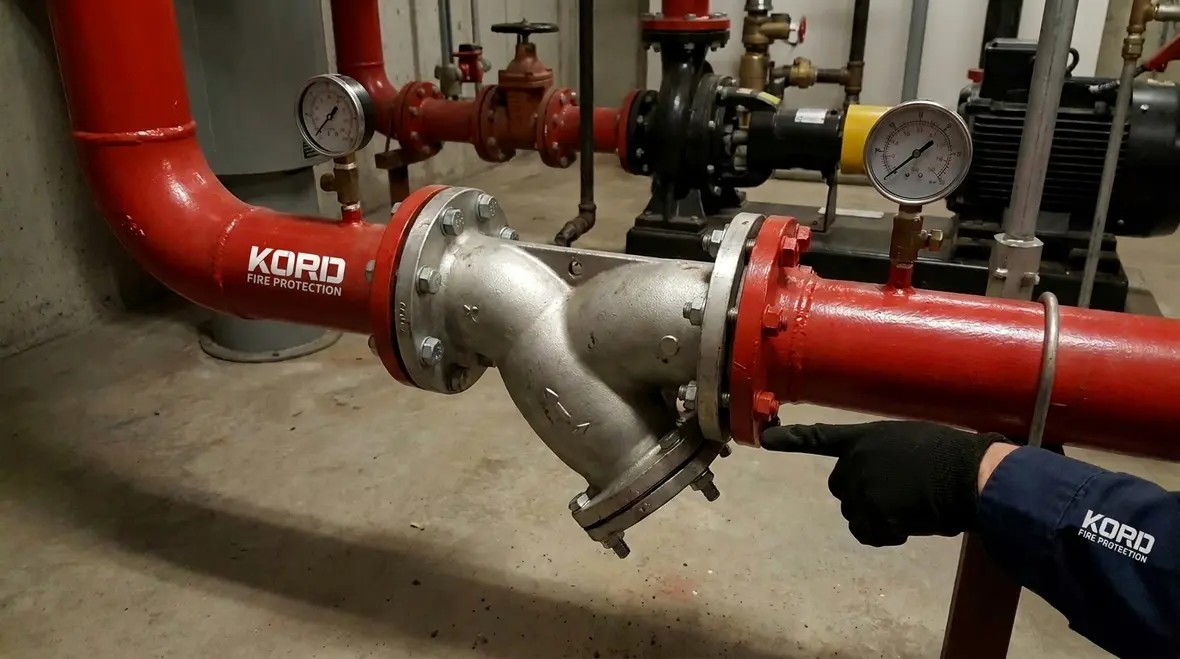
NFPA 16 Section 7.5: Strainer Installation Requirements for Foam Systems
Quick Answer
NFPA 16 Section 7.5 focuses on how foam systems must protect foam concentrate flow and downstream proportioning devices through properly designed and correctly installed strainers. Compliance depends on correct placement, strainer sizing and maintenance access, and verified performance through inspection and testing.
Facilities reviewing these requirements often also benefit from a broader look at foam fire suppression inspection requirements and service to connect strainer installation details with real inspection and maintenance workflows.
What does NFPA 16 Section 7.5 require for foam-water strainer installation?
NFPA 16 Section 7.5 sets practical installation rules for strainers used in foam-water systems so concentrate dosing remains stable and protected. For facilities addressing strainer installation requirements foam-water, the key outcome is consistent proportioning under real operating conditions, with strainers installed in a way that supports inspection, cleaning, and reliable flow. This matters in commercial, industrial, and retail environments where systems sit idle, accumulate debris, or run after long standby periods.
For a broader compliance framework, facility owners and fire protection teams often review the full NFPA 16 Standard to align inspection, impairment management, and testing expectations with foam system hardware requirements.
Where strainers belong in foam-water flow paths
Strainers function as the first line of defense against particulate contamination, scale, welding slag, and fibers that can obstruct small orifices and critical components in the foam system. In foam-water arrangements, strainers typically protect proportioning elements and downstream foam concentrate handling components by intercepting debris before it reaches precision orifice paths.
Installation location drives performance and maintenance outcomes
- Upstream protection: Install strainers where they will intercept contamination before concentrate meets any metering or proportioning mechanism.
- Consistent hydraulics: Maintain the system piping geometry so the strainer does not introduce unintended pressure gradients that can affect proportioning accuracy.
- Correct orientation and inlet control: Position strainers to promote stable flow and reduce bypass conditions that can lead to uneven contaminant capture.
Operational reality in commercial facilities shows that “correct location” must also consider how the system is actually used. A strainer installed in an inaccessible section of pipe leads to delayed cleaning, which increases pressure loss and can indirectly destabilize foam production during inspection testing.
How sizing and mesh selection affect foam-water proportioning
Strainer sizing is not a generic checkbox. The strainer must balance two opposing needs: capturing debris effectively while allowing sufficient flow with acceptable pressure loss during demand. Incorrect strainer selection can create a chronic reduction in flow to the proportioning system or can trigger frequent clogging.
Pressure loss is a common compliance failure point
When strainers accumulate debris, the upstream pressure rises and downstream flow drops. Even if the foam system “runs,” proportioning may change. That leads to foam-water mixing that fails to meet expected performance characteristics during discharge, acceptance testing, or operational evaluations.
Wrong mesh selection creates either bypass risk or clogging risk
- Overly coarse straining: Debris passes through and contaminates proportioning orifice features.
- Overly fine straining: The strainer clogs quickly, increasing pressure loss and impairing system discharge consistency.
Commercial and industrial owners often assume strainer mesh is interchangeable. Kord Fire Protection recommends treating strainer selection as an engineering and commissioning step, validated against system design intent and ongoing maintenance practices.
Installation workmanship: fittings, supports, and access requirements
Even when the correct strainer model is selected, installation workmanship can undermine compliance. NFPA 16 Section 7.5 requirements emphasize that strainers must be installed in a manner that supports inspection and cleaning without creating system hazards or long downtime.
Key installation practices that reduce failure likelihood
- Accessible strainer location: Provide practical access for removal, inspection, and cleaning without extensive disassembly of piping.
- Proper unions or flanged connections: Use connections that allow safe and repeatable servicing, reducing the temptation to “skip” maintenance.
- Secure mounting and alignment: Prevent strain, vibration stress, and misalignment that can damage sealing surfaces and gaskets.
- Correct sealing and gasket compatibility: Select gaskets and seals compatible with foam concentrates and water service conditions to prevent leakage and concentrate dilution.
A frequent field issue in retail and warehouse occupancies is the “installed but not workable” strainer. The device may technically be present, but maintenance personnel cannot safely remove the strainer screen or element within a reasonable maintenance window. That situation typically elevates impairment risk and leads to repeat deficiencies during inspections.
Inspection, cleaning, and proof of ongoing compliance
Strainers create an ongoing maintenance obligation. A strainer that stays clean provides predictable hydraulic behavior. A neglected strainer becomes a restriction that can alter foam-water output and reduce reliability.
Commercial compliance challenges to expect
- Debris generation: Pipe turnover, construction residue, and system water quality issues contribute to particulate loading.
- Seasonal or vacancy-driven delays: Idle equipment in retail back-of-house areas can sit for months, increasing the impact of initial debris.
- Maintenance gaps: Staff turnover or limited in-house expertise causes deferred cleaning schedules.
What Kord Fire Protection helps facilities manage
Kord Fire Protection supports foam system compliance through documentation review, targeted inspection planning, and maintenance alignment with the requirements of NFPA 16 and site operating realities. The goal is to keep strainer elements serviceable, ensure access remains practical, and reduce the probability of system performance surprises during testing.
If your team is evaluating broader upkeep needs, foam fire suppression system maintenance and testing is a useful companion topic because it ties installation details to what actually gets checked, cleaned, and documented in the field.
Common strainer noncompliance findings in the field
Inspection findings often cluster around repeatable causes. Addressing these early prevents costly rework and reduces the risk of failed foam system performance during discharge testing.
Typical deficiencies
- Inaccessible strainer assemblies: Devices located behind fixed obstructions or requiring unsafe access.
- Improper orientation: Installation that does not align with manufacturer flow direction and capture intent.
- No practical cleaning method: Screens or elements that cannot be removed and replaced without excessive downtime.
- Unknown strainer performance baseline: Missing records of what strainer size and element type is installed.
- Installation after modifications: Post construction piping work introducing debris without documented flush and strainer verification.
Facilities that treat strainer maintenance as a routine operational task typically see fewer impairment events and smoother audit outcomes. Teams that treat strainers as “set and forget” often encounter rising pressure drop trends and late-stage failures during scheduled foam testing.
Frequently Asked Questions
Next step: confirm your foam strainer compliance before the next inspection
Review your foam-water system’s strainer locations, element type, and maintenance access against NFPA 16 expectations. Then schedule a focused verification with Kord Fire Protection to document installation details, plan inspection and cleaning, and reduce the likelihood of performance shortfalls during testing. Contact Kord Fire Protection today to align your system with ongoing compliance and operational readiness requirements.

Join Our Newsletter!
Get the latest fire safety tips delivered straight to your inbox From our Newsletter.



